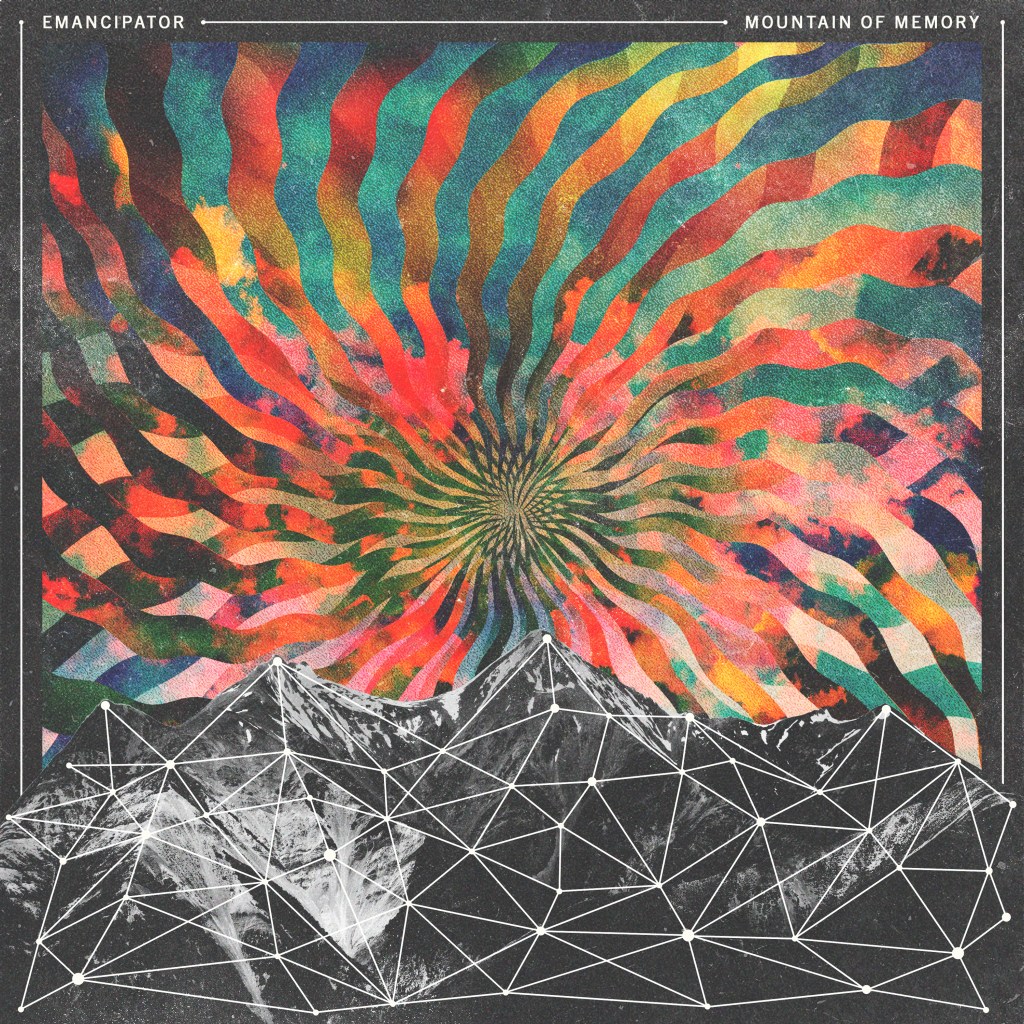
“The Painted Lady ft. Kishi Bashi,” lead single on 2026 Emancipator album “Chrysalis”
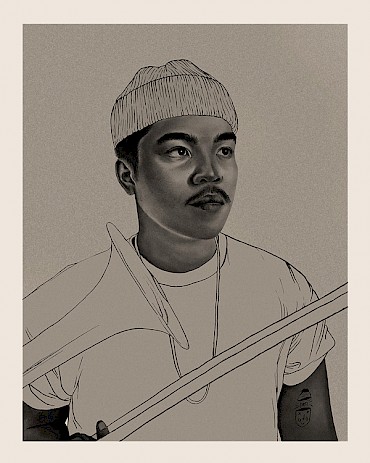
“The Painted Lady ft. Kishi Bashi,” the lead single on the upcoming 2026 Emancipator album “Chrysalis,” was released July 26, 2026. I play fiddle and mandocaster on the song. It’s the 6th Emancipator album and 14th song I’ve contributed to, and maybe my all-time favorite of the songs I’ve worked with Emancipator on.
I think great songs synthesize diverse cultures, and for me, the improv-composed, Irish-influenced fiddle and modal mandocaster on this song bring a lot up for me — and mad props to Emancipator and Kishi Bashi for their work! You can find the song on Bandcamp, Spotify, Soundcloud, Apple Music and other music artist/streaming platforms near you.
If you’re an artist/producer looking for some fierce stringz on a track, please reach out to me!
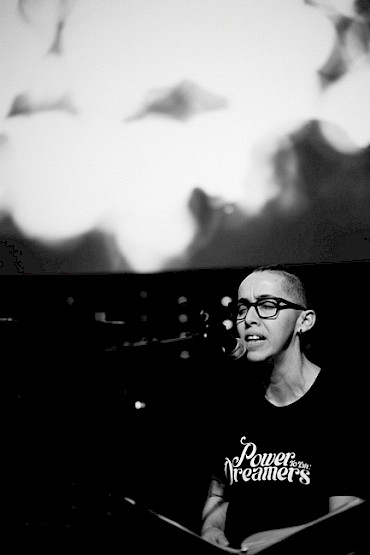
I was invited to play viola and violin with German electronic music producer Fejká (Brian Zajak) on a musical interlude called “Ways of the Sun.” It’s part of his 2025 album “Azur,” on the Coexist label.
It’s a small step towards continuing to develop my skills at recording violin, viola, mandolin and Fender Mandocaster in my modest home studio, and collaborating with amazing electronic producers like Fejká, Emancipator and several others I’ve been working with both here in the U.S. and internationally.
Here’s a YouTube link to the full album, “Ways of The Sun” comes in at 20:41. Check out the full album on your favorite streaming service, or maybe even do like I did and order the vinyl album!
As Walio Mohamed found herself shunted from the center of a terrifying attack to its margins, her world began to unravel
Thacher SchmidThacher Schmid is a writer, musician and social worker who lives in Oregon
January 17, 2024
Walio Mohamed at home in Portland, January 2024. (Leah Nash)
It was supposed to be a good day — two teenage friends out on a lark, a Friday afternoon trip to the mall. Walio Mohamed, who was 17, slung her book bag, stuffed with her high school planner and a copy of Jack London’s “Call of the Wild,” over her shoulder as she and Destinee Mangum, then 16, boarded a MAX commuter train in Portland, Oregon. The two laughed joyfully, heads leaning into each other — Mangum sporting a bejeweled cloth headband; Mohamed wearing a black cotton hijab.
They were having such a good time that they took the wrong train and ended up downtown. As they hopped on another line, a man held the door for them. It was 4:28 p.m. on May 26, 2017 — the moment Mohamed’s world tilted.
Inside the crowded car, the two friends found seats and settled in, “like nothing was happening,” Mohamed later told Portland police detective Michele Michaels. Then, “This guy just started talking.” Jeremiah Joseph Christian, a self-described Nazi and one of the large number of homeless people in Portland, was sitting just a few feet away, drinking sangria. He began ranting, Mohamed later testified, saying, “Fuck Muslims. Go back to Saudi Arabia. Kill yourself.” He raised a Bible. He looked scary, she said. Christian looked right at them and got louder. Mohamed and Mangum wordlessly stood and moved further down the car.
“That’s when he stood up,” Mangum recalled.
Three other riders, Taliesin Namkai-Meche, Rick Best and Micah Fletcher, stood up too, and positioned themselves between Christian and the girls. What happened next has become a kind of dark, ghastly legend: Christian lunged at the three men, stabbing them 11 times in as many seconds — a scene so gruesome one witness mistook the spray of blood for rain. Namkai-Meche and Best died. Fletcher barely survived, with severe wounds and what he later described as nightmares of sitting in a metal tunnel slowly filling with blood.
When the train stopped, Mohamed and Mangum burst out of the doors, running for their lives up a staircase before taking refuge in a gym bathroom. Christian fled too and was apprehended nearby. Shocked, and afraid of more trouble, Mohamed left without talking to police.
The crime made international news, and there was a global outpouring of support for the white men who put their bodies between Christian and the two teens. But the girl in the hijab, Mohamed, was largely written out of the story. She was treated as a witness rather than as the original target of Christian’s murderous violence, her name misspelled in police and court documents and by media from The New York Times and Wikipedia to Portland newspapers and TV stations.
Last summer, Musse Olol, president of the Somali American Council of Oregon, whom I interviewed in 2017 while covering the story for the Los Angeles Times, reached out to me and said Mohamed wanted to tell her story. I met her at Olol’s office, then at her modest apartment, with its “Inspire” poster on the wall.
Mohamed is the only victim of the attack who has never spoken to the media. She told me she has been “keeping everything in” for all these years. She said she is grateful to the three men who intervened, at such a staggering cost. For her, the crime became a turning point, even a cliff she fell off. Now 24, she is speaking out for the first time, she said, to share her truth and motivate others who have been targeted by hate, even as incidents are on the rise.
“Everyone should have given her the opportunity to speak on day one,” Olol said. Mohamed, her attorney Henry “Chip” Lazenby told me, “should have been a part of the story, so that people are starting to say, why did this racist thing happen in the first place?”
Donations to five crowdfunding campaigns for the victims totaled $1.6 million, yet Mohamed said she received only about $15,000.
“It’s understandable why we got what we got,” said Asha Deliverance, Namkai-Meche’s mother, “but why didn’t they get money, too, is the big question.”
But this is not fundamentally a story about money. Examining what happened from Mohamed’s seat on the train — and in the days from then until now — means scrutinizing not only neo-Nazis and the far right, but also courts and cops, the news media and online fundraising. Perhaps above all, it means carefully considering what arrests and holds our collective attention, what doesn’t, and why.
“I was a victim before. I’m a survivor now,” Mohamed told me, her soft voice forming a rare edge. “But I have never seen myself as a witness.”
Walio Mohamed poses for a portrait at her home in Portland. (Leah Nash)
Namkai-Meche’s last words, Deliverance reminded me, were “tell everyone on this train I love them.” She described how her son’s final eight words touched people around the globe, with dance troupes using them as inspiration, and people intoning them as they prayed at the Pyramids of Giza and Stonehenge. “We got thousands of letters from all over the world from the Muslim community.”
On the other hand, she said, “There should have been so much more support for the girls.”
Christian verbally attacked the girls, and murdered and severely injured the men, during the era of what was informally known as the “Muslim Ban,” and formally known as Executive Order 13780, created by former President Trump. The order barred entry into the United States to all nationals from Iran, Libya, Somalia, Sudan, Syria and Yemen — each a Muslim-majority country. Trump unapologetically spouted Islamophobic rhetoric throughout his presidency, saying, among other things, “I think Islam hates us,” the “us” being the U.S., which at the time had 3.45 million citizens who were Muslim.
So the attack touched an already raw nerve among Muslims as Ramadan began, adding to the rise in anti-Muslim hate incidents that Islamophobia scholars have said began during Trump’s presidential campaign. The Portland attack left a crater, hate crimes expert Randy Blazak said: “It’s wide in terms of the impact, and it’s deep in terms of how long it lasts.”
It’s easy to understand why so many from the global Muslim community were moved by the actions and sacrifices of Namkai-Meche, Best and Fletcher, and met that sentiment with financial support. In the context of Trump’s Muslim Ban and the ratcheting up of Islamophobia of that era, here, finally, were white men who cared enough about Black Muslim women that they put themselves in mortal danger to stop them from being harmed. They did what few white people in America, and few white Westerners elsewhere, are willing to do for Muslims or Black women.
They were not “white saviors” — a notion described by various thinkers and writers as white people descending upon impoverished brown and Black people around the world, enjoying the emotional fulfillment of having “helped” such people (whether or not that help was sought, and whether or not it was actually helpful), all while putting their own well-being on the line as little as possible. They did not go out in search of someone to help; they were bystanders. And at exactly the right moment, they put their bodies and lives on the line. They did what Black and brown activists have been calling on white people to do for decades, rather than white saviorism.
And yet, as much as the three men themselves intended to prevent harm from coming to the teens, a different kind of harm came to Mohamed in the aftermath. Even as the story went viral, Mohamed’s part in it was missing or marginalized. When her name did appear, in police reports, for example, and in court documents and dozens of media outlets, it was misspelled, sometimes as “Walia Mohamed,” others as “Walia Mohammed.” She is also mistakenly listed as aged 21 in a police report — which would have made her an adult, rather than a child, targeted by Christian’s violence. Police have said they don’t know why. “I don’t think they cared, to be honest,” Mohamed said. Although she is listed in court documents as a victim of intimidation, a second-degree misdemeanor, Mohamed says she was treated across the board as a witness to the crime, not one of its victims.
“It’s very simple: She’s a Black immigrant kid,” said Amina Afrah, manager of the Somali American Council of Oregon. “If this would be a white kid, this would be a completely different case.”
The media “focused more intently on the savagery of the attack and the deaths of the white heroes,” Lazenby, Mohamed’s lawyer, said, rather than interrogating the motivation for the crime or asking, “What can we do to make this a more inclusive and less violent place for people like Walio? That just fell off the map.”
Sins of omission are harder to track — and in this case, what is omitted is attention and curiosity, themselves subtle and hard to pin down. Yet where our attention is not often tells us more about our collective moral compass, which humans we count as worthy of care and which we do not, than where our attention is.
Mohamed’s family fled Mogadishu for Cairo, Egypt, when she was very young, after her parents separated. Many of her memories of Somalia revolve around being her daddy’s girl, she told me, and her father’s striking, protective presence. He was very tall, with a full beard and dyed red hair. He “spoiled me with candy,” she recalled. He did not leave with the family for Egypt, Mohamed recalled, instead moving to Saudi Arabia. He later died.
In Cairo, the family of seven shared an unfurnished, ramshackle home in one of the city’s poorest neighborhoods with several cousins. “It was hard raising us,” Mohamed recalled; her mother didn’t have much money or support. Some days they ate only one meal. “I think I got used to it over time, like this is how life is.” She quickly realized that there wasn’t room for childish caprices; she understood that when her mother spoke, “I have to listen, be obedient.”
When Mohamed was six, her family were resettled to the U.S. as refugees. When they landed in New York City, she was dazzled. “I remember the big lights and stuff,” she said. “I was like, ‘Oh my God, mom, this is where we’re going to stay?’ She was like, ‘No, we’re just waiting to go to Portland.’”
The lights of Portland didn’t shine as brightly for Mohamed and her family. The largely homogeneous city’s historically poor treatment of Black people — in the early 20th century the Ku Klux Klan paraded and met with the mayor, police chief and the U.S. attorney; in the decades since, there have been waves of displacement — had created small pockets of Black and immigrant neighborhoods. Mohamed found herself living in a small but growing Somali community: Before the beginning of the Somali civil war, in 1990, just 2% of African immigrants in Portland were Somali. By the time she arrived in 2007, they made up nearly one-third.
A year after they arrived, the family moved into a subsidized apartment in North Portland, in the state’s largest low-income housing community. Mohamed attended Rosa Parks Elementary as a first grader, speaking rudimentary English. One girl picked on her, she recalled, but Mohamed sidestepped conflict. She studied, got good grades and was devoted to her family.
Mohamed always had a sweet personality and smile on her face, recalled Hodan, a lifelong friend from Somalia. (We have given Hodan a pseudonym to protect her privacy.) She always wanted to play outside, go to a park; the pair played princesses and cavorted in shopping carts.
As a teenager, Mohamed enjoyed posting pictures and connecting with friends on social media and was fond of Dutch Bros. coffee. She was obedient, hardworking and enmeshed in her family, Hodan said. Mohamed was “disciplined, like ‘I need to finish my chores and then I can go play.’ All the elders loved her.”
On Sept. 20, 2012, at the age of 13, Walio Abdirahman Mohamed became a U.S. citizen. In her Certificate of Citizenship photo, she wears a red headscarf and a denim jacket. Her expression is bright, open, her two front teeth prominent. Soon after, the family moved to an East Portland cul-de-sac, near Destinee Mangum, whom she would soon befriend.
The two met at David Douglas High School when Mangum was a freshman and Mohamed a sophomore. When Mohamed began dating Mangum’s brother, Damarion Irby, Mangum said, “She would literally jump the gate just to come hang out with us, because her family didn’t really approve of her being with my brother.”
The relationship with Mangum and Irby became a key to Mohamed’s identity formation in her adopted country and culture. “People say I’m Americanized, because I always used to go hang out with African Americans,” Mohamed said. “I feel like at that time my culture was strict and I just didn’t like it. I just wanted to feel at least a little freedom — to do things that made me happy.”
On May 26, 2017, America showed Mohamed its darkest side. As news of the attack spread, Mohamed said her mother hid her away, then sent her to live with a family member she barely knew in Minneapolis, perhaps feeling her daughter would be safest in the nation’s largest Somali immigrant community. That “was a bad idea,” Mohamed added, brushing tears away with her thumbs. “I was losing it, I was by myself, I was like, ‘I’m not going to stay here.’”
Olol, the director of the Somali American Council of Oregon, saw generational differences after the attack. “When I went there she was running a very full house,” Olol said of Mohamed’s mother. “She did not quite understand what was going on.” The family, Olol added, did not comprehend the trauma, or its impact on Walio, instead telling him, “‘No, we’re going to send her to Minneapolis, she’ll have a vacation, and she’ll be OK.’”
Mohamed’s mother eventually returned to Somalia and could not be reached for this story. Mohamed’s sister did not return phone calls; her stepfather also declined to be interviewed.
Mohamed’s family took away her phone, Mangum said, but “We snuck her a phone so that she could contact us.” Three Snapchat selfies Mohamed shared with me from her time in the Twin Cities show her wearing plastic flowers around her hijab, a baseball cap and hooded sweatshirt, henna on her hands. The images are digitally altered to add furry animal ears, but Mohamed’s facial expression is jarringly vacant, with no hint of a smile.
Mohamed became “quiet — very low spoken,” Hodan recalled. In a phone call between them after the attack, Hodan said she felt like, “I don’t think I’m talking to the person I know.”
When Mohamed returned to Portland, she moved in with Mangum, Irby and their mother, Dyjuana Hudson — who still refers to Mohamed as her daughter. It was a grueling, confusing time for the whole household. “Just trying to get them to eat every day was hard,” Hudson remembered. “She’s been hurt by the people that loved her the most.”
In the months after the attack, Mohamed’s isolation deepened. Her hijab became an ambiguous reminder of the horrors: She began wearing it less often, she said, because when she wore it, she saw the faces of the men who died. “She had to get rid of the hijab or anything that brought this trauma to her,” Olol said. She stopped wearing it, and stopped going to the mosque, but other parts of her faith clung to her. Hudson fasted sometimes with Mohamed during Ramadan and tried to make their home comfortable for her. Mohamed had panic attacks and was hospitalized.
Research on hate crimes shows that their victims tend to experience psychological symptoms such as depression or withdrawal, as well as anxiety, feelings of helplessness and a profound sense of isolation to a greater degree than victims of similar crimes not motivated by hate. According to a 2021 study in the journal Pediatrics, young adults who faced frequent discrimination “were around 25% more likely to be diagnosed with a mental health disorder and twice as likely to develop severe psychological distress than those who hadn’t experienced discrimination or did less often.” The American Psychological Association also notes that, “Hate crimes can lead to a wide range of mental health issues, including increased rates of depression, anxiety, suicidal ideation, post-traumatic stress disorder, and substance use.”
Even today, telling her story is hard because, Mohamed said, her memory was affected by post-traumatic stress. “I forget about certain things, because I don’t even, like, keep it on mind, because of how much it hurt me,” she explained.
That lapse of memory, the blank spots in what most would consider a vividly imprinted event, is a common experience among those with post-traumatic stress disorder. In his book “The Evil Hours,” writer and veteran Davis Morris explains that PTSD can include memory distortions, or a traumatic memory that “stands apart, like a feral dog, snarling, wild, and unpredictable.” After major traumas, “your mind works differently and your body has been altered.”
The trauma of the attack extended far beyond the lightning-quick stabbing on the train. In the weeks after Mohamed moved in with Mangum, anonymous hate found its way to the family — both Mangum and Hudson had done media interviews in the aftermath of the attack — and by extension to Mohamed. They were bombarded with threatening phone calls, social media messages and even packages delivered to their home. Lazenby recalled that the girls suffered stress and ulcers, and had to change phone numbers. Hudson tried to protect them, she said. At one point, a local TV station set up outside their high school, after the district announced where they attended, and proclaimed that, “The trauma is not theirs alone.” Hudson switched them to a different school, from which both graduated.
Even today, telling her story is hard because her memory was affected by post-traumatic stress. (Leah Nash)
While the vitriol of strangers had no trouble finding Mohamed, the generosity poured out by others did. The flurry of media stories about the attack triggered an avalanche of alms from Muslims and others across the globe — $1,633,400 via 34,613 donations, The Oregonian reported. Mohamed said she received a comparatively small amount, about $5,000 in gift cards and a $10,000 bank deposit, or about $15,000 total.
The unexpected medical expenses and funeral costs incurred by the three men’s families made them obvious recipients of the material aid donated by well-wishers in the aftermath of the tragedy. Less obvious to many was why the two girls who escaped from the train without a scratch would need money or other sorts of support. After all, wasn’t this a near miss for them, a victimization prevented, precisely because the men intervened?
Yet the trauma of the attack derailed Mohamed’s life, and the cost of a derailed life — whether from poverty, hospitalization due to mental health crisis, social isolation, struggles to hold down a job or finish school — is expensive. And money can be one of the things that allow someone to transition from victim to survivor, to heal and even thrive.
“How can she only get $15,000?” Olol asked. “Millions were raised. She should have enough money to finish her school.”
The largest campaign, “Muslims United For Portland Heroes,” was co-sponsored by the Muslim Educational Trust, a school, community center and mosque located in a Portland suburb. It raised $609,724 for the Best and Namkai-Meche families, plus Fletcher — but not Mohamed. Olol, of the Somali-American Council of Oregon, claimed Wajdi Said, the trust’s executive director, “promised” him Mohamed would be included. Said refuted that claim, adding that the “heroes” and their families were always the intended beneficiaries.
“We didn’t know anything about Walio Mohamed,” Said said. “We tried to reach out to her, and we got blocked.” Asked to clarify, Said declined further comment.
Another of the major fundraisers was for Micah Fletcher’s recovery. Fletcher declined to comment for this story, but in 2017 he spoke out about Portland’s “white savior complex,” and urged people to give to Mohamed and Mangum. “This is about those little girls,” he said.
It may never be clear what happened to the money meant for “those little girls,” collected by YouCaring.com in another major campaign, “Girls who survived Portland’s MAX Attack.” It was organized by Lydia Grijalva and raised $149,329 from 4,248 donors for the teens, but Mohamed’s name does not appear in it. Grijalva, Hudson, and Mohamed all have different memories of what happened after the money was collected. Grijalva claims she gave all of the money to Hudson, for Hudson to distribute to the two minors in her care; Hudson claims she gave part of the money to Mohamed and with the rest paid for the girls’ every need. Mohamed remembers only receiving $15,000, though acknowledges this is an estimate, and that her memory from that time understandably has gaps in it.
What is clear is that the lion’s share of the funds raised went elsewhere, and what did come Mohamed’s way was controlled by others. Mohamed expressed gratitude for the help and support she got from Hudson, Mangum and Irby. “They were there for me,” she said. But when it came to interest and care from the broader community, the vast majority went elsewhere.
In an ongoing civil court case, $20 million is demanded by the Best and Namkai-Meche families in a lawsuit scheduled for a jury trial in 2024. They sued transportation agency TriMet and the City of Portland, asserting that the train operator, transit officers and police officers should have done more, including arresting Christian when he injured a Black woman named Demetria Hester in an attack that also originated with hate-filled rants on the train, a day before his triple stabbing.
“I feel like the girls should have at least been a part of that,” Hudson said of the joint lawsuit. “But once again, they’re not.”
Lazenby, Mohamed’s pro bono lawyer, who operates out of his home office without a staff that could handle a complex litigation, said he reached out to some of the best plaintiffs’ case firms in town, “and laid [the girls’] case before them, and there were no takers.” He’s seen far more specious claims brought, he said, yet one white-shoe Portland law firm told him the girls’ case was weak “because they didn’t even get blood spattered on them.”
Despite it all, Mohamed is on the mend. (Leah Nash)
That lack of financial support hit especially hard when, six months after the attack, Mohamed became pregnant with Irby’s child. The news furthered the rift between Mohamed and her family; once she told her mother, she “didn’t want nothing to do with me,” Mohamed said. “Everyone in the neighborhood was talking about it,” she added. “It caused her stress.”
Having a child out of wedlock — and with an outsider no less — “is completely a no-no in our culture,” Afrah, of the Somali American Council, said. But Mohamed was also “adamant about not reengaging with her family,” Lazenby recalled.
After the birth, Mohamed and her baby girl moved into a low-income subsidized apartment near where she first landed in the city as a young girl after leaving Africa. It was a lonely time, she said. Olol’s council was one of her few forms of support.
Too often in their culture and faith, Hodan said, “The blame goes back to the women.” Part of it, she added, is that many first-generation immigrants went through horrors too. “They migrated just to get away from the wars and have war trauma, but they’re not talking about it,” she said. “It passes down to their kids without them knowing about it.”
In the days after the attack, two Muslim therapists offered free sessions to Mohamed, Olol said, but her parents “did not understand the value of that, because we come from a culture that does not value counseling.” Somali elders often seek an imam over a psychotherapist, he added.
A Multnomah County District Attorney victim’s advocate referred Mohamed and Mangum to an older Black female counselor. Both women said it didn’t help. When she told the practitioner as much, Mangum recalled, “She got super offended … and told me, ‘Well, you can just stay angry the rest of your life, because you’re just a angry person.’”
Despite it all, Mohamed is on the mend. She lives in East Portland, in a neighborhood where many residents are struggling with poverty. But her apartment is near Olol’s offices and the home of state Sen. Kayse Jama, the first Muslim and first Somali in the state legislature, in a neighborhood Olol calls “Somali Street.” Mohamed is working as a caregiver, studying early childhood education, once again speaking “Somanglish” with her sister. Her apartment is filled with Minnie Mouse toys and the sounds of Rihanna and Beyonce. She wants to work with kids and run her own day care.
She has healed, and her name is proof of her healing. A first step came during her testimony in the 2020 trial that put Christian behind bars for life. She begins, “My name is Wa—,” exhales, stops. She starts over, weeping, but with a stronger voice.
“My name is Walio Mohamed,” she says. She wears a white Nike jacket and a black cloth tied over her red-tinted hair. She spells her name. Correctly. (Even after this, the Washington Post, CBS, Oregonian/Oregonlive, Willamette Week and The New York Times misspelled it.)
She has healed enough that she let me into her home, though I’m a 6-foot-tall, 200-pound white man with a ponytail, just as Christian was at the time of the attack.
Her treatment by powerful institutions remains a bitter memory, one echoed in recent news reports that suggest hate crime victims are often not considered worthy of attention. “There’s a bias within the system,” Jama told me. “I talk constantly to the Somali community and when people say they want to report a hate crime, often police departments don’t take it very seriously.”
Advocacy from people like Jama, and perhaps even the attack against Mohamed itself, have led to change, albeit glacially. It was unclear at first whether hate crime laws even applied to the triple stabbing case, but two years later, Oregon’s legislature passed a new law that made placing another person in fear of imminent serious physical injury a first degree bias crime and a felony. It included a new statewide hotline that collects bias incident data.
Calls to the hotline increased 74% between 2021 and 2022, according to a report by the Oregon Criminal Justice Commission; they rose higher still in 2023. It found that anti-Black bias is most frequent, but that underreporting is extensive. “If the data tells us anything, it tells us that this issue is going to be with us for a long time,” Jama said. “We have to be very serious, and we have to ensure that we support people who have been targeted for hate crimes.”
Mohamed depends on food stamps and occasional rent assistance, and doesn’t have a car or driver’s license. She lives near a light rail station, but uses it rarely; sometimes “her anxiety takes over and she has to step off,” Hodan said. Mohamed still does not wear her hijab, or go to mosque. But she is considering going back.
“It’s hard,” Mohamed said, “but I still have my faith in God. I still believe in Allah,” she added. Her voice fluttered on the final words. “It’s been a long journey … I’m getting there.”
She writes in a new yellow journal, words for her eyes only, which help her release her feelings. Sharing her story here is, in her reckoning, about letting go, personally, but also about reaching others targeted by hate, especially young Somali Muslim girls, who are still straddling worlds, and still being targeted. Olol mentioned a local Somali girl whose hijab was yanked off her head in class. School officials didn’t understand the significance, he said, after which the girl struggled with attendance and suicidal thoughts.
“You’re loved, and don’t let anybody try to tear you down,” Mohamed said she wants her fellow survivors to know. “Whatever situation it is, you can overcome it. Don’t give up. You deserve better. And you can do it. I believe in you.”
While largely undercounted by officials, the scale of homelessness in the United States appears to have grown significantly this decade. The pandemic brought eviction moratoriums, emergency hotel shelters, and a recommendation from the Centers for Disease Control and Prevention to halt removal sweeps, but those were temporary. Meanwhile, for complex reasons — but driven by structural factors like high housing prices and low wages — a majority of homeless people now live in unsheltered locales, like tents, vehicles, or shanties. Many cities and states have chosen to respond with a historic wave of sweeps, tows, bans, and new mass or outdoor shelters.
With Eric Tars as its legal director, the National Homelessness Law Center (NHLC) has served as a kind of legal conscience for the nation, hyperfocused on a mission of using the law to, according to its website, “transform fundamentally the landscape of homelessness and poverty in this country.” Founded in 1989, the nonprofit has issued reports on the nation’s growing homeless encampments and initiated the Housing Not Handcuffs campaign to draw attention to the criminalization of homelessness.
Tars’s father was born in a refugee camp during World War II — not only homeless but stateless. “He grew up in refugee camps in conditions that were, in some ways, better than what many people experience on the streets of America,” Tars says, “but with a lot of the same concerns about where he would be laying his head the next night.” This perspective within his family helped push the Georgetown University–educated attorney to take an unabashedly sympathetic point of view toward unhoused people. His analysis of the problem, however, is sophisticated and rigorous, reaching back decades to examine the New Deal and the Reagan Revolution, and weaving together racism, segregation, electoral politics, social trends, and the role of direct action.
If we would just prioritize housing as a human right, Tars argues, the U.S. wouldn’t just help hundreds of thousands — maybe millions — of houseless people. We’d improve city budgets. We’d increase public safety. And we’d transform how this nation treats people of color, our young and old, LGBTQ individuals, and those with disabilities.
Tars studied international human rights in Austria at the Institute for European Studies and the University of Vienna. He is a board member at the U.S. Human Rights Network and has also served as counsel of record in precedent-setting cases such as the 2019 Martin v. City of Boise decision of the Ninth Circuit Court of Appeals, which ruled that it is unconstitutional for cities to enforce anti-camping ordinances if there are not enough shelter beds for their homeless populations.
Tars spoke with me by phone from the NHLC’s headquarters in Washington, D.C. “I grew up with the sense that I had been given a lot of privileges just by being born into the place where I was, in suburban America, and that other children are born into very different circumstances through no fault of their own,” he told me. “So I’ve always felt like I needed to use the privilege that I have in order to advocate together with, and for, those who can’t advocate for themselves.”
Schmid: What’s the history behind today’s anti-homeless laws?
Tars: They very much date back to laws like the “anti-Okie” law that California had in the late 1930s, which made it a misdemeanor to knowingly bring any nonresident “indigent” person into the state, as well as to Jim Crow laws in the post–Civil War South. Anti-homeless laws come from the worst part of the American mindset. At its best, America values rugged individualism and self-reliance. But we also have this myth that if you haven’t gotten ahead, it’s always because you haven’t worked hard enough. That’s never been true, and it particularly wasn’t true during the Depression, when conditions beyond any individual’s control led to millions of people losing their jobs or their farms and moving to places where they’d heard there was more opportunity, only to discover that the people living there didn’t want to let them stay.
Income inequality is currently at the highest level it’s been since the Gilded Age. Rents continue to go up and up and up, while wages remain flat in real terms. Nowhere in the country can a person working full-time at the federal minimum wage — $7.25 an hour — afford a two-bedroom apartment. So homelessness is not the fault of individuals who are working two and sometimes three jobs just to make ends meet. It’s the systemic issues that are causing it. But this myth that it must be the individual’s fault has led to policies that punish people for living on the street rather than embrace them. In almost every city and state we see laws criminalizing basic life-sustaining acts like sheltering yourself and sleeping, sitting, or just existing in public spaces.
The better part of the American spirit is the Second Bill of Rights that Franklin D. Roosevelt proposed, in which he said that none of our countrymen should be without access to a decent home, adequate food and nutrition, and good-paying jobs. If we can come back to those better parts of our American character, we can see the same kind of success we saw from the 1940s to the 1970s, when social safety nets prevented mass homelessness.
Schmid: You mentioned Jim Crow and the Reconstruction era. How do laws passed then fit into the history of U.S. attitudes toward homelessness?
Tars: We have a racialized notion of poverty in this country. Many anti-vagrancy, anti-panhandling, and anti-loitering laws were passed in the immediate aftermath of Emancipation. The intention was to make it a crime for formerly enslaved people not to have a job. Then they could be tasked back into slavery using a loophole in the Thirteenth Amendment, which says that slavery is abolished except as a condition of incarceration. So if you made it a crime for formerly enslaved people simply to exist in public spaces without a job, you could get them back into the fields picking cotton. Many of the anti-homeless laws that we see — particularly across the South, but in other areas as well — come from that era. They continue to have the same effect now that they did back then, which is to disproportionately imprison Black people, Indigenous people, and other people of color.
Schmid: You’ve spoken of a “right to housing.” But terms like “housing” and “shelter” can be difficult to define.
Tars: That’s the beauty of using the internationally defined standard of the human right to adequate housing. The right to housing does not mean that every American can have a single-family home with a white picket fence provided to them free of charge tomorrow. It means that every American should have an adequate place to live, which means it can’t be temporary or unaffordable. You need to have legal rights as a tenant and the ability to protect those rights through a right to counsel. The location must have access to hospitals and fire services and not be in a food desert. There are so many things that go into making housing adequate.
But the housing might be more communal than we’re used to in the U.S. It could mean bringing back single-room-occupancy rentals — hotel-type situations with common cooking facilities and shared bathrooms. As long as each resident has a door to lock and the common spaces are well maintained, that could be part of the solution. We’ve lost that lowest-income housing, which is one reason we see more and more people living on the streets.
Schmid: What about the connections between homelessness and stagnant wages?
Tars: The biggest cause of homelessness in America is the lack of affordable housing. And housing is less affordable because over the past forty years wages have not kept pace with the rising costs of rent and homeownership. I mentioned the cost of a two-bedroom apartment being out of reach. In the U.S. today many people are paying 30, 40, even 50 percent of their income on rent each month. When they get some sort of shock to their finances — whether it’s an emergency medical bill, a broken-down car, or a missed paycheck — it puts them right on the street.
There’s also this concept called “network impoverishment,” where it’s not only you who are financially stretched thin, but everyone in your network. Then, when a shock comes, nobody you know can tide you over with rent money or help you fix your car. That’s why communities of color are far more vulnerable, and the people in them are far more likely to go directly into homelessness rather than get a helping hand that keeps them housed.
Also, when people are desperate for any income at all, it allows employers to keep their wages artificially low. So it’s both the low wages causing homelessness, and the threat of homelessness causing the low wages.
Schmid: Besides network impoverishment, what factors make people of color more likely to become homeless?
Tars: One is the racialized view of public assistance. Even though, over time, more white people have been helped by affordable-housing programs, people of color are seen as the ones who get those benefits. This goes back to President Reagan’s racist trope of the welfare queen, which was never true to begin with, but it cemented a racialized image of the beneficiaries of welfare programs, including public housing. When President Roosevelt launched many of the federal public-housing programs back in the 1930s, it was seen as something for everybody, and it was well funded — or, at least, adequately funded. You would see these housing projects open with great fanfare, and the news coverage celebrated “average” Americans — meaning white Americans — gaining access to the housing they needed. Families who lived there gained a foothold in a community with access to decent schools and other services and infrastructure that enabled them to then get into the middle class and out of public housing, exactly the way the program intended.
But as more people of color entered public housing, views of it became racialized, and the resources diminished. Public housing was no longer maintained as well, and then we got into a self-perpetuating cycle of more white people moving out of it and more people of color moving in, which led to fewer resources and more run-down buildings, until the system as a whole was viewed as a failure. Reagan alleged that public housing was failing because of the people who were living there, not because of the systemic neglect, and blaming tenants became an excuse for further systemic neglect.
Schmid: We know how ripples in the economy can force more people into homelessness — the pandemic being a recent example. Are there ripples that could push people back into adequate housing?
Tars: That’s a tough question. I think there once were, when our housing markets and labor markets were balanced in favor of workers and not corporations. Now it’s increasingly difficult for that to happen, because the benefits of economic ripples are so disproportionately captured by the top 1 percent. Look at the recovery from the recession of 2007–2009. That recession was caused by the housing bubble, which was caused by mortgages being bundled into these exotic financial products for investors. When the bubble burst, millions of Americans lost their homes to foreclosure, and many of those homes were bought up by the very venture capitalists who’d caused the housing bubble in the first place, who then turned them into rental properties and put them on the market again.
Now they’re bundling together those rental contracts into new, exotic financial products that are almost certain to lead to the next bubble and crisis. Because corporations bought all that housing, the number of homes available for sale is lower across the country. And despite all these rental properties, there still isn’t enough rental stock out there, especially at affordable levels. So rental prices are going up. And as rental prices go up, it makes it almost impossible for renters to save up a 20 percent down payment on a house — especially when housing prices have been so high.
There should have been a ripple of new homeownership during the recovery from the last recession, which would have made many more people’s housing situations stable, but because of the financialization of housing, we haven’t seen it. Housing is becoming a commodity rather than a basic human right. I just saw a statistic about Philadelphia, which used to have relatively high rates of homeownership, but now only about half of the city’s residents own their homes. That’s a long-term trend that has consequences throughout the city’s population. More of its residents have less housing stability and are more subject to the whims of landlords.
I think something like 2 percent of landlords in Philly own more than 50 percent of the rental units. So the rental stock has become concentrated among big corporate owners. Whereas mom-and-pop landlords are often willing to work out a payment plan and figure out if there’s anything they can do to keep somebody in housing, the big corporate owners are unlikely to negotiate. If the rent check doesn’t come in, the eviction notice goes out the next day.
I think the Build Back Better Act was an attempt to create a ripple that could have provided really deep benefits to the American public. The housing provisions of the act, in particular, would have targeted the most needy. But it didn’t pass. So we’re continuing to deal with the negative ripples of the pandemic, and we’ve lost the flood walls that the eviction moratorium and the expanded child tax credit of 2021 provided. Reinstituting one or both of those could provide a positive ripple effect, but right now we don’t have either. So I think we’re already seeing a lot more evictions, and a lot more homelessness as a result.
We could have built on successes during the pandemic and continued going in that direction, but now I’m afraid we’ve missed that window. We’re on the downslope of that tipping point, and things are going to get a lot worse before they hopefully get better.
Schmid: Since the NHLC began tracking laws and ordinances that criminalize homelessness in 2006, you’ve seen an increase in every category, from laws against camping or sleeping or sitting in public to statutes forbidding panhandling, loitering, or living in a vehicle. What are you most concerned about right now?
Tars: We are at a tipping point. In some ways the pandemic showed us the best of what we can do. The Centers for Disease Control and Prevention put out COVID guidelines saying that, for public-health reasons, homeless encampments shouldn’t be broken up unless people could be given individual hotel rooms. The Federal Emergency Management Agency provided funding to get people into hotel rooms, and we saw tens of thousands move off the streets and into dignified spaces where they could start focusing on finding jobs and permanent housing. We saw emergency rental assistance prevent homelessness for tens of millions of people, because there was a recognition that housing is a key component of public health.
But people have tired of the pandemic. They’re tired of the things that we’ve been doing to help, even though we haven’t solved the underlying problems that led to homelessness and housing instability prior to the pandemic. Now, with all of the pandemic programs having expired, we are already seeing a dramatic increase in homelessness — and in unsheltered homelessness in particular: people living in encampments or in their vehicles or in highly visible public locations. Unfortunately unsheltered homelessness often leads to more-punitive laws and tougher enforcement, rather than more compassion for our fellow citizens.
We could have built on successes during the pandemic and continued going in that direction, but now I’m afraid we’ve missed that window. We’re on the downslope of that tipping point, and things are going to get a lot worse before they hopefully get better.
Schmid: The improvised structures and areas in which unsheltered people live can become dirty, dangerous, or fire hazards. Where should local officials set the bar for encampment cleanups?
Tars: The National Homelessness Law Center doesn’t bring cases or litigation against cities to protect the rights of people to sleep on the streets. People sleeping outdoors is not a win for the Law Center, for the city, or for the unhoused people themselves. Our goal is for cities not to need to outlaw encampments, because nobody’s sleeping on the streets in the first place. A lot of communities use the criminal-legal system as a crutch to avoid having difficult conversations about providing adequate housing in their community. They can hide the costs of their failure in increases to the police budget and the jail budget. Since those are “for public safety,” they’re more popular to fund than affordable housing.
Where cities should draw the line is on conducting a sweep of an encampment without providing an adequate alternative place for those people to go. That’s the standard set by the Martin v. Boise decision, and the fact that communities were objecting to that line is really mind-boggling. People have to sleep. They have to shelter themselves from the elements. If you force them to move and don’t provide an adequate alternative place for them, they’re going to improvise a new solution, probably one that the community won’t like any more than the first. It’s in everybody’s interest for a city to provide an alternative — and not some undignified communal shelter with a lot of judgment, but a place you would feel good about sending your mother, father, brother, or sister, because people experiencing homelessness are the mothers, fathers, brothers, and sisters of other people.
Schmid: You mentioned Martin v. Boise. You worked on that landmark 2019 case in the Ninth Circuit Court of Appeals, which has appellate jurisdiction over seven western states, Alaska, and Hawaii. Can you talk about what the Martin v. Boise decision said and why it’s important?
Tars: The Martin v. Boise decision stands for the very simple principle that punishing a homeless person for undertaking basic, life-sustaining activities like sleeping or sheltering themselves — when there’s no adequate alternative accessible to them — is cruel and unusual under the Eighth Amendment to the Constitution. We didn’t bring that case because we’re trying to put limits on what cities can do; we’re actually trying to open them up. Martin v. Boise provides an opportunity for cities to take steps that will end homelessness, rather than continue to push around and harm homeless individuals, which costs communities more than it would to simply provide housing.
Before this decision, when a business owner said, “There’s a homeless encampment on the corner that’s scaring away my business, and I want it gone,” an elected official had two choices: They could provide adequate housing for all those people, but that would cost a lot up front, and they would have to fight zoning battles with neighborhood associations who don’t want affordable housing in their backyard, and by the time ground was being broken, the politician would have been voted out of office. Or the official could pass a quick law saying it’s illegal for that encampment to be there, then hide the costs of that in increases to the jail budget and the police budget. This would at least satisfy that individual constituent, even though it did nothing to solve the problem and actually made it worse, because now the individuals in that encampment would have criminal records and need to pay fines and fees — yet another barrier to saving up first and last month’s rent and security deposit.
The Martin v. Boise decision takes some of the heat off that elected official. It allows them to say to that constituent, “Look, I agree that encampment should not be there on your corner, but the courts have told me I can’t just force those people to move if I don’t have somewhere else for them to go. So if we want that encampment off the corner, we’ll have to work together to come up with housing for them. And it turns out it only costs one-half to one-third as much to provide housing as it would to keep cycling those people through the courts and the jails. So the good news is, your taxes could go down as a result of this solution, because we’re not simply using increased law-enforcement spending as a proxy for public safety.”
That’s what we hope the decision will do for communities. We’ve seen that kind of conversation going on in the Ninth Circuit, where it’s legally binding — like in Los Angeles, where it served as part of the backdrop to passing the United to House LA measure, which raises money from sales of mansions to provide affordable housing and fund initiatives to reduce homelessness. But we’ve also seen the influence of this decision in legislation and public policy outside of the Ninth Circuit. When the decision came down in 2019, the Trump administration was looking at a policy of rounding up people experiencing homelessness under threat of arrest and putting them into camps. Once they saw the Ninth Circuit decision, they backed off those plans. So that was an immediate impact. I know that for tens of thousands of people experiencing homelessness right now, they are sleeping more soundly without the fear they will be roused by a police officer saying, “Time to get up and move along.”
Schmid: What were some highlights of the Martin v. Boise proceedings for you?
Tars: One of the things that touched me most happened back in 2015, when the case was called Bell v. Boise and it was down at the district-court level. We got the Department of Justice (DOJ) to submit a brief supporting our position that criminalizing sleeping and camping in the absence of alternatives is cruel and unusual under the Eighth Amendment. Even though that wasn’t the formal ruling in the case, it was a clear indication of where the DOJ thought the ruling should go, and, as a result of that, a number of communities immediately put moratoriums on enforcing their anti-camping ordinances and started looking at alternatives.
A couple of months later I was in Portland, Oregon, to meet with some local advocates, including people who were experiencing homelessness, and after the meeting one of the gentlemen approached me. He knew I worked at the NHLC, but he didn’t know my role in the case, and out of his bag he pulled a tattered folder. Inside were crisp, clean copies of the DOJ statement and a report that we had made to the UN Human Rights Committee — which was partly what had led the DOJ to get involved. This man said, “I just want you to know that these statements, these documents, have meant everything to me.” He told me he hadn’t gotten a single good night’s sleep since becoming homeless more than five years earlier, but when the DOJ brief came out and Portland stopped enforcing its anti-camping laws, he was finally able to rest easy. “It gave me my humanity back,” he said. He was tearing up, and I told him how meaningful it was for me to hear that, because I had worked on that report and helped get the DOJ involved. Then he just opened up his arms, and said, “May I?” and I said, “Absolutely.” There we were, crying in each other’s arms.
Working at the national level, as I do, I often don’t get to see that direct impact. My work takes decades, and often the people who benefit will never know my name. So it was wonderful to make that connection.
Schmid: For Martin v. Boise to work in practice will require coordination among homeless people, police, and shelters. Is this happening?
Tars: The point of Martin v. Boise is to get us out of this assumption that the criminal-justice system is a legitimate way of dealing with homelessness. Communities that look at Martin v. Boise as a limitation are going to be frustrated, while the ones that look at it as an opportunity to finally find long-term solutions are going to enjoy its greatest benefits.
If you want a model of what a successful approach to Martin v. Boise might look like, look at Finland. They have adequate amounts of supportive housing, and they don’t have homeless people on the streets. So they don’t need to enforce the laws criminalizing homelessness in the first place.
It’s hard to find a perfect example in the U.S., but in Philadelphia police and homeless-outreach workers have been partnering in responding to any call that potentially involves a homeless person. A 911 dispatcher will send a law-enforcement officer and a social-service worker, and the social-service worker will approach first, because they’re trained in crisis de-escalation. The ideal is that the homeless person never needs to get involved in the justice system. The law-enforcement officer is there as backup but not as the first responder. That’s a positive model. It’s not a perfect model. It’s worked in some cases, and in other cases police will still sweep an entire encampment.
During the pandemic we saw many communities working on creating new shelters or using federal funding to get people into hotels — like California did through Project Roomkey, which provided unhoused people with private rooms — following the spirit of Martin v. Boise if not always the letter. For example, right after the Ninth Circuit decision came down, the city of Modesto, California, canceled a planned sweep of a homeless encampment in one of their parks. They ultimately worked with the people living in the encampment to move them to a sanctioned tent village with access to sanitation and porta-potties and things like that. Meanwhile the city worked to build a permanent indoor shelter, and once that facility opened up, the people were able to move there. The capacity is limited, so it isn’t a permanent solution, but the community took a constructive approach.
Schmid: What about less-successful models?
Tars: Places that have experienced failure are trying to do the least they can rather than rethink their approach to homelessness. They are rewriting their ordinances to try to bring them into compliance, but in the meantime they continue using the police as their primary response to street homelessness. In a number of cases courts are finding that these communities are coming up short of what Martin v. Boise requires. For example, in Chico, California, after the Paradise wildfire, there was initially a high degree of sympathy and support for those who’d been displaced by that disaster. But people’s memories are short, and some displaced people weren’t able to find housing. The encampments in Chico increasingly were harassed by individuals and by the community. So the city proposed creating an encampment at the airport — literally on the tarmac, with very limited shade and access to restrooms. It was an inhospitable place, particularly in summer. And a judge basically said, “When Martin v. Boise talked about providing an alternative, this is not what it envisioned.”
The city government has come to a settlement where it is working on creating a large-scale tiny-home community in partnership with people with lived experience of homelessness, and there are restrictions on when the city will be able to enforce its anti-homelessness laws. It’s not a perfect solution, but it has a lot of good features.
Schmid: California is considering requiring its law-enforcement officers to record housing status during stops. Should already-busy officers have to do that?
Tars: They should do it, and one of the reasons that they’re busy is because they are unfairly tasked with being our frontline response to homelessness. To gather housing-status data is a minor administrative burden — they are already having to record race, gender, and other demographic information — but it will give us a lot of data we don’t have right now.
In places where we do have this data, we know that half, or even more than half, of people in jail on any given night are there primarily because they are homeless. This costs our communities a tremendous amount of money. If we can start collecting this data in more communities, it will help us make the case that we’re misusing our police officers.
Individuals don’t become law-enforcement officers because they want to harass people who are just trying to survive. They go to the police academy because they want to ensure the safety of the entire community. But where there is heavy enforcement of laws against low-level “crimes” of survival, it eats up a lot of officers’ time and resources, and the rates of violent crime and unsolved crimes are actually higher in those communities. It’s keeping them from doing the work they’re hired to do, which is to prevent violent crime and ensure public safety in other ways. Law-enforcement officers aren’t trained in crisis intervention and de-escalation techniques the way social workers and other outreach personnel are. Their lack of training sets them up for potential viral-video incidents. The officer’s badge and uniform and the gun at their hip alone can escalate the situation and lead a homeless person who feels threatened to do something they’ll regret. Collecting this data is a win for the entire community, but law-enforcement officers in particular have a vested interest in showing the work that they’re doing, so they don’t have to be doing it anymore.
It really comes down to empathy, and there are forces in this country that are trying to stop that empathy from growing by making people worry about their own well-being to the exclusion of others’ well-being.
Schmid: New York City has a right-to-shelter law, and, according to the most-recent prepandemic federal count, roughly 95 percent of that city’s homeless people are sheltered. In Los Angeles, by contrast, only 28 percent sleep in shelters. Does the right-to-shelter law help drive this stark difference?
Tars: Definitely. New York City has recognized it has a duty to at least provide some basic form of shelter to citizens. But a right to shelter is not the same as a right to adequate housing. Also, the shelter system in New York is not providing dignity and safety for many of the people living in it, which is why there is still an unsheltered population in New York City.
Similar dynamics exist in Los Angeles. There are some shelters doing a good job but also many others where people just don’t want to go. They’d rather be on the streets than be subjected to the dehumanization, the trauma, the lack of safety, and the terrible health conditions inside some LA shelters.
There are better ways of addressing the issue than you’ll find in Los Angeles or in New York City. In Scotland, for example, citizens have the right to adequate housing. If you present yourself as homeless to the housing agency there, they give you immediate accommodations in a semiprivate “bed-and-breakfast,” as they call them. Then, within ninety days, they are legally required to move you into a permanent accommodation that’s appropriate for your family size and your other health, disability, or safety needs. There are a lot of benefits to doing it that way. They don’t have this giant shelter system like in New York City.
The downside of right-to-shelter laws has been that people are staying in the shelter system for years at a time while awaiting permanent housing, and the shelter system is really inefficient and costs more than just providing housing. The requirement to maintain that basic access to shelter has prevented some communities from being able to explore the longer-term housing options homeless people want. You don’t see so-called housing resistance among homeless people, but you do see lots of shelter resistance when people go into a shelter and find that it’s not conducive to their mental health, their physical health, their dignity, or their safety. I would actually argue that it’s the shelters that are people resistant, and not the other way around.
When Section 8 or public-housing wait lists open up, there are lines around the block. When you don’t see those lines of people waiting to get into a shelter, it tells you more about what’s being offered than about the people who are or aren’t trying to access it.
Schmid: How does having a conservative majority on the Supreme Court affect legal advocacy for unhoused people?
Tars: In the case of Martin v. Boise, it was appealed to the Supreme Court, and we advocated for the Supreme Court not to take the case — it didn’t — because even though it would have been great if Martin v. Boise had become the law of the entire land, we weren’t going to take a chance with the conservative majority if we didn’t have to.
Homelessness has a hugely disparate racial impact in our country. To be able to really address that, we need to acknowledge those disparities and take measures to affirmatively remedy them. And affirmative-action programs are under threat right now. This Supreme Court does not seem likely to acknowledge any legal distinction between people of different races, even to remedy historical discrimination. We’re trying to figure out ways for housing agencies to reduce the racial disparities that are a direct result of past federal, state, and local discrimination, but we’re not optimistic that this Supreme Court will support that. That’s a big barrier.
The other matter is voting rights. People experiencing homelessness have a very difficult time voting, and voter-suppression efforts are making it even more difficult. It’s hard to maintain ID when you’re homeless, and there’s nowhere to register to vote when you don’t have a permanent address. Kansas’s new voting law, for example, is phrased in a way that might exclude anyone who doesn’t have a physical address. And this Supreme Court seems to be taking a stance that it’s OK to exclude large numbers of citizens from voting.
Schmid: You mentioned racial disparities. The NHLC has noted that refugees, undocumented migrants, persons with disabilities, children, youth, women, LGBTQ individuals, and older people are also disproportionately homeless. Why is that?
Tars: For decades in the mid-twentieth century, if you were elderly or on a fixed income, if you were disabled, if you were working but couldn’t pay market-rate rent, there was still public housing and the housing-voucher system. These programs were never perfect, but they prevented homelessness on the scale we see today. The latter didn’t exist until the 1980s, when the Reagan Revolution cut the Department of Housing and Urban Development’s affordable-housing budget in half, and wages started stagnating. It doesn’t have to be this way. We don’t have to leave the most-vulnerable members of our society on the street, but those are the choices that we’ve made.
Of course people who are vulnerable — whether it’s because they’re elderly or disabled or Black or Indigenous or a person of color or LGBTQ — are going to be the ones most deeply and immediately impacted. I know we can do better as Americans, but we have to stop “othering” these individuals and blaming them for their circumstances, and instead recognize that they are our fellow citizens. They deserve the basic necessities of life and a dignified existence.
It really comes down to empathy, and there are forces in this country that are trying to stop that empathy from growing by making people worry about their own well-being to the exclusion of others’ well-being. If the pandemic has shown us anything, it’s that we really are all in this together. That’s what motivated the emergency rent assistance and the eviction moratorium and other steps that were taken during the pandemic — because politicians on the Left and the Right recognized that people needed to be able to stay home, which meant they needed a home to stay in. But as the pandemic continues to wane, this push toward a more selfish approach is taking hold again.
Schmid: Representative Cori Bush of Missouri has proposed an Unhoused Bill of Rights, and the NHLC has advocated for housing as a human right. Are such outcomes politically feasible?
Tars: The fact that politicians are taking these steps shows that they are feasible. The idea that housing is a human right resonates with three-quarters of Americans. We recently polled Californians and found that the majority there — including the majority of Republicans — support amending the state constitution to recognize housing as a human right. And when you see Cori Bush sleeping out on the steps of the U.S. Capitol in 2021, calling on the White House to reinstitute the eviction moratorium — and ultimately getting the administration to put that moratorium back in place, despite what the courts were saying — it shows the message is broadly resonant.
It’s not a foreign concept. This is as American as apple pie, dating back to FDR and the 1930 and 1940s. The key difference is that back then, FDR was able to convert popular sentiment into actual legislation and adequately funded programs. That’s the challenge we face now, and it’s not easy. We saw Build Back Better fizzle. And I’m particularly worried about the messaging coming from the right-wing punditocracy, blaming the Housing First concept for the failures of the current system and saying that since Housing First hasn’t solved homelessness, it must not be working, even though it has relieved homelessness for millions. The reason we haven’t ended homelessness is because more people are becoming homeless than are finding their way out of it.
I’m worried that we’re going to lose what limited common ground we have between the parties on this issue, and it’s going to make finding solutions more difficult. Unfortunately, with former president Trump demonizing unhoused people in recent speeches — and Tucker Carlson making evidence-based approaches like Housing First as politically toxic on the Right as critical race theory — even those fiscal conservatives who know that housing costs less than criminalization are being cowed from speaking the truth. That’s why we need to establish the government’s duty to create the conditions by which every American can have a long-term place to live. Public housing, Section 8, inclusionary zoning, market regulations, tenants’ right to counsel, eviction moratoriums — all of those things can go into making housing a right, as important as the right to a fair trial, the right to an attorney, and many other rights that we all take for granted.
Schmid: Property laws are among our strongest, yet few scenes epitomize what’s broken in the U.S. like people living in tents or vehicles while vacant homes number 16 million, according to the 2020 census. What, if anything, can be done about this?
Tars: We’ve seen what can be done through the leadership of groups like Moms 4 Housing in Oakland, which found properties owned by investment firms that were letting them sit vacant while there were tens of thousands of people experiencing street-level homelessness in the Bay Area alone. Moms 4 Housing in Oakland said that the human right to housing overrides investors’ right to make a profit, so they were just going to move families into the empty properties. [Laughs.]
If squatters taking over property is scary to other residents, then there are legal, regulated ways of making sure those properties are lived in. First, it would be useful to know how many empty properties there are. New York has either passed or been looking at legislation to require the counting of these properties. In some places nonprofit groups are doing informal counts. Second, you can put penalties like a vacancy tax on owners who leave buildings empty, so that investors aren’t encouraged to keep some properties vacant to drive up prices on others, or just to sit on properties and wait for the market to turn around. Housing isn’t just another commodity. If there are vacant homes and homeless people, those two should be put together in some way.
Schmid: Title V of the McKinney-Vento Homeless Assistance Act allows the government to use surplus federal buildings to help people experiencing homelessness. The Law Center says this capability is “underutilized,” providing only about five hundred buildings nationwide. What can be done to change that?
Tars: In addition to huge numbers of vacant private properties, we also have at least a hundred thousand empty federal- and state-government buildings that could be put to public use. Title V of the McKinney-Vento Act requires the federal government to make its vacant properties available to homeless-service providers for free. Unfortunately the Department of Health and Human Services, which administers the program, has put unnecessary bureaucratic barriers in the way of homeless-service providers, like requiring them to put together an application in ninety days that proves committed funding for operating programs for years to come for a property they don’t even own yet. And it requires that the properties be fully ready for use within three years, despite the fact that affordable-housing developments typically take five years to complete.
We’re working with the Biden administration right now to remove some of those barriers. We need tweaks to the legislation as well. There’s hope on the horizon for improved use of this program. It could be a great tool, because it doesn’t cost anything. In fact, it relieves the government of providing upkeep on these properties.
Schmid: I’d like to ask you a question taken from the Law Center’s comments on the draft strategic plan of the U.S. Interagency Council on Homelessness: What would a progressive realization of the right to housing look like?
Tars: It doesn’t have to look like anything revolutionary. We have many programs in place domestically that, with adequate funding, could do the job. The right to housing could be realized through public housing and vouchers. In practice, we would need additional protection for people who use those vouchers; discrimination against them is a major barrier, and many have not been able to rent in areas that would give them better housing and educational opportunities, among other things.
But it could also be done in other ways. The successful expansion of the child tax credit in 2021, making it fully refundable, set a good example for what a renter’s tax credit could look like: Renters wouldn’t have to get a voucher and figure out where they could use it. The government wouldn’t have to construct new public-housing units. Everyone could continue to rely on the private housing market, but renters could be assured they wouldn’t have to pay more than 30 percent of their income on rent each month. In an ideal system, if an individual loses their job, they could report that to the federal government, and then the federal government could instantly adjust the amount of money that’s going into their bank account each month to prevent that person from being evicted.
Or if there’s a natural disaster, rather than waiting for Congress to approve disaster-housing vouchers, you just figure out who has been displaced and get the money into their bank accounts so they can get a motel. Something like that could be revolutionary. If we’d had this system set up before the pandemic, we wouldn’t have needed the CARES Act or an eviction moratorium. As it was, the administration side of our public-housing system was so decimated it wasn’t able to get benefits out to people quickly enough. We had to wait for HUD to create its regulations, and for the Department of the Treasury to do this and that.
But if we’d had a renter’s-tax-credit system set up in advance, then the aid would have just gone out to people whose income had decreased because of the pandemic. They could have gotten the benefits in their bank account and continued to pay rent.
Schmid: Many grassroots groups, nonprofits, and even some governments have supported sanctioned encampments or villages, but you’ve expressed concerns about them. Is it about making sure these spaces are “adequate” and “decent,” as the NHLC’s 2017 Tent City USA report suggests, or something else?
Tars: I’m concerned we are accepting the existence of encampments in our communities, and, as a moral matter, we shouldn’t. We are the richest country in the world. We have more than enough resources — and more than enough vacant properties — to adequately house every American. But rather than trying to get people indoors, our communities are giving up and saying, “We’ll just legalize encampments and let them live there.” We’re acquiescing to the creation of shantytowns in the wealthiest country in the world. It normalizes this wealth divide, where a very few people are hoarding huge amounts of wealth while millions don’t even have the ability to keep a roof over their head. That’s my concern.
I think that legalized encampments can be a useful harm-reduction tool if used as a transitional step — if you create the encampment with an explicit plan for how you’re going to get everybody from that encampment into housing within a limited period of time, and you make it an attractive facility such that people will go there without the threat of arrest. But if you don’t have that plan, then you’re kicking the can down the road and setting it up to fail. And if you need to coerce people with threats of arrest, that’s not consistent with harm-reduction principles. Just as public housing stopped being adequately funded and those buildings began to deteriorate, and then public sentiment turned against them, the encampments may look like nice-enough facilities at first, but if you don’t get people out and into permanent housing, eventually people will say, “This hasn’t solved the problem of homelessness,” and they’ll stop funding it and let it deteriorate. And these miserable shantytowns are going to become permanent features of American cityscapes. I don’t think we should accept that.
This is why I don’t trust former president Trump or extremist groups like the Cicero Institute when they propose creating mass encampments of “high-quality tents.” They want you to think they care about the people experiencing homelessness, but then they take away funding from permanent housing; they promote using heavy law enforcement to force people into the encampments; and they explicitly waive liability for camp operators in all but the most-extreme cases. So you know they aren’t talking about a harm-reducing model. They’re talking about mass internment of America’s most-vulnerable poor populations. That we’re even discussing this should frighten us all.
A case against one of the globe’s most influential artists highlights the longstanding prejudice against Black music in U.S. courts.
Call it creative, artistic, or poetic license. Writers and musicians have long used bold and provocative language, trusting audiences to distinguish between what is metaphor and what is literal. But recent U.S. court cases suggest that not all artists are given that same license when it comes to using their words as evidence of guilt.
On one hand, we have the words of Nancy Crampton Brophy, an Oregon novelist: “I spend a lot of time thinking about murder,” she wrote. “Divorce is expensive, and … if you married for money, aren’t you entitled to all of it?” Guns are “loud, messy [and] if it takes 10 shots for the sucker to die, either you have terrible aim or he’s on drugs.” Brophy concludes that “it is easier to wish people dead than to actually kill them,” but “every one of us has it in him.”
The former are from Brophy’s 2011 essay titled “How To Murder Your Husband.” The latter are part of the work of a musician the BBC named the twenty-first century’s most influential rapper, a Grammy-winner who’s sold 2.5 million albums, with fifty-one songs certified platinum or gold.
In May this year, jurors convicted Nancy Brophy, who is white, of killing husband Daniel Brophy with a ghost gun in 2018. Her words were excluded as evidence. Earlier that month, Jeffery Williams, who is Black, was arrested and charged with renting a car used in a homicide, reckless driving, and drug and weapons charges. His lyrics are at the heart of a Fulton County racketeering indictment against twenty-eight people allegedly in a Bloods-affiliated gang called “Young Slime Life,” which Williams purportedly leads. His lawyer says Williams is innocent and “cannot wait” for trial, which could begin as soon as January — at which point Williams will have been incarcerated for nine months.
The Young Thug case is the latest, most high-profile example of U.S. courts’ decades-long, racist history of prosecuting rappers for creative expression. But it is also fueling a growing grassroots movement looking to finally put a stop to the practice of putting rap on trial.
California recently passed the nation’s first “Decriminalizing Artistic Expression Act,” which will make it harder for rap lyrics to become evidence. In New York, S7527 passed the Senate, and two U.S. Representatives have proposed a new federal law called the RAP Act, which would amend federal rules to limit the “admissibility of evidence of a defendant’s creative or artistic expression” in a criminal proceeding. Outside legislative halls, rap mogul Kevin Liles has launched both a Change.org petition called “Protect Black Art” that now has 68,000 signatures, and an open letter advocating for First Amendment protections for Black and brown artists signed by a lengthy list of stars and companies.
The movement is focused on courtrooms, but springs from a basic question of creative freedom: Who, exactly, owns the power of metaphor?
“Unlike white artists, especially men, who are often read as geniuses, there is a longstanding treatment of Black artists as if they are instinctual and only speaking about their feelings and themselves,” says Stephan Pennington, a musicologist at Tufts University. “They never get to be metaphorical.”
In their original fifty-six-count, eighty-eight-page indictment, prosecutors call Williams’ lyrics “overt acts,” or acts which show a clear intent to commit a crime. “The law is, if you sing the song, that’s an adoptive admission, you don’t have to write them,” a prosecutor told a Georgia court in August, in a proceeding in which Judge Ural Glanville denied Williams’ request for bail. His lawyer says Williams, who often collaborates with other artists, didn’t even write some of the words.
“Unlike white artists, especially men, who are often read as geniuses, there is a longstanding treatment of Black artists as if they are instinctual and only speaking about their feelings and themselves.”
In Oregon, in the very first minutes of Nancy Brophy’s 2022 trial, Multnomah County Judge Christopher Ramras excluded her essay as evidence. “Any minimal probative value of an article written that long ago,” he said, “is substantially outweighed by the danger of unfair prejudice and confusion of the issues.”
When I quote this to him, University of California-Irvine law professor Jack Lerner responds, “If that’s not the criminal justice system telling on itself, I don’t know what is.” Some of Williams’ words, he adds, were written eight years before his indictment, making them older than Brophy’s.
Can Williams’ lyrics show criminality? “It doesn’t mean shit,” Lerner says. That’s not an off-the-cuff remark, but one backed by careful research: Lerner co-authors a legal guide for attorneys with University of California, Irvine criminology professor Charis Kubrin, whose research has confirmed that the same lyrics, when presented as rap rather than country music, are often perceived as more “threatening.”
Two other professors, Erik Nielson and Andrea Dennis, documented 500 cases of rap lyrics used as evidence and nearly thirty cases “where rap lyrics were introduced to help prosecutors obtain death sentences,” in their book Rap on Trial.
To anyone who grew up “on the wings of hip-hop,” as former MSNBC anchor Tiffany Cross has put it, the idea that a rapper’s rhymes about Elmo would be the centerpiece of a major criminal racketeering trial might seem laughable. But it’s been happening for over three decades, Lerner says, and may be just another symptom of our nation’s growing racial and cultural polarization.
In 2019, Maryland’s Supreme Court ruled in Lawrence Ervin Montague v. State of Maryland that “rap lyric evidence has heightened probative value … when the lyrics bear a close nexus to the details of an alleged crime.” And in a 2020 California case, People v. Ramos, Lerner says, “The court said, ‘well it’s true that some rap is fictional, but street rap is like a diary. Gang rap is true.’ Just this blanket statement, using this term no one ever really uses. It’s super irresponsible.”
Court records show police officers and prosecutors scouring “diss” tracks online, taking what they see and hear not as art but as confession. White artists, by contrast, are assumed to be abstractly profound, to the point where even Eminem’s ultra-violent and misogynist rhymes—often directly referencing his mother and ex-wife—are still deemed Shakespearean.
In law, as in music, Lerner sees the same double standard. “A lot of the decisions by overwhelmingly white judges to admit rap lyrics comes from this notion that a young Black man is somehow less capable of having a fantastical or an active imagination, an inner life, and anything he puts down on paper can only be a literal expression of what he’s doing,” he says.
“Rap music is a creative expression and covered by the First Amendment, which is neither a Democratic or Republican idea.” —U.S. Representative Jamaal Bowman
Nationally, evidentiary rules that protect “crime novelists, radical poets and screenwriters of horror films,” Nielson and Dennis write in Rap on Trial, don’t help rappers “unless the defendant is famous.”
That’s certainly true of Williams, who helped make Atlanta an epicenter of hip-hop. His high-flying stature in the industry is clear in his collabs: Post Malone, Drake, Ariana Grande, Nicki Minaj, Camila Cabello, Usher, T.I., Future, Kanye West. It’s likely that some of the officials who have removed Williams’ freedoms have enjoyed his autotuned melodic verbiage at a bar or sports arena.
Even the strongest pro-rap advocates agree that defendants should answer for any crimes for which there’s real evidence. “If you have hard evidence against someone, and you want to indict them, try them and convict them,” Representative Jamaal Bowman, Democrat of New York and co-sponsor of the RAP Act, told Cross on MSNBC, “that’s fine. But do not choke the life out of rappers and go after their free speech.”
Like rap songs, the murder ballads that pepper country and folk music can be interpreted as illicit or threatening. Taylor Swift and Haim recorded “no body, no crime” last year— in which Swift sings the real name of Haim member Este Haim: “I’ve cleaned enough houses to know how to cover up a scene / Good thing Este’s sister’s gonna swear she was with me.”
Imagine Taylor Swift in court, facing those words. It wouldn’t happen. When asked in separate interviews, country music historians Rich Kienzle and Bill C. Malone couldn’t cite a single example of a white musician’s lyrics used as evidence in a criminal proceeding against them.
Will the Young Thug case prove a turning point?
Support for the RAP Act bill keeps growing in the U.S. House of Representatives, its co-sponsors doubling to ten Democrats in recent weeks. Governor Gavin Newsom says that California’s new law ensures creative content can’t be used against artists without review. The New York bill—which passed the state Senate just days after Williams’ May arrest in Atlanta, but is not yet law—requires a higher standard: “clear and convincing” proof of lyrical relevance.
In October, in what Lerner calls a “major” decision in the California case People v. Bryant that turned on rap lyrics, the verdict was overturned and a retrial ordered. Judge Clare Maier of Contra Costa County Superior Court ruled that prosecutors violated California’s Racial Justice Act, which became law on September 30, but applies retroactively.
“Rap music is a creative expression and covered by the First Amendment, which is neither a Democratic or Republican idea,” Representative Bowman writes in a statement to The Progressive. “Nearly 600 mostly Black and brown men are incarcerated because lyrics have been used against artists in court. People are realizing that these are unjust prosecutions.”
The open letter—signed by companies including Sony, Live Nation, and Spotify and celebrities including the members of Coldplay and Drake—focuses hip-hop’s popularity on the halls of power. It was spearheaded and has been heavily promoted by Kevin Liles, former head of legendary Def Jam Records. Liles is the current CEO of 300 Elektra Entertainment, a branch of Warner Music Group and home of Williams’ Young Stoner Life label.
Liles has been fighting these battles for four decades, he told Judge Glanville. “So we sit here on trial, and we talk about lyrics,” he said. “Lyrics? I don’t understand the thing. But I’m going to keep fighting for it, because I believe [in] self-expression. And I believe we should protect Black art. And I’m on trial for lyrics? Come on, man.”
As RAP Act co-sponsor Representative Hank Johnson of Georgia noted in a statement (quoting a 2021 case, Bey-Cousin v. Powell): “Bob Marley did not confess to having shot a sheriff. And Johnny Cash did not confess to ‘shooting a man in Reno, just to watch him die.’”
White misperceptions about Black music go back to Robert Johnson, said to have sold his soul to the Devil rather than practicing until his fingers bled, musicologist Pennington says.
“There’s a persistent idea that Black people are only instinct, that they’re the body, not the mind. This is racism.”
While a growing number of rap songs address mental health, little attention has been paid to the connection between hip-hop and ADHD. GRAMMY.com explores the discussion of neurodivergent artists, from Nicki Minaj and Diddy, to underground rappers.
While tweeting about an interview last March, Nicki Minaj seemed to confess that she has ADHD, or Attention Deficit Hyperactivity Disorder.
“I have a difficult time getting out what I have to say,” the rapper wrote. “Honestly, I think it’s one of the many embarrassing signs of ADHD,” she added. “Not diagnosing, just thinking out loud. You’re asked 1 question & go off on a tangent about 5 diff things b4 you answer the 1st question.”
Minaj’s tweet, to 25 million followers, can be seen as yet another dot in ADHD’s long and winding history in hip-hop — the four letters forming a kind of through line in the music over the years. Yet until recently ADHD, and other mental health struggles, were considered too shameful to talk about.
Despite lists of rap songs that address mental health, the popularity of the genre and the prevalence of ADHD, little media attention has been paid to hip-hop and ADHD. While estimates vary and good data can be years old, the best numbers suggest that 6.1 million children (about 9.4 percent) plus 10.5 million adults (about 4.4 percent) have ADHD in the United States alone.
Hip-hop stars who have reckoned with ADHD — whether creatively, IRL or both — are legion. This includes the first rapper to win a GRAMMY, Will Smith, and a beloved track on Kendrick Lamar’s debut album. “I suffer from ADHD,” Tyler, the Creator spits on “Odd Toddlers.” “I should win a f— award for being me.” Will.i.am of Black Eyed Peas, describes his tunes as the “most ADHD songs ever.”
The rapper and mogul Diddy opened up about struggling to focus in a 2018 Instagram video: “Sometimes my brain can go in different directions,” hesaid. “I may have to sit here and read this book five times.” Singer Tyrese Gibson responded, “Champ that’s called ADD or ADHD most creatives have it bad….. Me too! Lol.”
Chance the Rapper is said to have had Attention Deficit Disorder (now considered the “inattentive” subtype of ADHD). Russell Simmons’ All Def Digital launched a short-lived ad agency called ADHD. A now-deleted 2018 interview links Young Thug to the diagnosis, while Wale named his major label debut album Attention Deficit and Kodak Black raps that “they say I’m ADHD.”
Lesser-known stars whose work has touched on the diagnosis include Houston’s Sad Frosty, whose 2018 breakout single was “ADHD Freestyle,” Boston’s Michael Christmas, and British punk rapper slowthai, who has a 2021 track called “ADHD.”
While some public admissions of ADHD are controversial, others seek to turn lemons into lemonade. Brit rapper Loyle Carner has made it a focus, founding an “ADHD Cookery School” called “Chilli con Carner.”
***
ADHD has been overdiagnosed in the past, and its potentially risky, stimulant-heavy medications overprescribed. Yet Black Americans have been historically underdiagnosed and therapeutic supports undermined by racial bias. (This is likely even more true of Black girls and women, some studies and articles suggest.) Like Minaj, some Black female artists are now opening up about their experiences with ADHD — one of several conditions including dyslexia and autism sometimes referred to as “neurodivergent.”
Doja Cat recently revealed struggles with ADHD in a Rolling Stone story, which led her to drop out of high school amidst “a period of artistic awakening” when she found her longtime producer, Yeti Beats. Solange Knowles has been diagnosed with ADHD twice. The first time, she told Black Doctor, she “didn’t believe” it, thinking “ADHD was just something they invented to make you pay for medicine.”
While struggles with trauma and “so much trouble on my mind” — to quote LL Cool J — have been on tape all along for countless rappers, Black artists have not been given the same latitude as white ones like Eminem.
Joyner Lucas titled his 2020 debut album and a song on it, “ADHD.” “I feel like I’m dying inside / Why do I seem crazy? / Someone save me / You can’t blame me / It’s my ADHD,” Lucas sings on “ADHD With Revenge Intro.” In the video, he wears a Bob Dylan T-shirt — Dylan, who famously wrote the lines “like a rolling stone / no direction home,” is reputed to have had ADHD-like behaviors. It’s filled with images of white people pushing prescription medications that Lucas refuses — until the end, when he takes a pill and goes to sleep.
On the album, Lucas pays tribute to Will Smith, while on “ISIS” he partners with Logic, whose 2017 song about suicide “1-800-273-8255” (the National Suicide Prevention Lifeline number, now 988) made a splash. Lucas tells GRAMMY.com he’s used music to flip the script on ADHD.
“All my life, I’ve been an underdog and underestimated because of my ADHD,” Lucas writes. “Instead of the condition being a weakness, I made ADHD into my strength and channeled my creativity into music. ADHD helps breed creativity and it’s allowed me to tap into my talent to create every song and visual.”
Lucas is not alone in claiming ADHD as a creative strength. Will.i.am (William Adams) told ADDitude Magazine that while he often feels like he can’t stop or slow down, “those traits work well for me when I’m in the studio.”
Stephan Pennington, a critical musicologist at Tufts University, sees such moments as part of a sea change in ADHD, which he posits is evolving from a condition to an identity: “It becomes not that you did it despite it; it becomes this is who you are.”
“There’s a lane for it now,” agrees San Francisco State University Africana Studies professor Dave “Davey D” Cook. The industry, Davey D adds, has been “forced to accommodate.” The rise of social media and other platforms for artist-fan engagement, coupled with the growth of online communities of people who identify as having ADHD, makes this possible.
There’s no solid proof of a link between ADHD and creativity, though some studies — and a mountain of fantastic music — suggest one. Author Lara Honos-Webb writes that one way of conceptualizing kids with ADHD is as “orchid children,” “fragile, delicate and over-excitable creatures” who can “grow into startling, colorful successes” under the right conditions, but lacking those, can be “easily crushed.”
Salif Mahamane, a psychology professor who has ADHD, describes it in a TEDx talk as “like popping popcorn: one kernel goes off, and then they all take off. … Parts of having ADHD in this world really, really suck,” he says, then adds slyly, “but I quickly get distracted from them.”
“If it’s a superpower, [ADHD] is a pretty sucky superpower,” Pennington tells GRAMMY.com. He lists hyperfocus, burnout, inconsistency, time blindness, executive dysfunction, not finishing projects. “The thing is, if you have a condition you can’t change, it is quite natural to turn that into something positive,” he adds.
It’s something musical artists have been doing forever.
***
Hip-hop and mental health have different languages and histories, but they’ve often overlapped in our contentious, multiracial, musical nation.
Rappers have been talking about “getting their mentals right” since “day one,” Davey D says. “Pick an artist and you’ll probably see it being addressed.” Back when Grandmaster Flash and the Furious Five’s 1982 hit “The Message” — its legendary chorus a warning: “Don’t push me / ‘Cause I’m close to the edge/ I’m tryin’ not to lose my head” — was released, rap was not even considered “music” by some. But emceeing, Davey D says, “is a form of healing, for many people. Let me get this cypher, and let me express whatever angst and anger that I have.”
ADHD has had its own long, strange trip in psychiatry. Its roots.) go back to Scotland in 1798, when it was called “hyperkinetic disease.” Hyperkinetic was still the term when it was added to the American Psychiatric Association’s manual in 1968; in 1980, it was renamed “Attention Deficit Disorder,” but in 1987, ADD became the “inattentive” subtype of ADHD. In 1994, ADHD was redefined to have three subtypes, inattentive, hyperactive-impulsive and combined, which were redefined in 2013 as “presentations.”
While Americans have begun speaking more openly about mental health, the music industry has been changing, too. For decades, it pushed “that gangsta s— … that Black anger,” denying rappers multi-dimensional personas and emotional breadth, Davey D says. If a star came for an interview and the host “wanted to broach something a little deeper … somebody would step in and be like, ‘Let’s keep it moving.’”
Now, we are seeing more of what Davey D calls “real conversation” about the music. It’s as if the blinders are coming off and artists know “they’re probably going to have to have a more in-depth dialogue, and to a certain degree, that is now part of the job and part of their brand.”
As always, the music both reflects and pushes broader changes. So the rise in rappers spitting about or disclosing ADHD is also “about claiming this identity,” Pennington says. “It’s like, ‘Hey, we’re not bad kids who are stupid or lazy. Actually, we have ADHD.’”
Pitfalls and complications remain, both for individuals who have ADHD and in hip-hop’s treatment of the subject. Among them is hip-hop’s forever love affair with getting faded, and the self-medication which often pops up in the music along with ADHD. In his 2011 classic “A.D.H.D.” Kendrick Lamar raps in a raspy, lower-pitched voice about “eight doobies to the face,” “twelve bottles,” “two pills and a half” and “sippin’ cough syrup like it’s water.”
“F— that,” Lamar drawls, over Sounwave’s hypnotic suboceanic groove. “Got a high tolerance when your age don’t exist.” Other artists hit similar notes describing self-medication.
“Here go your prescription,” a typically bombastic Wale flows in “Prescription” on his debut album Attention Deficit. “I put Adderall in y’alls / Riddle them with Ritalin.” Slowthai’s 2021 song “ADHD” is darker, more somber: “Mind complexity be the death of me,” he raps. “Smoke weed only way I fall asleep / Same routine, drink ’til I can’t speak.”
Artists like Lucas and Logic, who are courageous enough to make art that is overtly about taboo topics like ADHD and suicide, may face the challenge of being “forever” associated with the subjects. “More importantly,” Davey D says, “will fans allow a particular artist to move off of a particular angle?”
Racism also continues to rear its ugly head in a country in which the power of metaphor, Pennington explains, has long been denied to Black musicians. Blues pioneer Robert Johnson, for example, was said to have literally sold his soul to the Devil, rather than have simply employed a metaphor. It would follow, then, that a flow about ADHD does not equate to a diagnosis.
Yet “Black people are [still] being arrested and put in prison because of rap lyrics,” Pennington notes, something the Washington Postfinds is increasing. In May, Young Thug and Gunna were arrested in Atlanta; a grand jury indictment includes lyrics as evidence. “They rapped around having robbed someone, so then they get arrested, and that [song] is the ‘evidence,’ it’s a ‘confession,’” Pennington says, speaking generally, not about that specific case. By contrast, lyrics from country music’s murder ballads are not similiarly seen as fair game in legal settings.
All these changes, for better and for worse, bring us to Ye a.k.a. Kanye West’s very public struggles with mental health. “I give [Ye] more credit in terms of bringing this conversation to the forefront than anybody else,” Davey D notes, noting that Ye has always been “very emotive.”
Many interpreted Ye’s self-titled 2018 album as an admission to having bipolar disorder which, the National Alliance on Mental Illness notes, can co-occur with ADHD. Ye’s music has long referenced mental health; on that album, he raps “S— could get menacin’, frightenin’, find help… / That’s my bipolar s— / That’s my superpower….” Ye’s claimed his art is his therapy, inspiring Trevor Noah to respond “I do understand that art can be therapy … but I also understand that therapy can be therapy.” Recent reports suggest Ye may now be getting professional help, but what may be most salient about the saga is that it’s played out so publicly.
“Mental health now is much more of a mainstream conversation … because people who were sequestered to just one type of emotion have been able to express themselves in a variety of ways,” Davey D says. “You just can’t put anybody in a box any more.”
Ye’s supporters include Lucas, who in April dropped a song titled “Ye Not Crazy.” When he raps “How do you spell crazy? G-E-N-I-U-S,” Lucas joins an unproven, yet distinguished tradition linking insanity and creative brilliance that stretches back to van Gogh and Beethoven.
“I’m proud to use my platform to uplift those with ADHD and show how we can overcome the odds to become innovators,” Lucas says.
The city’s scene may not have a coherent sound, but from hip-hop to alternative, and jazz to reggae, Portland music packs a protest-fueled punch
THACHERSCHMID | GRAMMYS | APR 18, 2022 – 10:51 AM
In front of a Black Lives Matter stencil at a small Portland venue in March, a trombone player began a concert by sharing a personal and political truth.
“My name is Denzel Mendoza,” he said. “I am an illegal immigrant and a trombonist.”
Mendoza then read British-Somali poet Warsan Shire’s poem “Home,” which reckons with the desperation of forced migration, before picking up his instrument. Above bassist Sebastian Owens’ fluid arpeggios, Mendoza vocalized breathy, plaintive complaints and elephantine blasts of rage, at times seeming to yell into the horn.
Mendoza won three GRAMMY awards in 2019 as one of John Daversa’s “Dreamers” — undocumented immigrants brought to the U.S. as children and accepted to the Deferred Action for Childhood Arrivals program. His legal status hasn’t changed, nor have the political implications of the music. Clad in a cholo-style button down and orange knit cap, Mendoza huffed, puffed, scoffed and mourned. At one point, he briefly fainted.
“When I’m on the bandstand, all of that chaos, that unknowing, and hope comes out,” he says. “I’m a wreck, and that’s how it should be.”
Trombones are uncommon instruments of protest, but in Portland, musicians use any and every tool to bring people together and push for social justice. These days, there may not be a “Portland sound,” but the scene coheres around progressive politics. That may reflect the city’s continuing turmoil, including a mass shooting at a protest in February and another dumpster fire near a police station just this week.
“Portland’s a really complicated place,” says John Gourley, lead singer and rhythm guitarist in Portland-based indie rockers Portugal. The Man. Similarly, the infectious first single off PTM’s upcoming album, What Me Worry, has “a lot of layers.” Its video begins with hip-hop artist-activist Mic Crenshaw shaving Gourley’s head, followed by imagery of protests and fires.
Other hypnotic, provocative examples abound in hip-hop, rock, electronic and reggae. Portland rapper Wynne lights herself afire in the video for her head-noddy “CARROT CAKE,” with Christo, spitting, “PPB can’t be reformed! / Used to slide by now I’m yelling back ‘free the boys,’” a clear reference to the Portland Police Bureau. In the video for electronic artist Logan Lynn’s retro club banger, “Is There Anyone Else Like This in the World,” Lynn dresses in a black hoodie and skull facemask, then swings a baseball bat at the camera.
“The imagery is pulled directly from what’s happening here in town and across the nation,” Lynn says. “What’s cool about Portland is that so many people have come together visibly. That’s felt like a movement.”
Portland-based, Tuff Gong-distributed reggae artist and children’s educator Aaron Nigel Smith co-produced the GRAMMY-nominated children’s album All One Tribe. The upbeat, stylistically-diverse project came out of the Black Lives Matter movement, he says. Nominees in the children’s and family music category have been “very unbalanced” in recent years, Smith says, so he and a dozen artists created the Family Music Forward coalition to “amplify and uplift” artists of color in that category.
Smith tries to “expose, encourage and engage” kids — especially Black and brown children, he says. He’s also “done protests specifically for children.” Youth are naturally at the forefront of social movements, he adds, and often “baffled by the adults that are leading this world into chaos and destruction.”
Sometimes life puts a choice in front of us, Oregon’s music scene seems to be saying.
“This is going to be a moment in history that we’ll all look back on and think, ‘What did I do for other people during this time?’” Michelle Zauner of Japanese Breakfast recently said. Zauner grew up in Eugene, south of Portland; her band was nominated for two GRAMMYs in 2022. “There’s a real sense of shame if you look back and think, ‘I hid and did nothing.’”
It Must Be ‘Something In The Rain’
It’s not always clear why the region’s politics — and music — gets so fierce. “There’s definitely something in the rain, or water,” half-jokes Mac Smiff, also known as Fahiym Acuay, an activist and Editor-In-Chief of the city’s We Out Here magazine.
While it’s only the nation’s 24th-largest city, Portland is an anchor on the powerful West Coast circuit. It punches outside its weight class — and rarely shies from a fight. Local musicians whose music has challenged include riot-starters like Sleater-Kinney, the Thermals and Team Dresch; consciousness-raising emcees like Mic Capes, Wynne, and Cool Nutz; marching bands like March Fourth and Frontline Drumline; and folkies Derroll Adams and David Rovics — who just released an album with Crenshaw.
There are many reasons why; as Gourley quips, “Portland goes harder.” Portland is one of the “whitest” major U.S. cities, and Oregon’s racism predates its constitution. “Yes, there are Black people in Portland,” a billboard put up by Aminé proclaimed in 2018. Local musicians are outwardly sensitive to the city’s white guilt, multiple displacements of its Black community, its gentrification or much-debated homeless crisis.
“I feel torn every single day I wake up,” Gourley says. “Just having space. I mean, a house, with a yard.”
Then there’s continuing controversy around police violence. In 2020, as protests crested, federal agents went to Portland and reportedly used unmarked vans to snatch protesters. Global attention and phenomena like the “Wall of Moms” resulted.
Portland Trail Blazers pro and rapper (as Dame D.O.L.L.A.) Damian Lillard marched. Crenshaw helped organize the Black Existence March. DJ Ronin Roc pumped a Swiggle Mandela song, “Dear Portland Police,” from the back of a pickup truck, Smiff says. One guy walked up and made a $1,000 donation, Smiff recalls. “We bought a generator and a couple more speakers.”
“There’s a lot of political music here,” Crenshaw explains. “It’s no longer fringe. Because everybody’s seeing with their own eyes what protest music addresses.”
Inherently Politicized Identities
Just as Lynn’s grooves are informed by of decades of house, disco and synth-pop created within the LGBTQ+ community, Smith’s and Crenshaw’s work reflects the African diaspora. “The lineage of hip-hop comes from a colonized people who were struggling for liberation,” Crenshaw says.
Making this music is not “political” so much as intrinsically connected to who these artists are.
“My music has always been political in that my identity has been really politicized,” says Lynn, a voting member of the Recording Academy since 2015. “I’m an openly queer person with a mental health condition who has been in long-term recovery. Each of those things has always had society coming at me negatively in some way.”
Portugal. The Man’s members are white, but have had friends and family who are Indigenous since their childhoods in Wasilla, Alaska. Today, hey work with and advocate for tribes across the world. In 2018, they dedicated their Best Pop Duo/Group Performance GRAMMY for the hit “Feel It Still” to “all the Indigenous people in Alaska and around the world.” They’ve won awards from Native American groups. At concerts, they invite Indigenous people to perform, and — in a modern update of an ancient tradition — call out the connection between the land and these First Nations.
Such struggles can be intersectional. Led by guitarist Eric Howk, who “shreds” from a wheelchair, PTM push for accessibility for people with disabilities — offering “Accessible VIP Treatment” at shows, for example, or insisting on inclusivity while on tour with Alt-J.
“We get asked when we show up at venues [even] now,” Gourley notes, “‘Do you need a ramp? Do you need these things?’ Like — yeah,” Gourley says, exasperation creeping into his mellifluous voice. “We need a ramp.”
Creating During ‘A Really Dark Time’
As this year’s emotional GRAMMY Awards ceremony reminded us, these last couple years have been hard on many artists and fans. Polemics and pandemic also took their toll in Portland. “At a point, the music scene was dark,” Mendoza, the trombonist, recalls. “A lot of folks weren’t creating. But it also gave way to a lot of other folks who were underrepresented, or who felt like, ‘I need to make a way to make this better.’”
Gourley spent part of the pandemic healing from a broken jaw he’d had since childhood. “I could barely talk,” he says. “I couldn’t exercise, I couldn’t do anything.”
Gourley says the band’s upcoming album — reportedly due in June, though PTM management says it’s not yet scheduled — is the first concept album he’s written, and centers “around what we were seeing in Portland, the way these movements take off.” It’s about fights that matter, Gourley says — not PR stunts like the one he sings of, when the KLF, in 1994, burned a million pounds. While many in the pop music industry have long seen political content as “ill-advised,” you don’t have to literally burn money for sales to slide.
Crenshaw says he’s sold fewer units for decades by “intentionally making music that’s not as commercially viable.” But his combative, collaborative projects can be riveting. Among them: “Cao Xango” by Rebel Wise (Crenshaw, Xamada, Pharaoh The 47 & Quincy Davis), which begins with video of local protest marches.
Aaron Nigel Smith, too, says he “definitely took a hit” after releasing 2019’s In Our America, which included “Ring The Alarm.” Singing over a tight roots reggae riddim, Smith decries rising hate, declaring, “We don’t want no racist Nazi hateful wannabe pussy-grabbing, cheating, lying thief leading our country.”
It debuted at No. 1 on the Billboard reggae charts, Smith says, but “split my fan base in half,” Smith says. Still, he’d “do it again the same way.”
Portland vs. The World
Like many cities, Portland can be a left-leaning island in an ocean of more conservative areas. Outside the city, its progressive politics can be misinterpreted. “Everywhere we traveled, especially during the lockdown, during the feds being in Portland,” Gourley recalls, people would say, “‘Oh, my God! Are you OK? You live in Portland? Is it still there!?’”
It’s still here, and still home to politicized violence. In February of this year, when protesters gathered in a local park to decry police brutality, a man named Benjamin Smith pulled out a firearm and started shooting, hitting five people, paralyzing one and killing a 60-year-old woman named June Knightly.
Such tragedies perpetuate entrenched stereotypes, including that the city is full of violent, black-clad “antifa” brawlers — and apathetic, privileged “Portlandia” liberals. Each is unfair, the city’s musicians say, but contains a grain of truth: Portlanders do “either stand behind windows and watch — or break windows,” Mendoza says.
Unlike purely political operatives, though, the city’s musicians crave socially diverse spaces, chafing at the echo chambers and “mosh pits” of social media. “I never want to be surrounded by people who all think the same thing I do,” Gourley says.
Great music, they say, isn’t made from political talking points — or monochrome emotions. “The sense of despair and hopelessness has always fed [my project] Illegal Son,” Mendoza says. “It sounds chaotic and cacophonous, and what the hell is going on? But at the end, there is this sense of coming together, [like] hey, we’re all here together.”
At the February protest, an armed demonstrator returned fire, hospitalizing Smith — who after transfer from hospital to jail was charged with nine counts, including the murder of Knightly, nicknamed “T-Rex.”
“T-Rex will roar in our hearts forever,” tweeted Portland rapper Jahdi.
Building And Healing, Amidst A Possible Backlash
It’s unclear what’s next. Some are seeing projects that satisfy listeners who want music with more combative sonics. Others envision the scene evolving in less-polemical ways. Some see both happening simultaneously.
“I think it’s definitely evolving into a coherent larger movement,” Smiff says. “There’s still a lot of fracturing as well, a lot of anti-gay sentiment in a lot of communities, a lot of anti-Black sentiment in a lot of communities, a lot of ‘men first,’ but there really is a growing appetite for more meshing.”
Smiff helps organize a recurring hip-hop event called The Thesis, which he says has become more inclusive. “We made a conscious effort to not have any more shows that were all a bunch of white dudes, all a bunch of Black dudes — that’s not going to fly.”
Lynn notes that “human rights violations are a throughline” for how local artists respond to the region’s sometimes divisive struggles, both in and outside of music. Lynn’s song “Here’s To Us” draws a parallel between the gay rights and civil rights movements, though he wages the same fight IRL as a co-founder of .gay, a domain name company based in Portland that is “rooted in safety and support for LGBTQ+ people.”
The fledgling Portugal. The Man Foundation, which Lynn directs, bought protective equipment for First Nations, sponsored Native get-out-the-vote campaigns in 2020 and even called in to school board meetings to protest the banning of books — while buying “thousands” of those titles for teachers and kids, Lynn says.
“We’re all kind of punks, you know?” Lynn says. “So I think we were able to do some dangerous stuff … just because we really didn’t care what the traditional philanthropic world thought about us.” It’s donated $367,751 to date.
Still, Portland artists are aware of a possible backlash, ranging from politics to markets. “Has the appetite for political music grown?” Mac Smiff asks. “I think in pockets, definitely. But there’s also the impact of people just being tired.” Gourley says the back-and-forth between political parties isn’t helping society’s neediest.
Crenshaw believes social movements drive artists’ output, forcing them to respond, or risk irrelevancy. But artists can also be the “canary in the coal mine,” he notes: vulnerable due to race, sexual orientation, gender, poverty, youth or other factors.
Mendoza’s music, with his trio Illegal Son and with fellow Filipino-American artist Haley Heynderickx, incorporates both his precarious legal status and his resilience. “Not only is there despair and chaos, but there is also hope,” he says. “Whether you hear it or not, that’s what I’m trying to say.”
Mendoza, Aaron Nigel Smith and Crenshaw all teach kids from diverse backgrounds. Smith says that playing a djembe, singing or clapping can empower a community, or heal an individual. “The sonics of a melody impact our bodies, our heart rate,” he says. “There’s something healing, and there’s something that is a connector.”
In a similar vein, Portland born and bred Esperanza Spalding’s Songwrights Apothecary Lab album, which just won a GRAMMY for Best Jazz Album, centralizes healing. It guides listeners through, then out of, a “tunnel” of “everything that doesn’t serve us anymore.”
In “Formwela 3,” co-written by Michael Neil and Raphael Saadiq, Spalding sings “everybody’s heavy with the zombie consciousness,” her aeriform mezzo-soprano hovering over a bass-piano heartbeat, lyrics tracing “unspoken and thundering” stress.
Like Mendoza’s multiphonics, or Gourley’s layered lyrics, Spalding’s album seems to be processing the fractured politics and the trauma. Call it sensitivity-as-strength, or just what musicians have always done.
“This is a legacy, and it’s evergreen,” Aaron Nigel Smith says. “If we can capture the moment, and articulate the moment through art and music, that’s how we can thrive, and how art can live on forever.”
Visit Grammy.com story to read this story with the music videos embedded.
Graham Pruss On Why More People Are Living In Cars And RVs
BY THACHER SCHMID • OCTOBER 2021
By some accounts individuals who reside in vehicles make up the fastest-growing subpopulation of homeless people in the U.S. They occupy an ambiguous public space, having a mobile shelter, sometimes of considerable value, but often no private place to park it. The U.S. government classifies someone whose primary residence is a vehicle parked in a public space as both “homeless” and “unsheltered,” a designation that ignores recreational vehicles, or RVs, which are made to shelter people.
For their residents, vehicles offer advantages that tents, doorways, and subway stations do not: privacy, a lockable door, storage space, a way to get to work or flee threats. People living in vehicles include the “rubber tramp” retirees-with-no-pension depicted in the 2020 film Nomadland but are usually distinct from social-media-savvy “digital nomads” cruising the continent in custom Mercedes-Benz Sprinter vans.
Ethnoarchaeologist Graham Pruss is among the nation’s top experts on vehicle residency. Now a postdoctoral scholar at the University of California San Francisco’s Benioff Homelessness and Housing Initiative, Pruss was homeless for a time as a teenager. He slept at the Bay Area punk-rock club 924 Gilman and got a crash course in the social-services system after having a child at age eighteen. A former U.S. National Science Foundation graduate research fellow, Pruss has developed a vehicle-residency research program at Seattle University; helped launch a “safe lot” program in Seattle that provided places for people to park their vehicle homes; directed a tech startup that facilitated online donations to people experiencing homelessness; and worked as a city liaison to unhoused people, serving on the Seattle mayor’s Innovation Advisory Council.
His work is urgently needed. A study by the National Homelessness Law Center found that local laws restricting vehicle residency grew more than 200 percent between 2006 and 2019. In Seattle the number of people living in vehicles has more than tripled, from 791 in 2012 to 2,748 in 2020. In the Los Angeles area the most recent estimated count of vehicle residents — before the pandemic — was 18,904, which represents a 213 percent growth since the 2015 count. During the pandemic, Pruss says, communities across the West Coast reported increases in numbers of vehicle residents. The national total is unknown, since federal officials don’t report this subgroup of the homeless population.
Days after Pruss and I spoke, my hometown of Portland, Oregon, broke its all-time record high temperature three days in a row. The heat wave killed nearly a hundred Oregon residents and highlighted the growing risk unsheltered people face due to climate change. Then, on July 31, the federal pandemic rent moratorium expired, leaving millions facing possible eviction. After an outcry a new moratorium was instituted three days later, then overturned by the U.S. Supreme Court on August 26. How many vulnerable tenants will next face eviction or homelessness is unknown. But it’s almost certain some will end up living in vehicles.
Schmid: Is there an official definition of homelessness? Is it simply a person who lives in a public space?
Pruss: The federal definition of homelessness includes the habitation of spaces that are unfit for human habitation: a park bench, the outdoors, a doorway, condemned buildings, and other forms of informal shelter, such as a vehicle. But people in emergency shelters and transitional housing are counted as homeless, too.
Schmid: Is vehicle residency the fastest-growing subset of homelessness?
Pruss: Anecdotally, yes. Many communities that track vehicle residency report that it is among the largest — if not the largest — subset of people who live in public spaces. But I can’t fully answer your question because nobody knows how many people live in vehicles parked in public spaces across the country. There is no federal effort to calculate that number. There is the biannual “Point-in-Time” count conducted by the Department of Housing and Urban Development (HUD) — to document the number of people who are homeless at a particular time — but it does not delineate by shelter type, so it does not give numbers for vehicle residency.
Communities such as Seattle, Los Angeles, San Francisco, and Oakland document vehicle residency, and every one of those communities has seen a significant increase in vehicle residency over the last decade.
Schmid: You’ve written of a “nomadic turn” in society, an adaptive response to challenges like gentrification, evictions, and growing income inequality. What does that mean, and how deep does it go?
Pruss: It’s important to recognize that the term “nomad” or “nomadic” is subjective. Many people who come from historically nomadic communities are settled. When I describe a “nomadic turn,” I mean systemic displacement that is forcing people to mobilize. We’re seeing more and more people turning to mobile, adaptive forms of housing in response to larger structural problems. The subprime-mortgage crisis in 2008, for example, really destabilized this country. What we are experiencing now is the result of these larger forces. For some people mobile shelters may be the best choice out of a very limited set of options.
Schmid: Last year was the first time in the history of the official U.S. homeless count that we found more unsheltered homeless individuals than sheltered.
Pruss: We have a growing displaced class in the U.S. Black, Latino, and Indigenous communities have experienced compounded inequity. People are being priced out of their neighborhoods due to gentrification. People who exit the criminal-justice system, the foster-care system, or medical institutions may not have a place to go when they get out. Many are turning toward vehicles as housing. Does this mean they’re nomads? Not necessarily. Many want to lead settled lives but are forced to use a mobile form of shelter. People who have a felony or sexual offense on their record are not allowed into many shelters or programs. Most of the emergency shelters in Seattle are adults only, so a family looking for emergency shelter faces the possibility of separation, with children and parents being placed in different locations. They may not want to be separated, so they choose to stay in a vehicle. People who are elderly or have a terminal illness, or both, often require care that’s not available in shelters. There are also a significant number of undocumented immigrants who fear going to shelters, not only because of possible arrest but also because any acceptance of social services might disqualify them and their children from citizenship.
Schmid: As you mentioned, some cities document vehicle residency in their homeless counts, but most don’t. Why should we count this group separately?
Pruss: They may need different services or have different barriers to accessing those services. If we do not know the number of people who have these needs, then we can’t allocate resources to them. Because there’s been little attention to vehicle residency, there really has been no effort to include this population in the total system of care. Half the people who are living on the streets in King County, Washington, are living in vehicles. That’s about three thousand people, and there are fewer than a hundred parking spaces for them to use that connect them to social services. This is exactly why it’s important to recognize these communities in the U.S. Census and in counts of homeless people. Without that, we simply don’t know how best we can help them participate in society and stabilize their lives.
Schmid: You lived in an RV community for a time while studying vehicle residency. What was that like?
Pruss: I have slept in an RV numerous times throughout my research. I wouldn’t say that I lived in one. As an adult I have always been a renter and now a homeowner. But I’ve stayed in tiny-house villages. I slept under a bridge for several months after I failed out of high school and became a teenage runaway. I reconnected with my parents when a volunteer at a community meal offered me a quarter to call home. More recently, unhoused friends have invited me to stay with them overnight. We salvaged cardboard and slept near a park.
I have also been staying in an intentional community of people who live in RVs and vans. It’s been a beautiful experience to see the connections people can create with very little. Some of the people I’ve met there have come through safe-parking programs, which provide a place for people to park long term while they access social services. They are waiting to get into subsidized housing, and their vehicle has been a form of affordable housing for them. When parked in a private space, vehicles are legitimate housing. This intentional community is on private land; they’re not squatters. It might be considered a low-rent RV park, except it also has people living in tents and yurts.
But if one of the people I know who sleeps in a van at that site were to move his van onto the street, he would be defined as homeless. It reminds me that the definition of homelessness includes a tremendous amount of bias. It puts a label on people that they may not place on themselves. Many of the vehicle residents in that intentional community do not see themselves as homeless in any sense, and it seems unfair to call them that just because they move their vehicle a hundred feet into a public space.
Many vehicle residents would settle down if they had a place to do so, but society keeps pushing them around. They might have deep roots in the local community, but people view them as Other.
Schmid: You’ve written that society tends to both stigmatize and fetishize the “nomad,” “tramp,” or, in the UK, “Traveller.” What do you mean?
Pruss: Theorists including sociologist Erving Goffman have described how stigma and fetishization have gone hand in hand to separate people as Others. People living in vehicles tend to be stigmatized for their unsettlement, their instability. I think of Romani groups in Europe, or the Travellers in the UK, or hoboes and tramps in the U.S. Some of these people are displaced and disconnected from society due to colonization or privatization. They are often seen as unfit, foreign Others who have come to your town to cause havoc and raise chaos. If they are displaced, they are “nomads” or “homeless.” Either way, the idea is that this person “isn’t from around here.”
But there’s also this fetishization of their lifestyle: they don’t have to pay bills, and they live a freewheeling existence. The belief is that they choose this life. There used to be a psychiatric diagnosis called “dromomania,” a kind of uncontrollable wanderlust. The idea was that certain people are driven toward mobility by genetics or psychological makeup; that they “need” to move.
The reality is that many vehicle residents would settle down if they had a place to do so, but society keeps pushing them around. They might have deep roots in the local community, but people view them as Other.
Schmid: You’ve said your choice to get a PhD was inspired by the death of a man named Michael who lived in an RV in Seattle. What happened to him?
Pruss: After I earned my bachelor’s at the age of thirty-five, I wasn’t sure if I should stay in school. While waiting to join the graduate program, I was working as an outreach worker for Seattle’s first safe-parking program. This was around 2013. I was the city’s only paid outreach provider for people living in vehicles — working with 1,500 in all.
As part of that work I often responded to referrals from law enforcement or local politicians. In advance of a planned mass displacement of vehicle residents, I would be sent in to encourage them to relocate before the police came through. That was very difficult work, and I had constant ethical struggles with it. I didn’t feel right about being part of any effort to force people to move, but I was providing probably the only advance notice of these displacements.
Once, I was asked to help relocate a group of vehicles in Ballard [a Seattle neighborhood]. I actually knew the inhabitants of all three vehicles, because I had been organizing a regular community meal under a bridge nearby for about seven years, and the people who lived in those vehicles — an RV, a van, and a truck — were frequent attendees at the meal. I was able to speak to two of them but not to the third, Michael. I came back every couple of days to knock on his window and leave flyers, trying to let him know that the police were planning to impound his vehicle. I asked law enforcement not to tow him, but the parking tickets kept piling up. I have this vivid memory of his windshield wiper sitting an inch off the glass from all the tickets wedged underneath it.
After two months or so the police said they had given him enough chances; they were sending a tow truck. A friend of mine, Jenn Adams, who had also lived in a van for quite some time, arrived at Michael’s RV to check on him. She was able to see inside — I’m not sure how — and spotted Michael’s body. He’d died of natural causes.
He had been deceased for maybe three months. The entire time I’d been knocking on the window, I’d been inches away from where his body lay. And that street is one of the busier industrial avenues in the Seattle area. Thousands of people drove past Michael while he lay dead in a public space. He was taken away rather unceremoniously, and there was no obituary for him in the paper. His death really troubled me, because I had known him for years. He deserved better, and things could have been done to help him live longer.
Ultimately it was the fact that his life and death were so unseen yet so public that led me to want to approach this work from a more structural perspective. I was feeling pretty disillusioned. A lot of the outreach I did felt like a Sisyphean task: one step forward, two steps back. Michael’s death led me to work for change on a much larger scale.
Schmid: Towing and ticketing are frequent government responses to vehicle residency. Is there a better way?
Pruss: I think so. I have never been convinced that taking vulnerable people’s property is an effective way to bring stability to their lives. One reason why cities ticket and tow is to remove these people from public spaces. Such relocations can be deeply traumatizing and often push vehicle residents further toward instability, making it even more difficult to connect with outreach, social services, and housing they may need. It creates fear and distrust. And ultimately, if there is no place for people to go, it doesn’t solve anything. In Martin v. City of Boise the U.S. Supreme Court said that if there is not a space off the street for someone to sleep, it is unconstitutional to criminalize their sleeping on the street. It’s the same for a vehicle. There simply are not enough private parking spaces for these people to use, so ticketing them for parking where they can is deeply harmful.
Schmid: The movie Nomadland won an Oscar in 2020 for its portrayal of Americans who live in vans and move around in search of seasonal jobs. Did it hit or miss the mark in its depiction of vehicle residency?
Pruss: When we see a vehicle home on TV, it’s generally sort of a tenement on wheels. It’s portrayed as substandard housing for the extremely poor. Nomadland, both the film and the book it’s based on, does an excellent job portraying RV residency. The people in that movie are a little different from the vehicle residents I often work with. Many of the people in Nomadland actually seem to fit a traditional definition of the term “nomad,” in that they move on a seasonal circuit between job sites. The people I worked with in Seattle were using their vehicles as a way to resist displacement and maintain a tenuous connection to their local community. But there is a lot of overlap between those groups.
Other pop-culture images of vehicle residency are less nuanced. I think of Chris Farley’s infamous Saturday Night Live character who lives in a “van down by the river”; or Ken Kesey and his followers living in a school bus, as made famous by Tom Wolfe’s book The Electric Kool-Aid Acid Test; or National Lampoon’s Christmas Vacation with Randy Quaid as the cousin who lives in his RV and says, “Shitter was full.” [Laughs.] So of all the media representations, I think Nomadland is probably one of the most accurate — at least, in terms of that particular type of vehicle residency.
All human beings make homes. Our society views shelter from an economic and political vantage point, but the individual doesn’t necessarily see their home that way.
Schmid: Have you ever met anyone who chooses to live this way?
Pruss: Certainly. All people choose their housing and their form of settlement from among the options available to them. I have met many people who prefer to live a more mobile lifestyle, moving around and connecting with multiple communities. But I would argue that they may practice a different form of settlement, which is more about human connection and less about staying in one place.
Schmid: I’ve learned not to take it at face value when people tell me they “chose” homelessness. Typically there’s a deeper story about trauma, generational poverty, health challenges, abuse, and other barriers.
Pruss: Whenever I give a presentation, the first question someone asks is “What about people who choose to live in their vehicles?” There are many who do. Instead of dividing us, this should remind us of our mutual humanity. Like my unhoused neighbors, I choose my shelter from a limited set of alternatives. My options are very different from theirs, but that doesn’t mean anyone’s choice should be valued less. Imposing the term “homeless” on a person who says, “This is my home,” can actually be very damaging, because it dehumanizes them. All human beings make homes. Our society views shelter from an economic and political vantage point, but the individual doesn’t necessarily see their home that way. The idea of home exists outside of the form a shelter takes. Making a home is a human act that can be independent from economics or politics.
To insist that people who have a mobile shelter are “homeless” not only denies that their shelter can be a home; it also has the potential to deny their humanity, because it insists that they are incapable of making a home. That can have a significant psychological effect on someone who is already disconnected from society, already an “Other” pushed out on the periphery. A person I’ve known for years, who lived in an RV with her parents from the ages of seven to seventeen on the streets of Seattle, once told me, “It’s like you’re apart from society, not a part of society.”
Schmid: Does the label “unsheltered” make sense for vehicle residents?
Pruss: Technically vehicle residents are “unsheltered” in that they inhabit public spaces other than emergency shelters or transitional-housing systems. But vehicle residents do inhabit a shelter. Many of these RVs, in particular, were made for shelter. And people retrofit other vehicles to serve as shelter. I’ve known people who’ve lived in an RV for twenty years and just relocate once a week to avoid parking tickets. It’s hard to say that an RV isn’t a permanent shelter for such individuals. So linguistically I could contest the classification “unsheltered.” Vehicle residents may not self-identify as homeless and may not see themselves as belonging to the same community as people who live in tents.
At the same time, many of them may not have access to more-stable housing that fits their needs. They may not see the emergency-shelter system as being appropriate for them, sometimes for legitimate reasons, or they may lack a way into that system. It’s important to understand what the barriers to access are. The “three Ps” — partners, pets, and possessions — are not allowed at many emergency shelters. As we discussed, many vehicle residents have almost no way into systems of care that can improve their lives: because many shelters are adult only; because they have medical challenges; because of their immigration status; or because they have a felony or a sex offense on their record. So for all of these people, living in their vehicle may be the best way to maintain a connection to their communities, local economies, and systems of care.
Schmid: All motor vehicles are environmentally harmful and potentially dangerous, but this seems especially true of the ramshackle contraptions vehicle residents often live in.
Pruss: The majority of the dilapidation you’re describing is related to inhabiting a public space. In those conditions the owners often can’t do maintenance on the vehicle. They’re constantly in danger of being ticketed or towed. They have to worry about vandalism or the theft of their property, catalytic converter, tires, or gas. If the vehicle is towed, it can cause significant damage to the frame or the septic system. So their RVs are often more run-down than those in mobile home parks, because a mobile home park allows you to do maintenance, you don’t have to fear tickets or seizure, and you have legal recourse against vandalism.
We live in a society in which our political representation is made possible by our access to private property. People who inhabit public property do not have the same political representation or the same civil rights in our society — though they should. So not only the vehicle but the individual is at risk. Once that vehicle is in a private space, its inhabitant has that representation.
Schmid: Is there a connection between “tinkers” and vehicle residency?
Pruss: I’m not sure whether tinkering and metallurgic trades are connected to vehicle residency or just to unsettlement as a whole, but they are common among unhoused people. Scrapping is essentially metallurgy — the understanding of metal and the breakdown of metal products to their core components for recycling or reworking. Some sources say that the term “tinker” comes from the tink of hammer on tin. Metallurgy has been practiced by unsettled people almost as long as there have been settled societies. They reclaim the waste of a settled community and generate capital from it.
This is where we get closer to actual nomadism, which, according to theorist Anatoly Khazanov, may have less to do with displacement and more with the use of resources available in an environment. Nomadic communities often obtain resources by moving to a new place where that resource is available — such as taking their reindeer herd to a greener pasture. Or they salvage pieces of metal that have been cast off by a settled society, rework them, and sell them back.
Schmid: Tell us about your current projects, such as interviewing RV residents in Oakland, California.
Pruss: I have been able to work with an amazing group of doctors, anthropologists, and researchers doing COVID testing among unsheltered communities on the streets of the Tenderloin neighborhood in San Francisco. We’re interviewing people about testing and care. We just received approval to research residents of oversized vehicles in Oakland. That includes RVs, school buses, and converted commercial vehicles.
During COVID Oakland has seen a roughly 50 percent increase in people living in oversized vehicles parked on the streets; the number went from about seven hundred to more than a thousand. They have a safe-parking program that allows for RVs, which is relatively rare among safe-parking programs in the U.S. We will be looking into the demographics, backgrounds, and experiences of people who live in these vehicles, assessing their needs and their barriers to accessing services. We will be asking them about COVID testing, vaccination, and medical care, as well as their preferences in off-street-parking programs. We’ll be discussing a new model I call “supportive parking” that is focused on larger vehicles and provides long-term residency, similar to a low-income or subsidized mobile home park.
Schmid: Why the focus on larger vehicles?
Pruss: Because more people are using them as affordable housing over the long term. Many people in smaller vehicles are simply trying to avoid literal homelessness, or they are homeless but recently became employed and earned enough to move out of a tent and into a van, on their way toward an apartment.
Increasingly, though, we’re seeing people who aren’t using the vehicle as a space between homelessness and housing but are actually using the vehicle as housing. This is why we need a variety of safe-parking programs. Currently, most aim to provide short-term parking for smaller vehicles in order to connect the inhabitant to systems of care. A supportive-parking model provides indefinite parking and accommodates larger vehicles. We need to bring that RV in off the street and recognize it as a form of housing. It’s a human-centered, harm-reduction approach.
In a sense these programs are similar to what’s called an “incremental housing model,” which says that rather than stripping away these people’s precious resources, we should be providing the infrastructure to allow them to use those resources safely. That ultimately increases social stability both for the unhoused individual and for the larger community.
Schmid: Vehicle residency seems to be disproportionately concentrated on the West Coast.
Pruss: I have read reports of increases on the East Coast as well, particularly in Florida. To be honest, I don’t know as many researchers on the East Coast who are focusing on this issue, so I don’t know to what degree this is a national phenomenon. When you get up into the Northeast or Midwest, it’s very difficult to sleep in an RV in winter. There are also differences in the availability of parking. It’s more difficult to park an RV on the street in Manhattan than it is in a more spread-out metropolis like Los Angeles. But the majority of studies I’ve seen have come out on the West Coast over the last several decades. There is very little federal or national research on vehicle residency. Without that, it’s hard to get national attention, which drives the funding for research.
That’s changing, though. There is currently a movement of people who want to hold a national safe-parking summit, to bring together the designers of safe-parking programs across the country for a conversation, as well as a group to advise lawyers who are working on these issues. I’ve been invited to cochair the legal forum and am assisting on both of those efforts.
Schmid: Is setting aside some public space for vehicle residents a step toward helping them find private spaces, or is it an end in itself?
Pruss: This is a challenging question. My research shows that setting aside public space tends to be a temporary fix and can ultimately distract from the larger issue of the lack of private spaces where an individual can inhabit a vehicle home. Because our society tends to connect our political representation with our acquisition of private property, providing public space sort of kicks the can down the road. The rule still exists that a person who lives in a public space in our society is “homeless.” So it seems that providing a public space allows the community to say, “We’ve done something,” and move on without finding that individual a private space to live.
Schmid: So-called NIMBYism — people crying, “Not in my backyard!” — can be a challenge for vehicle residency and other forms of adaptive shelter. How would you suggest someone approach a vehicle resident parked nearby?
Pruss: As a neighbor. There’s a saying I’ve heard from a group called Facing Homelessness: “Just say hello.” Go in without preconceived ideas of foreignness, of this person not being from around here. Many of the people who are living in vehicles are from the communities where they live. They’re often employed in the local economy. They don’t exist outside society.
These might be people who are firmly established within the neighborhood, having chosen it for many of the same reasons that you did: because it’s near public transportation or near the schools their kids attend or near the medical systems or the VA. These members of our communities don’t have access to private spaces, but they are otherwise a lot like us. They are us. Many of our neighbors are vehicle residents.
Schmid: The pandemic showed us how fragile our economy is. If we have another massive jolt, do you think we can expect the vehicle-resident population to increase?
Pruss: That is probably my deepest concern. My research suggests that systemic displacement is driving vehicle residency and unsettlement in the U.S. So if we experience more systemic displacement, it should bring an increase in people living in vehicles.
Schmid: How prepared are our local and state governments for that? Are there areas of the country that are more prepared than others?
Pruss: Local communities, for the most part, are not prepared for the current population of people who live in vehicles. In Seattle around half a percent of vehicle residents have parking spaces from social services. Should there be an increase without first bringing those systems up to an adequate state, it will overwhelm the system even more.
Where does it look good? Los Angeles is developing safe-parking programs that seek to meet the current need. Oakland is looking at some innovative solutions. We need to do more for people who are looking to move out of their vehicles and connect with housing.
“Just say hello.” Go in without preconceived ideas of foreignness, of this person not being from around here. Many of the people who are living in vehicles are from the communities where they live. They’re often employed in the local economy. They don’t exist outside society.
Schmid: You cofounded a tech startup that sought to connect people in need with others looking to donate items, but it never fully got off the ground. What are the strengths and limits of technology for assisting unhoused people?
Pruss: Far more unhoused people have access to smart-phones and the Internet than the housed community realizes. Particularly among younger unhoused people there’s a tremendous amount of digital literacy. Many people access the Internet through free Wi-Fi, so they don’t need a cellphone plan.
As important as the Internet is to all of us nowadays, it is even more important to people who are living on the streets, because access to information can mean life or death. It could determine whether you are going to eat or sleep indoors tonight. So smartphones are a critical tool for people trying to live in public spaces. And not everybody has a phone, or if they do have one, not everyone can pay for a monthly plan or keep it charged. And then there’s an even larger issue, which is: To what end? If the shelters are all full, or are full of problems they don’t want to be exposed to, then knowing where a shelter is won’t necessarily help them.
This is why we came up with the idea for WeCount. It was a website, not an app, specifically because we wanted people without cell phones to be able to access it on a library computer or at social-service sites. WeCount allowed users in need to create a personal profile that wasn’t visible to others, where they could list items or services they needed. The goal was to enable people to search Amazon Marketplace, find anything they wanted under fifty dollars, and make a request that would be visible to the public. If you or I were to purchase the item for that person, the website would tell the person it was available. So you could buy them a backpack they had chosen themselves, and then they could choose where to pick it up. The pickup locations also offered services that matched their needs. The point wasn’t just to let you donate to your neighbors but also to connect that person to social services that could meet their larger needs.
Unfortunately I had to step away from the project to finish my PhD. The website was only briefly available, and I think that’s a shame, because it really could have helped a lot of people during the pandemic.
Schmid: Do you see any promising new technologies that might help unhoused people — or vehicle residents specifically — in the coming years?
Pruss: None that I know of. But vehicle residents are members of our larger community, so any technologies that help with employment or housing in general would help them as well.
When it comes to the individual, it’s direct relationships with human beings that help the most. We should be wary of trying to automate our social-service systems. Deciding people are not deserving because they don’t have access to technology isn’t helpful. There’s a great book called Automating Inequality, by Virginia Eubanks. She describes how attempts to use data technology to automate social services like Medicaid and housing for poor people have only made matters worse. And when we let an algorithm distribute care, it relieves us of responsibility for those who are disconnected from our systems. These systems have failure points many of those applying for services cannot see or fix — like when a bureaucrat makes a typo in a phone or Social Security number or faxes a document upside down. If applicants fail, we can just say, “They didn’t jump through the right hoops.” We need to expand entry points and access to care so we can include as many people as possible. We need to better support and increase the number of people working in our systems of care.
Technology isn’t going to end homelessness in the U.S. We must dismantle the systems that displace people and create a new system that connects them to their larger community. That’s not something we can do with an app. That’s something we have to do with each other.
At this lawless encampment of rickety RVs, residents face eviction, addiction and machete battles, but their self-made community is the only thing they have.
The moment Cricket’s life flips upside down begins with a spark, and a gasoline generator. She is lying on her bed, playing with her cell phone in the 1991 Allegro Bay mobile home she shares with her boyfriend, Chaos. The lights go on. Then she hears him scream, “No! No! No!” She jumps up, looks outside and sees fire.
It’s 10:30 p.m. on October 18, 2020. The mercury has fallen, bringing new hardships for everybody living in Cricket’s community — three dozen rickety mobile homes perched along a busy arterial bordering the airport in Portland, Oregon.
“I’m coming, I’m getting water, I’m getting water!” Cricket yells as flames engulf the machine’s lidless gas tank, in an exterior compartment of the R.V. The couple has several vehicles that they park there, including another R.V., a GMC Yukon, a Ford F-150, a Toyota Camry and a Corolla, and a boat. “Let’s pull the generator out so we can save our home!”
She tries but can’t budge it. Chaos grabs the generator, and Cricket hurries to get out of the way. But, she recalls later, “I wasn’t fast enough and it splashed the burning gas all up on me.”
Things blur. After running for a moment, she stops, drops and rolls, then rips her pants off. Chaos pats out the flames. Someone pours water on her. In an effort to save the R.V. and their Chihuahua, Buddy, Chaos gets back in and drives away from the flaming pavement. The blazing generator, still attached, bounces alongside.
Again and again, Cricket screams, “I need to go to the hospital!” The pain is excruciating. “I was told I looked evil, like the devil,” she says.
Cricket and Chaos roar off in their Camry toward a hospital, but they miss a turn and skid up an embankment. “He backed it up off the hill, and then we realized the car was going donk-donk-donk,” Cricket recalls. They call 911. Finally — mercifully — an ambulance finds them. But the paramedics won’t let Chaos ride along.
Just like that, the pair are separated. Because of the ongoing coronavirus pandemic, he can’t visit her in the hospital. Except for a stint when Chaos was in jail, Cricket says, it’s the longest the two have been apart in their five years together.
It will trigger what she now calls the biggest change of her life. She never would have seen it coming six months earlier, when the pair arrived at the place residents simply call “33rd.”
In the first months of 2020, reports of a scary new disease emerge, first in China, then near Seattle. By March, Oregon begins shutting down, creating major disruptions throughout the state, including for the city of Portland’s large population of unsheltered people. The Oregon Convention Center turns into a coronavirus homeless shelter. Local officials cut back on “sweeps” of homeless campsites; they also open three sanctioned tent cities. Probation officers halt in-person meetings. The Department of Motor Vehicles closes, and the Portland Bureau of Transportation stops towing most abandoned vehicles, as well as any occupied vehicles.
The growing pandemic’s effects soon reach NE 33rd Drive near NE Sunderland Avenue, on the city’s northern edge, near the airport and the Columbia River. It’s a place caught between nature and carbon combustion. Heron stalk canals, fawns graze under radar towers. Some evenings, Mount Hood shimmers pink, a picturesque backdrop for the lights of landing jetliners. Semitrailers full of fresh fruits and vegetables power to nearby warehouses, past jersey-clad cyclists heading to a riverside bike path, alongside luxury cars on their way to a golf course rated 17th-best in the nation.
Vehicles belonging to houseless residents parked on the side of NE 33rd Drive in Portland.
The handful of people living here in vehicles begins growing into a vehicular campsite a third of a mile long, occupying both sides of the road, at one point the largest such cluster in the city.
For many of the camp’s new residents, Covid-19 is just the latest in a series of body blows. A 41-year-old named Tim, who suffers from what he calls “extreme” bipolar disorder, arrives with his Chrysler PT Cruiser and a plan to “homestead,” or seek a legal way to live on public land. (Narratively chose not to publish the last names of residents on 33rd to allow them to speak freely about their experiences.)
A map of “33rd,” the area occupied by houseless people for most of this year. (Image by author)
On February 1, at 2:11 a.m., Tim puts up a disturbing Facebook video from the Interstate Bridge, a 3,558-foot-long structure across which more than a hundred thousand motorists travel daily, taking Interstate 5 between Oregon and Washington. Its towers reach 190 feet above the roadway; the Columbia River surges 230 feet below.
“Hi everybody,” Tim begins, wind crackling around him, green bridge trusses behind and inky waters rolling below. “I just want to know, what would you do?” His voice is high, pinched. “I get so much love from my so-called friends and so-called fucking family, that here I am. Highest point on the I-5 bridge.”
His pale, goateed face reflects the reddish hues of brake lights on the road below. “The only reason I’m not jumping? Because I’ve done it before, and it didn’t kill me!”
Tim standing behind his Chrysler PT Cruiser.
A few months later, Tim explains that he was in stable housing until the virus arrived. “I was in a house,” he says, standing on 33rd, taking sips of a whiskey and Dr. Pepper, waving pesky bees away. A huge gothic cross tattoo adorns his shirtless back. “Covid really fucked me off.” His roommate’s son got out of jail — possibly because of early releases of inmates by local jails due to Covid-19 — and moved in, with an “entourage.” Tim moved into his car. Then he blew a head gasket. He needed somewhere to go, and he had seen the growing community on 33rd.
Other residents on 33rd have equally harrowing tales about how the pandemic upended their lives.
Tom and Don drove up in a 1988 Jamboree Rallye motor home soon after their landlady shot herself. “Her doorway was 10 feet from the doorway of my bedroom,” recalls Don, who is wearing a “US Army, Ret.” ballcap. “I was in my room. I opened the door, she was on the floor, dead, right there. Her husband is freaking out. Automatically, one of my first thoughts was, how does this affect me?”
Tom outside of his 1988 Jamboree Rallye.
Don had been renting a room; his former brother-in-law Tom was paying to park the R.V. outside the house. They’d had a verbal agreement with the landlady. After her death, Don joined Tom in the R.V.
“Finally,” Don recalls, “the [new] landlord, the husband, he kind of freaked out.” He brought a “mob” to run them off.
The former brothers-in-law share a pattern of frequent, mostly harmless bickering with each other. Tom, age 59 with fluffy white hair and a snaggletooth, recalls good times camping and waterskiing in Bend, Oregon. He left in 2008 when work ran dry. Now he is often gone a few days on a job. It keeps him in shape, he says, but four decades of hauling furniture has taken its toll. On a recent day at work, he recalls as his cigarette’s cherry burns the filter, the job included “a lot of stairs.” Then the wind blew a door open, striking his head and almost knocking him out.
Don, a year older, wears leather shoes and a big gold watch, and occasionally salutes as a greeting. He comes from a family of Army “lifers,” including his father and a brother, and he retired as staff sergeant after 23 years. He cherishes the memory of a wild New York City homecoming parade after Operation Desert Storm, as well as the middle-class life that followed. “I had a wife, two kids, house, job, truck, cars. I was pretty satisfied.”
Don next to the Jamboree Rallye where he lives with Tom.
He also suspects that he has post-traumatic stress disorder, and he has struggled with addiction. In 2008, Don was arrested for driving under the influence. He retired from his job as an Occupational Safety and Health Administration inspector. Now he lives on a $1,500 military pension, after alimony. He survived Stage 3 tongue cancer, and struggles with enunciation due to the removal of part of his tongue, but he still smokes Marlboro Black 100’s and drinks, even though, he says, alcohol “blows my tongue up.”
The pair sought refuge on 33rd, the only mobile home campsite within Portland city limits listed on Freecampsites.net. A one-star review compares 33rd to “a scene from Escape from New York.” Next to the line of ramshackle vintage mobile homes, there are tire piles, car parts, personal possessions, heaps of scrap metal, items gleaned from waste receptacles.
Since the Great Recession of 2008, experts say vehicle dwellers have become the fastest-growing subset of the houseless population.
“Vehicle residency is the biggest problem in America that no one’s talking about,” says Graham Pruss, Ph.D., an ethno-archaeologist at the University of California San Francisco’s Center for Vulnerable Populations. “We need a systemic, national response.”
There is no accurate national estimate for the number of people in this category. About 19,000 people in Los Angeles live in vehicles. San Francisco’s number has nearly doubled recently, from 755 to 1,355. Seattle’s grew fivefold between 2006 and 2020, from 544 to 2,748. Florida, Virginia and other East Coast communities are seeing spikes too, Pruss says.
In Portland’s Multnomah County, the official number of vehicle residents — 310 — wasn’t included in the county’s January 2019 “Point-in-Time” report detailing its most-recent count of homelessness. A spokesman wrote via email that the county-city Joint Office of Homeless Services used a new “in house” analysis, and the omission “might have been a hiccup.” But a comparison to Seattle’s King County, which carefully measures the trend, suggests that if the vehicle residency trend is similar in both places, there are roughly 1,000 people living in vehicles in and around Portland.
Now, in the pandemic era, some scientists project the already-growing homeless population will rise by as much as 40 percent. At the same time, laws restricting vehicle residency have grown 213 percent since 2006, according to the National Homelessness Law Center.
During the shutdown, some unoccupied R.V.s have been towed. Between April 1 and September 30, the Portland Bureau of Transportation (PBOT) green tagged 50 vehicles in this section of 33rd and towed 19 “abandoned, unoccupied vehicles,” PBOT spokesman Dylan Rivera wrote in an email. He added that the agency prioritizes “extremely hazardous or junked” unoccupied vehicles.
On 33rd, official visits are a part of everyday life, like passing cars, trucks and jets.
“This population has been and continues to be banished from public space, and yet nobody seems to even notice,” Pruss says. “Even advocates. Even social services. People see it. They just don’t write it down.”
Thirty-third Drive is part of a Portland neighborhood called Sunderland, whose very name — from “sunder,” meaning “to break apart” — suggests its uncoupling from surrounding areas. Its neighborhood association is inactive. There is, however, a minimum-security prison, the Columbia River Correctional Institution, and an Oregon Army National Guard facility nearby. Next door to the prison is Dignity Village, a cluster of tiny houses that is the oldest homeless village in the U.S. that has remained in a single location. Across the street lies the weed-covered track-and-field center for Concordia University, which closed in February after 115 years.
The F-15s taking off from Portland International are world-stoppingly loud. “When those fighters take off — holy shit,” says Bill, a retiree in a tie-dyed T-shirt and Birkenstocks who is living on Social Security in a trailer on 33rd. “You don’t hear nothing until they leave.”
Though they live on public space instead of private property, many vehicle residents on 33rd have local connections. Don was stationed at the National Guard facility. Chaos was paroled from the prison. One works at a nearby warehouse. Others have friends at Dignity Village.
None call themselves homeless. “I’m address-less,” Cricket, whose given name is Corinne, explains. “We just don’t have postal or garbage service.”
Except in jest. “I’m homeless,” jokes an easygoing bachelor named Donald who goes by Donovan, “but I’m a hopeless homebody.” Few are more connected to a wheeled home than this man, who is balding and wears a key and heart on a necklace, and says his great-grandmother lived in a wagon. He took his nickname (“Donald” plus “van”) from a vehicle, and now he resides in a janky green 1991 Ford bus.
Donovan in front of the 1991 Ford schoolbus he calls home.
“Everybody loves a school bus,” Donovan says. “I don’t get many people frowning at me, even with the condition that it’s in.” Inside, poetry is scrawled on walls above a briefcase full of stickers, a TV and DVD player, a laptop, and a cardboard box full of bright yellow lemons.
“I have yet to make lemonade,” he adds with a grin.
Donovan collects scrap metal and aluminum cans. He has “one baby mama and one ex-wife,” and a son who lives in a different bus in a different neighborhood. He says he has a black belt in karate and he’s worked at Olive Garden, Red Lobster, temp agencies, marijuana farms and FedEx, but a sciatic injury has made manual labor impossible. “I’m scared of that pain,” he says.
A tiny fan on the bus points at the driver’s seat, where Donovan places a Buddha statue when he leaves. Two machetes hang near the door. The words “BangHer Bus” are painted across the front: Donovan came to Portland from California five years ago after a divorce, partly to “hook up.” It sometimes seems like a sad solo mission.
The driver’s side window on Donovan’s school bus.
“My friend’s always going on, ‘Why do you hold yourself down in your third chakra?’” Donovan says, apparently appreciating being kidded for his proclivities. “I’m like, ‘Damn, I like it here.’ Plus, I’m 50. Pretty soon I’m going to be too old to fuck.”
Homeless people arrive at the San Deigo convention centre, now being used to house some of the city’s homeless population during the coronavirus pandemic [Mike Blake/Reuters]
Portland, Oregon – Outside the Oregon Convention Center (OCC) in downtown Portland, Oregon, sits a mobile shower with a wheelchair lift and a smoking shelter in which the massive building’s new, temporary residents sit shoulder-to-shoulder.
Inside, people pass the hours, sitting or lying in numbered, military-style green cots, in a shared central sleeping area divided by tape and hanging blue curtains. Residents say there is an eating area, large folding tables, chairs tipped up to show they have been sanitised and a single TV, whose remote control, a resident said, is kept by staff. No guests are allowed inside; coloured adhesive bracelets are checked at the front door. Officials at OCC declined Al Jazeera’s request for a tour.
“The vibes are pretty good for the most part,” said 19-year-old OCC resident Logan Staggs. “They provide everything you need.”
There is one detail that Staggs dislikes, however: the star-like constellations of tiny LED lights in the ceilings.
“When I first went in there, the lights creeped me out,” Staggs said. “There’s no windows, so it can mess with your body clock.”
Logan Staggs stands outside the Oregon convention centre homeless shelter [Thacher Schmid/Al Jazeera] [Daylife]
For residents the convention-centre homeless shelters that have popped up across the United States since the coronavirus hit, those lights can symbolise the cavernous scale and surreal nature of their surroundings – unprecedented, unforeseeable, and brought by a pandemic.
“It’s just a jillion lights,” said Kathleen Mortensen, 62, in San Diego Convention Center (SDCC). “There is a resemblance to stars.”
Warif Rahemtulla, 60, who is staying in the Fort Worth Convention Center (FWCC), said the lights help him relax. “It’s like looking at the sky,” Rahemtulla added. “If I can’t sleep, I look up, and I’m like wow, man. It’s pretty cool.”
As the impact of the coronavirus grew severe in March, convention centres axed programming and events that would have brought in billions of dollars. Homeless shelters also began to close as they could not meet social distancing guidelines. Homeless service systems, working with public health authorities, hoped that refurbishing the convention facilities into “non-congregate” shelters would allow for greater physical distancing. Around the country, they moved thousands of people into an unknown number of shelters in convention centres, many of them buildings with glimmering glasswork and stunning grounds. While authorities say the approach marked their best option for minimising COVID-19’s effects on the homeless population, critics fear that such massive undertakings may instead put them in the coronavirus’s crosshairs.
Shelter referrals
The Federal Emergency Management Authority (FEMA) has received requests from 31 states and one Indigenous tribe for a total $1.2bn in funds for “for eligible activities including but not limited to non-congregate sheltering”, the agency said.
FEMA told Al Jazeera the funds are for “health- and medical-related needs” and “may include” unhoused individuals, but the agency would not say how the $1.2bn was specifically allocated.
It is not clear how many of these shelters sit inside convention centres. FEMA “does not track” the number or locations of homeless shelters it is funding inside convention centres, a spokesperson said. FEMA referred Al Jazeera to the Housing and Urban Development agency, which did not respond to requests for comment.
The convention centre in San Diego alone holds 1,135 and is growing, while about 328 people on average sleep in the FWCC and 120 in Oregon.
Many of the “federal medical sites” for coronavirus could also be understood as de facto homeless shelters.
Inside Boston’s convention centre, at the Boston Hope medical centre for people recovering from COVID-19, more than half, or 97, of its 187 patients are homeless, according to Chief of Health and Human Services Marty Martinez.
The vast majority of those living in the convention centres are referrals from existing shelters, though some shelters, such as SDCC, later opened their doors to unsheltered homeless people. All of the centres require health screenings at intake. Residents must wear adhesive wristbands and are allowed to leave.
In turn, residents are provided with catered food, according to nearly a dozen residents who spoke to Al Jazeera from the San Diego, Portland and Fort Worth convention-centre shelters.
“The food can’t be beat,” David, a 70-year-old resident of the OCC shelter who declined to give his surname, told Al Jazeera. “I haven’t eaten this good for f****** decades.”
Public health concerns
Little is easy in these shelters, however. Authorities used the Las Vegas, Nevada, convention centre’s car park to give “shelter”. In Cincinnati, Ohio, pink yoga mats were used as beds. In Oregon, Texas and California, residents sleep in facilities that can cover 14 city blocks.
“This is all new and somewhat strange,” said Denis Theriault, spokesman for the OCC. A site lead and recently hired former data analyst there, Peter Tiso, said, “we’ve been learning a lot.”
Public health experts have expressed concern over the convention centre shelters. Dr Margot Kushel, director of the University of California San Francisco centre for Vulnerable Populations, said the idea these shelters prevent infections is “magical thinking”.
“You’re sharing bathrooms,” Kushel told Al Jazeera. “You can’t keep people six feet (1.8 metres) away.”
Homeless people get settled in a temporary car park shelter at Cashman Center, with spaces marked for social distancing to help slow the spread of coronavirus disease (COVID-19) in Las Vegas, Nevada, [Steve Marcus/Reuters]
Eric Tars, legal director at the National Law Center on Homelessness and Poverty, agreed.
“Every one of these facilities is on its face violating the CDC’s guidance to avoid large gatherings,” he said.
The homeless population has a high incidence of what medical professionals call “comorbidities”: risk factors such as existing serious health problems, mental health struggles or addictions that make them particularly vulnerable, experts say.
Svenn-Erik Mamelund, a public health expert in Norway, said socioeconomic status has long been overlooked in public health responses. His study of deaths in the 1918-1919 influenza pandemic found “the first wave hits the poor, the second wave hits the rich.”
“I’m really, really concerned that in the end, it will be the poorest sections of society that will pay the highest burden from [coronavirus] mortality, as we have seen back in history,” Mamelund said.
SDCC recently saw its first two positive COVID-19 tests, while FWCC has had five, but currently has none. At OCC, county officials declined to share numbers. None has had outbreaks, but there have been outbreaks in some homeless shelters, including one in the Seattle area erected to decrease crowding.
In Portland, David said, coughing is “out of control”.
OCC shelter spokesman Theriault said that residents are referred to motels for isolation if they have a “new,” “worsening,” or “different” cough.
While the centres are not ideal, public health experts concede there is no simple solution.
“It’s almost impossible to manage the crisis of homelessness in a pandemic,” Kushel said.
Best option?
In the convention centre shelters, local officials contend that the facilities are the best option given the circumstances.
“They were already in our shelters, so we had to take quick action to make sure the physical distancing was being met,” said Ashley Bailey, a San Diego city spokesperson. “So, the convention centre is the best option.”
Officials have set up handwashing stations and mobile showers, hired staff, added screening procedures, transportation to hotels, and isolation programmes. They said they have been doing the best they can to keep vulnerable people – and the entire population – safe.
“This is what they’re used to,” said Richard Zavala, director of Parks and Rec at the City of Fort Worth, in charge of the FWCC shelter. “We’re only temporary, we’re not going to operate on a permanent basis. We don’t want to institutionalise it.”
Theriault said “the best public health practice would be for people to have homes” and “anything else we come up with is our best harm reduction approach.”
William Keith stands outside the San Diego Convention Center [Courtesy of San Diego activist Amie Zamudio]
Federal housing officials agree, saying “private individual rooms” are the preferred pandemic homeless sheltering approach, while “shared spaces” are the least ideal.
In Fort Worth, 39 RV-housed individuals who have tested positive for COVID-19; 10 RVs provide isolation. In Portland, 17 people are in two hotel isolation programmes. San Diego is offering hotel rooms to some, Bailey says, “but that setting is not ideal for everyone.”
Zavala draws his experience from managing hurricane shelters, he said. Whereas SDCC and OCC residents can stay all day, Zavala’s gets residents up, feeds them breakfast burritos and gets them outside by 7am. They can return at 4pm.
There are other differences. In Portland, couples can push cots together; FWCC and SDCC separate genders. Four months pregnant, Lori Pena left bed 126 in San Diego because she was not allowed to be near her boyfriend.
“I want to protect my pregnancy,” Pena, 34, said. “We’re trying the best we can right now to stay together and keep our little family safe.”
It is not clear how long these convention-centre shelters will be open. Traditional shelters are often closely spaced, and cannot return to capacity until social distancing guidelines are no longer in place. “It’s the local and state health departments that are really running the show,” the University of California San Francisco’s Dr Kushel said.
In Texas, the first phase of the governor’s reopening plan took effect on Friday. Zavala estimates the Fort Worth centre’s shelter will be open another month or two.
“All depends on governor orders, moreover pandemic trends and health professionals,” he said.
It also may depend on the biggest unknown of all: the 30 million newly unemployed Americans. How many will lose their housing, and how much could the current figure of a half-million homeless grow, especially in cities and states already facing affordable housing crises?
Despite challenges and remaining questions, officials are upbeat, and residents have also found cause for gratitude.
In San Diego, Mortensen said, fresh laundry is placed in plastic bags on cots by 2pm daily, and “they don’t lose a sock.” In Portland, “we all just kind of support each other,” said Rubin, 23, declining to give a surname.
“This [pandemic] is the worst experience of my life. I’m going through hell, really,” said Rahemtulla, who is employed and has plans to get back into housing. “If it wasn’t for the convention centre, I don’t know what I’d do.”
Portland-based electronic/down-tempo producer Emancipator, a.k.a. Doug Appling, just released his sixth full-length album, “Mountain of Memory,” on Loci Records. I play violin, viola and mandocaster on two songs, “Iron Ox,” which was released as a single, and “Awakenings.” It hit #2 on the iTunes Electronic Albums chart.
Buy a copy and/or have a listen on your favorite streaming service, or here:
Portland, Oregon, has a reputation as a city with progressive values, a love of nature, a strong LGBTQ community, and a heavily Democratic voter base. The television comedy Portlandia satirized it as the home of women-only bookstores and restaurants where diners can visit the farm that raised the chicken on the menu. But Oregon also has another, less-well-known identity as the only state to have been admitted to the union with a law in its constitution excluding black people. Though the law was repealed in 1926, this unsettling history has drawn many racist organizations to the state over the years.
It has also attracted one of the nation’s foremost experts on hate groups, Randy Blazak. A former professor of sociology at Portland State University who also taught at the University of Oregon, Blazak has monitored the activities of racist skinheads, neo-Nazis, and Klansmen, as well as newer far-right groups like the Proud Boys and Patriot Prayer. As chair of the Oregon Coalition Against Hate Crimes (CAHC), he’s worked with government agencies and community and civil-rights groups to combat racism and protect those targeted by it. According to an annual FBI report, hate crimes against persons (as opposed to property) reached a sixteen-year high nationally in 2018, with notable increases in attacks against Latinos and transgender people.
The left-wing antifascist group Antifa also has a large presence in Portland and is known for clashing with ideological opponents in the streets, sometimes damaging property and assaulting Proud Boys and others. The CAHC does not support such tactics and rejects “violence in any form, including against those who may perpetrate hate.”
Blazak grew up in Stone Mountain, Georgia, a notable gathering place for the Ku Klux Klan. While doing research for his master’s and doctoral degrees in sociology at Emory University in Atlanta, he went undercover to study racist skinheads and learn what motivated their hatred. He challenges the idea that we should automatically shun anyone who has held racist views. His research has shown that people who join hate groups are often motivated by economic uncertainty, alienation, and “old-school” masculinity, and over time they can change their views: a racist skinhead may become a “SHARP,” a Skinhead Against Racial Prejudice.
Blazak is married to Mexican artist and writer Andrea Blazak-Barrios, and he left his position at Portland State University in 2015 to stay home with their daughter and work as a consultant and speaker. He currently teaches at Portland Community College and is the co-author of Renegade Kids, Suburban Outlaws and editor of the anthology Hate Offenders (randyblazak.com). He’s been an expert witness in court cases ranging from homicides to “a case about a teenager who got a bit crazy in a mosh pit.” He’s worked with the National Institute of Justice and the Southern Poverty Law Center and has appeared on the BBC, NPR, CNN, and Al Jazeera. Since President Donald Trump’s election in 2016, Blazak has increasingly been asked to explain phenomena not just on the fringe but in the political mainstream.
Before becoming a leading expert on hate, Blazak was manager of the Atlanta rock band Drivin’ N Cryin’, and the modest Portland bungalow he shares with his wife and daughter also houses a substantial record collection. He says he’s witnessed, through his wife’s experience, how the racist, anti-immigrant politics of the Trump administration create fear. Lately his work has focused on collective trauma suffered by members of marginalized communities. In conversation he often interrupts his observations with asides about music or irrepressible chuckles that belie the seriousness of his work.
Schmid: You’ve described Stone Mountain, Georgia, as a “Klan town.”
Blazak: Yes, the Klan town.
Schmid: How did growing up there shape you and your work?
Blazak: Well, first of all, I wasn’t born there. My family is from Ohio, and my dad worked in the steel industry. When the industry collapsed, we moved south and ended up in Stone Mountain in 1972. One of the first things I learned as an eight-year-old newcomer was: the Civil War never ended. [Laughs.] I was branded not only a Yankee but a “damn Yankee,” which is a Yankee who moves to the South and stays.
Stone Mountain has a giant carving of three Confederate “heroes”: Stonewall Jackson, Jefferson Davis, and Robert E. Lee. If I couldn’t immediately name who was depicted on Stone Mountain, I would get punched. I had a friend whose dad played guitar and knew all these great country songs, like “Wildwood Weed.” I liked the man, but he was a known member of the Klan. Until the 1980s the Klan held regular rallies every Labor Day on property around Stone Mountain. The lake I swam in as a kid is named for the family of James Venable, who founded and was a longtime leader of the National Knights faction of the Klan.
In the late 1970s and early 1980s schools in DeKalb County weren’t integrated through forced busing, but we had something called “majority-to-minority transfer”: if you went to a school where you were in the racial majority, you could voluntarily transfer to a school where you would be in the minority. Not a lot of white kids decided to go to majority-black schools, but there were some black kids who came to majority-white schools hoping to get a better education. As the number of black students at my school increased, the Klan showed up to hand out flyers on the edge of the parking lot. I remember a man dressed in normal clothes, but with a Klan pin, handing out literature about how the “invasion” of black people would bring crime, rape, drugs, and gangs. And the next day the flyers would be all over the school. It just breaks my heart to think about those black students who left their neighborhoods in search of better schools and then had to deal with this.
As a kid I did have the feeling that my neighborhood was changing, and I was conflicted about it. The music that I loved most had black roots. A black friend in my folk-guitar class had turned me on to early hip-hop and reggae. Music was my world. But I also was susceptible to the Klan’s message. For our senior ring we could pick the stone, and for mine — which is somewhere in this house — I picked mother-of-pearl, as sort of a subtle white-power symbol. I wanted to defend my whiteness against all this change. I didn’t really have the intellectual tools to make sense of what was happening. I was probably one of those kids who would say, “I’m not racist, but . . .”
Then I went off to Emory University and took a sociology class. It was as if a light went on. They should have called that class “Everything You Think You Know Is Wrong,” because it helped explain things that I had just sort of accepted in my hometown.
Schmid: Some skinheads stole your Vespa scooter in 1986. You’ve described this as a pivotal moment. What happened, and why did it become so important to you?
Blazak: I had been a fan of British “mod” subculture since I was fifteen years old. [The mods were youths who wore tailored clothes, rode Vespa scooters, and listened to R & B and early British rock bands. — Ed.] In college I sold my car and bought a Vespa. I was part of a little scooter gang in Atlanta. We would protest whatever Ronald Reagan was doing that week, and we started having run-ins with the local skinheads. They would show up at demonstrations to defend Reagan and label us all communists. Sounds familiar, right?
When I was in grad school, my scooter went missing. Someone told me the skinheads had stolen it and set it on fire in a field. Suddenly this skinhead problem was serious, now that it had affected me. [Laughs.] The skinheads may have been harassing people of color, women, and feminists, but now that they’d stolen my scooter, it was personal.
So I switched the focus of my master’s thesis. Until that point I’d been working on something about shipping trends in the Netherlands in the 1600s, but I had no passion for it. Then the skinhead thing came along, and I had passion for that.
Schmid: As research for your master’s thesis, you hung out with racist skinheads in Orlando, Florida, for thirteen months. What was that like?
Blazak: I’d decided that the most effective way to do my research was to go into the movement as if I were a sympathizer and find out what motivated them. The skinheads in Atlanta knew me, so I went to stay with my younger brother in Orlando. I located the skinheads there and played the part of a sympathetic, naive white guy. I let them recruit me at a Danzig show.
It was both exciting and scary. I got off on being a spy in this alternate universe, but there was always a risk of discovery. The skinheads were highly paranoid about infiltration by police, civil-rights groups, and journalists, so I was always being asked questions. When I finished my master’s thesis in 1991, I was glad that part was over. But I wanted to turn it into a dissertation, which meant I had to show that these racist groups weren’t just a Southern phenomenon. I had to do more interviews and more infiltration in places like Chicago, which was really the birthplace of American skinheads. Those guys are hyperviolent, and that was a bit dodgy. I also went to Europe and did interviews in Berlin with neo-Nazis who claimed their grandparents had been in the SS [Schutzstaffel, among the most brutal and feared Nazi groups — Ed.].
Schmid: When you went undercover, did you look the part? Did you shave your head and wear steel-toed boots?
Blazak: I played the role of a subculture kid they could recruit. At the Danzig show I had on my jean jacket with the Metallica patch. If I had shaved my head, I wouldn’t really be the one asking questions. I would already know what it was to be a skinhead. So I always played the naive guy on the margins, which gave me permission to ask questions like “What’s ZOG?” [ZOG, or Zionist Occupied Government, is an anti-Semitic conspiracy theory about Jews secretly controlling Western governments from the shadows. — Ed.]
It was a weird world. One time I went in for a meeting with my adviser, and I had this shiner. My eye wasn’t swollen shut, but I had a pretty good bruise there. “What happened to you?” he said.
“Oh, I’m just working on research,” I said.
Schmid: Did that happen in a mosh pit?
Blazak: No, there was a fight at a skinhead house over who was whiter: One guy had brown eyes, and a guy with blue eyes said, “I bet you have something in your history that makes you not white.” The brown-eyed guy was offended, and a fight broke out. They were rolling around on the ground when the blue-eyed guy bit a chunk of the brown-eyed guy’s ear off. Blood was spurting, and I was trying to break up the fight, because I was the most sober person there. That’s when I got punched in the face.
But that’s not the end of the story. They had a house cat named Adolf, and the cat grabbed the ear and ran under the house with it. [Laughs.] I swear to God. I was together enough to know that if we got the ear, we could take it to the hospital, and they could sew it back on. So there were drunk skinheads in the crawl space calling, “Adolf! Adolf!” Meanwhile blood was pouring out of this guy’s head. Finally we went to the hospital without the ear. The doctor offered to take skin off the guy’s butt and fashion something that looked like that part of his ear, and all the skinheads immediately started calling him Butthead. So he said no and left. He might have had a big chunk missing out of his ear, but nobody was calling him Butthead.
One thing I learned from that incident was that most of the violence these guys committed was among themselves. They talked a lot about going out and beating up people and racial holy war, but mostly they were trying to prove to one another how tough they were. I began to look at their racist posturing as a performance of masculinity. That helped me frame what was going on. Until then, I’d focused on the changing economy, deindustrialization under Reaganomics. Now I realized these guys also saw gay rights and feminism as an attack on their masculinity.
In Bridge City, our music community seeks to overcome immigration politics and connect global communities by building bridges, not boundaries.
Fingering accurate patterns of notes anchored to complex chord changes at 300 beats per minute is something only a few musicians can do. That’s up to three times the speed of the average runner’s heartbeat, or more than twice as fast as the tempo of Lady Gaga’s hit “Bad Romance.”
Count Portland musicians Sebastian Silva and Denzel Mendoza among them.
Silva rips death metal riffs at pulse-pounding speeds on his Jackson Dinky electric guitar. He recently completed two European tours with rising goth rockers Idle Hands.
Mendoza blasts jazz trombone at light speed on his Best American Craftsman Elliot Mason series instrument. He won a Grammy last year with John Daversa and plays in several local projects, including Haley Heynderickx and Kulululu.
Both men are 23-year-old undocumented immigrants who came to the U.S. as children, then qualified for the Obama-era Deferred Action for Childhood Arrivals, or DACA, program. They have temporary legal status to live and work here. But that status is precarious and doesn’t allow them to leave the country.
In March, immigration authorities ruled Silva is not “extraordinary” enough to merit an artist visa, so he is now living with relatives in Guadalajara, Mexico, rather than home in Portland with his bandmates. Mendoza has skipped lucrative gigs in other countries and an immigration lawyer told him his chances of scoring a visa weren’t “promising.” Now he’s trying to save the thousands needed to apply.
Music is amazing at building bridges, especially here in Bridge City. But what happens when immigration politics constrain art, careers and economic growth? What bridges aren’t being built when xenophobic politics rule and building walls is prioritized? What’s lost when immigrant musicians can’t tour and international artists can’t come here from afar?
Portland musicians and others affected by the wall-building say federal immigration policies are a millstone. Yet they continue to do what they do, in amazing fashion.
Shredding Visas
When opportunity knocks in the music business, one better be ready. Guitarist Sebastian Silva was. “Idle Hands got offered these European tours like right off the bat,” Silva recalls. “I thought I would bite the bullet and just fly and do it, even though I knew my chances of returning to the U.S. were very slim.” He’d previously turned down offers to play in Europe and Japan, but this time, “I thought, ‘Why should I wait when [the opportunity] is going to be happening right in front of my face?’”
Guitarist Sebastian Silva of Idle Hands and Silver Talon: Photo by Peter Beste
Immigration visas don’t move at the speed of metal. Silva’s application was filed January 18, and the response was dated March 7. A few days later, on the last day of Idle Hands’ first European tour, Silva was waiting patiently in Amsterdam, alone—his bandmates had flown out. A text arrived from Nathanial Myers, Silva’s sponsor and head of Portland-based doom and black metal label Eternal Warfare Records. Bad news.
“Hey man, I’m sorry to tell you but they denied your application,” it read. Returning to Bridge City was no longer an option. Because of the visa denial, Silva wasn’t even allowed to fly through New York, so he spent a week plane hopping and living in airports. Ultimately, he ended up with relatives in Guadalajara he barely knew. “It was kind of crazy reconnecting with my family [there] for the first time in 14 years,” he says.
Silva’s I-129 petition for an O-1, or artist, visa under the Immigration and Nationality Act was denied with a river of jargon. “You provided articles, testimonials, reviews, media kit and concert reviews,” U.S. Citizenship and Immigration Services (USCIS) wrote Myers and Silva, whose legal name is José Silva Figueroa, yet “no evidence was provided to establish that selling out [a] 1,500-seat venue constitutes a record of major commercial or critically acclaimed successes.”
Idle Hands just released a new album, Mana. Myers says it has “huge stuff coming up.” Silva’s ability to absolutely shred on electric guitar has been a big part of that, says Bryce VanHoosen, who plays with Silva in local heavy metal band Silver Talon.
“I think we all feel a bit powerless in our inability to bring our friend and bandmate home,” VanHoosen says. Portland has been Silva’s home for 13 years, since he moved here at age 10. “No one is trying to do anything illegal here—Sebastian has been amicable in going through the motions with immigration, filing the appropriate paperwork, and paying the massive amounts of money the U.S. government wants to do this stuff.”
When Silva went back to Europe in April for a second tour, he felt groundless.
“I just remember thinking, ‘Oh my God, am I going to be stuck in Mexico [after this tour]?’” Silva recalls. “Every day I would think of the worst-case scenario and kind of replay it in the back of my mind. I would keep quiet to myself a lot.”
Silva could have skipped the tours and stayed in the U.S., but music is his profession, what he’s good at. He’s delighted ears in Belgium, Sweden, the United Kingdom, Germany, the Netherlands, the Czech Republic and beyond.
“When I see everybody [in the audience] and they’re all different, and when we’re playing our music, it’s like nothing else matters,” Silva says. “And that’s the way it should be, we can all just get along and we can find the things we have in common. If we start looking at things that way we might be able to reach a better place eventually.”
Silver Talon’s Wyatt Howell, Gabe Franco, Sebastian Silva and Bryce VanHoosen: Photo by Peter Beste
But Silva will not be able to tour stateside, Myers says, unless a new path presents itself. Sometimes, Myers suggests, such a path can be inscrutable. “I think he can pull it off, but he’s going to have to do it a different way,” Myers adds mysteriously, “and it’s a way I don’t want to talk about.”
For now, Silva’s a frizzy-haired Portland rocker who speaks perfect English and “fourth grade” Spanish, living 2,000 miles from his Oregon home and bandmates. On the way back to Guadalajara in June, a Mexican customs agent asked him, “Are you sure you’re Mexican?”
“I dream in English, I speak English, I feel everything in my second tongue. I’ve pretty much lived my whole teenage years and my musical career in America,” Silva explains. “I just wish I were born on the right side of the border, it would have just made my life so much easier.”
VanHoosen sees Silva’s courage as inspiring. “It makes having to leave your [day] job in order to tour seem small by comparison.”
Illegal Son
The day after President Trump won, Denzel Mendoza was despairing, but he rambled with his trombone to a house party where he met another Filipino musician, Haley Heynderickx. She invited him to open for the band, and the resultant 20-minute solo trombone set won him an invitation to join her and became the basis for his new trio, Illegal Son.
“That was the day I came out to strangers, and said, ‘Listen, my name is Denzel Mendoza and I’m undocumented, and unafraid to tell you my story. I don’t know what’s going to happen to my life or to others, so right now I’m going to play how I feel.’”
Mendoza’s improv is a metaphor for undocumented life. “Life, for me and for every other undocumented immigrant out there, is completely improvised. Honestly, one day everything could be okay, and then the next day it could be gone.”
Mendoza was in fourth grade, part of a Filipino family from Singapore, when his father “just straight up left.” His words are still laced with pain when he recalls a special concert in front of family “and the only empty seat was my father. We came back to our apartment and all his stuff was gone.”
The trombone is a unique tool for bridge building. The producer of the album for which Mendoza won a Grammy was so happy to find a Dreamer with Mendoza’s skills on trombone that, Mendoza told the Recording Academy, he called the young man a “unicorn.”
Mendoza’s bright horn grumble and singing is now key to Heynderickx’s sound, but he can’t join her for some shows. “I’ve had to turn down gigs in Iceland, many dates in Canada,” Mendoza says. “That’s a lot of money, among other things.”
Federal college loans don’t extend to undocumented immigrants, and Mendoza dropped out of NYC’s The New School for lack of funds. Then he briefly became what he calls his “mother’s worst nightmare”: homeless in New York. After a cousin graduated from West Point, Mendoza considered military service, but says when he spoke with a military recruiter, he was told he’s ineligible because he doesn’t speak a second language.
The ironies pile up: Mendoza is so American he only speaks English, not the Tagalog language of his Filipino roots. And a nation seemingly determined to keep out immigrants has a military that badly needs bilingual recruits.
“I was in between these giant towers of American or Filipino,” he recalls. “I was neither.”
A week later, a drummer friend drew him to Portland, and his trombone beckoned. Now, he holds forth on what he can do with music: “Destroy walls of hate.” As hardship becomes art, Illegal Son’s cacophony and motifs derive from “bitterness and sadness.”
Then he pauses, and laughs. “Wow, I sound like such an egotistical prick.”
Such humility is a leitmotif for Mendoza, Silva and myriad other immigrants, whose lives are often filled with toil—the proverbial “bootstraps” of our shared immigrant history. How many Grammy winners also work as landscapers, as Mendoza does?
The Turn Down
Portland immigrant artists say the feds are turning down the volume on their music, and careers. Dreamers—a common moniker for DACA recipients, derived from a bill liberals have long been trying to pass called the DREAM Act—are caught in limbo.
Edna Vázquez: Photo by Adolfo Cantú-Villarreal
“It’s a loop,” says Heldáy de la Cruz, a graphic designer and Dreamer who heads Power to the Dreamers, which “aims to marry art and the undocumented narrative.” De la Cruz says he can’t stay and be whole, but neither can he easily go “home” to a country he hasn’t seen for 26 years, since age 2. “Even if I wanted to voluntarily deport, self-deport, which is something I’ve considered, it’s an entire process that a judge has to approve.”
Edna Vázquez, a singer-songwriter from Mexico here on a U visa for victims of crime, is a legal permanent resident, but hasn’t been able to tour internationally as she waits for approval. “I’ve been waiting for these fucking papers since 2012,” Vázquez laments.
The waiting game is not new to Myers, the label head, who works with artists from Finland, Japan, Mexico, Canada, Norway and Turkey. “If the USCIS doesn’t like [an artist], instead of giving you a denial, they’ll give you a request for evidence,” Myers says. “This is what happened to Sebastian [Silva].”
Myers spends thousands—not including attorney’s fees—on each artist he sponsors. About half get approved, he says. Silva raised $3,500 via GoFundMe for his denied visa and is spending more for a new application round. Want to expedite an application? That’s another $1,410, please.
Denzel Mendoza: Illustration by Heláy de la Cruz
Artists, labels and managers have to do tons of work to put together tours, knowing it could all be for naught. “[Officials] literally expect every detail of the tour or event to be booked and finalized before they give out said visas,” VanHoosen says. “So the agents and promoters have to do all the work before the band even knows if they can make it or not.”
Anatomia, a Japanese metal band, was recently denied though they’ve toured here before and have a following, Myers says. Who gets through? Finntroll, a Finnish folk metal band, which Myers says draws 100,000 at some European festivals.
One band from Turkey, Myers notes, came to Portland on a tourist visa, a no-no, and a band member leaked they were here to perform. Imagine government officials interrogating a nervous Turkish musician—with no powerful Marshall stacks—in a windowless room at PDX. “I guess they grilled him so hard he got scared and told the truth and they deported him,” Myers says. The other band members “got on a random bus just to get out of the airport.”
The Homeland Security Wizards
Perhaps no American political issue has been as divisive as immigration. Since the Immigration Act of 1990, Congress has consistently failed to pass a comprehensive reform bill. In June, the Democratic-controlled House of Representatives passed the American Dream and Promise Act of 2019, but it’s unlikely to pass the Republican-controlled Senate.
Such deadlock has not slowed the growth of the immigration security bureaucracy.
Somewhere inside a fortress-like concrete edifice in a suburb south of Los Angeles, a USCIS wizard sits behind a curtain of paper and pixels, deciding whether or not to give Silva a visa. This highly educated adjudications officer is one of 229,000 employees of the Department of Homeland Security and receives about $100,000 per year to decide what “extraordinary ability” means.
It’s not clear whether they know anything about music.
USCIS spokeswoman Sharon Rummery says adjudications officers rule on applications from athletes, clergy, educators, business people and agricultural workers. The USCIS rules are complex and the process involves filing an I-129 petition for an O-1 visa. The federal government, she claims, doesn’t know the numbers of denials, only approvals. (There were 16,904 artist visa approvals last year.)
Illustration by Heldáy de la Cruz
As a “matter of policy,” USCIS does not allow interviews with adjudications officers, Rummery says. Asked if adjudications officers are required to understand the arts, Rummery did not answer, instead noting they “attend training” and “research, interpret and apply appropriate statutes, regulations and precedent decisions.” Further questions about the role led her to email, “I’ve been told to suggest you file a Freedom of Information Act request.”
VanHoosen says USCIS uses “archaic” criteria for approval. A review of Silva’s denial paperwork mentions “box office receipts” and “trade journals,” but references to blogs, social media or streaming services are rare—and when mentioned, are deemed “insufficient” or unreliable.
Myers sees an arbitrary process. “It basically depends on who’s working that day and if they’re having a bad day or not,” he says.
Carlos Tovías, program director at Portland’s Mexican music radio station 93.1 El Rey, agrees federal visa rulings have “nothing to do with the quality or talent of the group.”
Major label backing doesn’t hurt, Tovías says. “A huge major label is better than an independent” for scoring a visa, he adds. “Universal or Capitol is better than Río Record Label that nobody knows.”
Silva’s papers reveal that USCIS prioritizes artists who “command a high salary or other substantial remuneration.” Such financial factors were likely a consideration when a Slovenian immigrant named Melanija Knavs began dating a billionaire named Donald Trump in 1998. Three years later the immigrant, now First Lady Melania Trump, obtained an “Einstein” visa for her “extraordinary ability” as a model.
Tovías says he doesn’t know the “problems [artists] are suffering.” He hears stories though, including about Mexican consulates. “One of the consulates, there’s a rumor that they have a little stage [inside], that you need to perform for them,” Tovías says.
The image is an immigration policy curio: a tiny stage somewhere near the U.S.-Mexico border, where mariachi and norteño musicians play their asses off to prove they’re not terrorists or narcotráficos.
María’s Charango
María Damaris says her charango is a weapon. Of love.
María Damaris plays her charango (left) while marching with Bajo Salario (including Leo Salazar, center with flute, and Paul Riek, right with the guitar-like jarana) at the Portland International Airport to protest the Muslim ban in January 2018: Photo by Douglas Yarrow
Damaris got the small, 10-stringed Andean instrument in 2005 from a roommate in lieu of rent. She says she’s used its distinctive sound to lead marches, free people from Immigration and Customs Enforcement (ICE) detention, and win over judges.
Damaris is part of Bajo Salario (translation: Crappy Wages), a collective she estimates has played 400 gigs over the years, including at Occupy ICE, the Latinos Unidos Siempre march and the women’s marches. In an accent that still carries a trace of Morelia, Mexico, she recounts an interaction with an official at Portland’s ICE offices she says led to the release of an immigrant facing deportation.
“I went to immigration and told them, ‘I have this charango, and we’re going to be playing to say goodbye to him.’ They were like, ‘Wait, no. You cannot bring your charango, and you cannot play your musical instruments.’
“I was like, ‘Well, okay then, we will be playing out in the streets where you have no jurisdiction.’
“They come back and say, ‘We will release him in an hour or two—just go.’
“We said, ‘Well, we are not in a rush.’” Damaris says jarocho or fandango can be more powerful than words.
Damaris and her charango (center) with Bajo Salario
“I am a very confrontational person. I have that fire in my heart, very passionate. But when we play music, we are very different. We are the loving people where we don’t need to use our words in anger.”
While young people may conflate today’s immigration battles with President Trump’s hateful rhetoric, Damaris sees a continuum that includes Democrats and leftist politicians. “The person who wanted to deport my husband was not Donald Trump, it was Obama,” she says. “This has been happening forever.”
Damaris says Bajo Salario was invited to play onstage with Bernie Sanders in 2016, but had to turn it down because the collective would not acquiesce to FBI background checks. “It was like my dream,” Damaris says, “because most of us are legally here, and we wanted to be on that stage supporting Bernie Sanders.”
Not even jamming with Bernie is worth risking deportation.
Wade in the Water
Water is among the powerful themes in 21 Cartas, a collaboration between jazz pianist-composer Darrell Grant, pan-Latin troubadour Edna Vázquez and filmmaker Adolfo Cantú-Villarreal. The work is sourced from letters Cameron Madill collected from undocumented mothers incarcerated in a for-profit, refugee prison in South Texas. Written in 2016 while President Obama was in office, the 21 letters are a study in the power of heartache, exploring “what it means to be a mother in prison on Mother’s Day.”
21 Cartas connects the suffering of undocumented immigrants with slavery, weaving together Latin American folclórico and African American spirituals.
“Who’s that angel dressed in white?” Grant sang in a low, sonorous voice over buttery organ chords at the May 10 debut of 21 Cartas at the Alberta Rose Theatre. “Wade in the water / One more child of the Israelites / God’s gonna trouble the water.”
The Red Sea has become the Rio Grande. Water, the tool of baptism, separates life and death in the vast deserts of northwest Mexico and the southwestern U.S. Behind the two musicians, clad in white, Cantú-Villarreal’s haunting video and imagery surveyed the La Bestia trains and broad rivers. During a poignant moment, both musicians’ heads bowed.
Water is both barrier and bridge, Vázquez says. “What I understand is something like, ‘God’s gonna trouble the water,’ because if it weren’t so, then how could we advance as human beings?”
After the show, an old woman approached Vázquez. “Que dios la bendiga,” she said. “God bless you.”
“That was very powerful,” Vázquez says. “Because what I understood from her was, ‘Thank you for being brave enough to talk about this,’ and ‘God bless you’ because you’re risking your life.”
Hyperbole? Maybe not. A recent New York Times article seems to confirm the worst fears of many, detailing federal steps towards using information obtained through public benefits like housing vouchers and food stamps to start deporting people.
A day before that show, a Power to the Dreamers event featured de la Cruz’s art and “raw” interviews between four parents and their Dreamer children, including Mendoza.
A common thread was the sacrifice emigrating entails, de la Cruz recalls. “It wasn’t even a choice, [emigration] was something that needed to happen for them to get along, to survive, to be able to provide a future for their children.”
you have to understand, that no one puts their children in a boat unless the water is safer than the land no one burns their palms under trains beneath carriages no one spends days and nights in the stomach of a truck feeding on newspaper unless the miles travelled means something more than the journey.
Music, and art, in the end, is a way to overcome fear, and trauma—not just for immigrant artists, but for all of us. No border wall can separate that which magnetizes ears and eyes.
“I would like to motivate people to look each other in the eyes, and not be afraid,” Vázquez says. Her words recall a move Heynderickx and Mendoza made during their NPR Tiny Desk Concert when they proffered “five seconds of intimate eye contact to the camera, to show the people we love back home that we love them.”
“Let’s be more aware of our humanity,” Vázquez says, “to be able to advance more.”




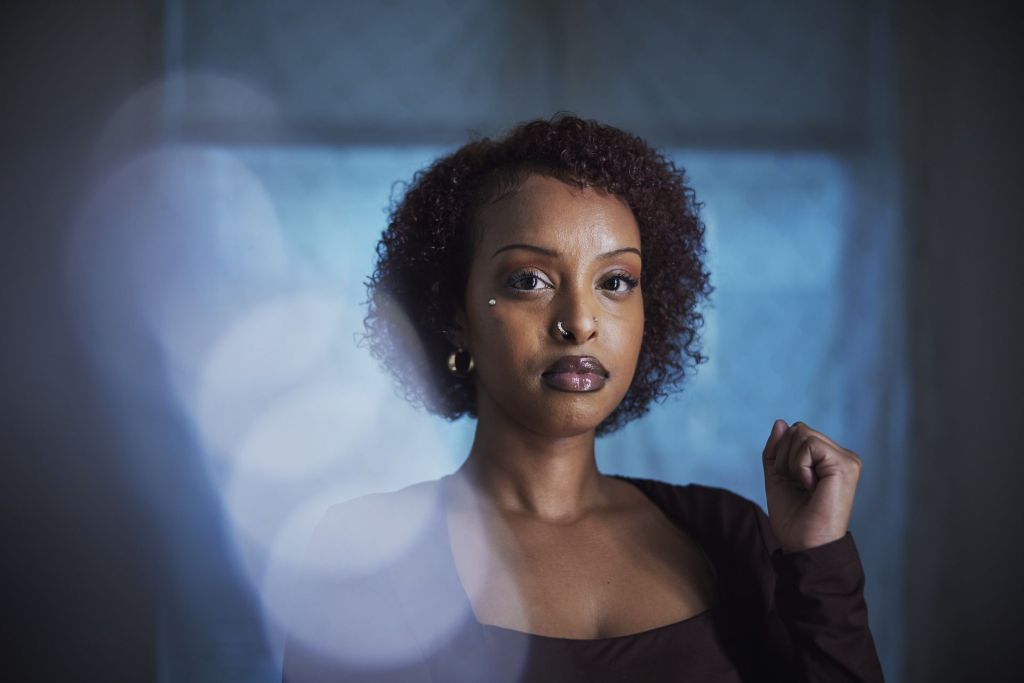

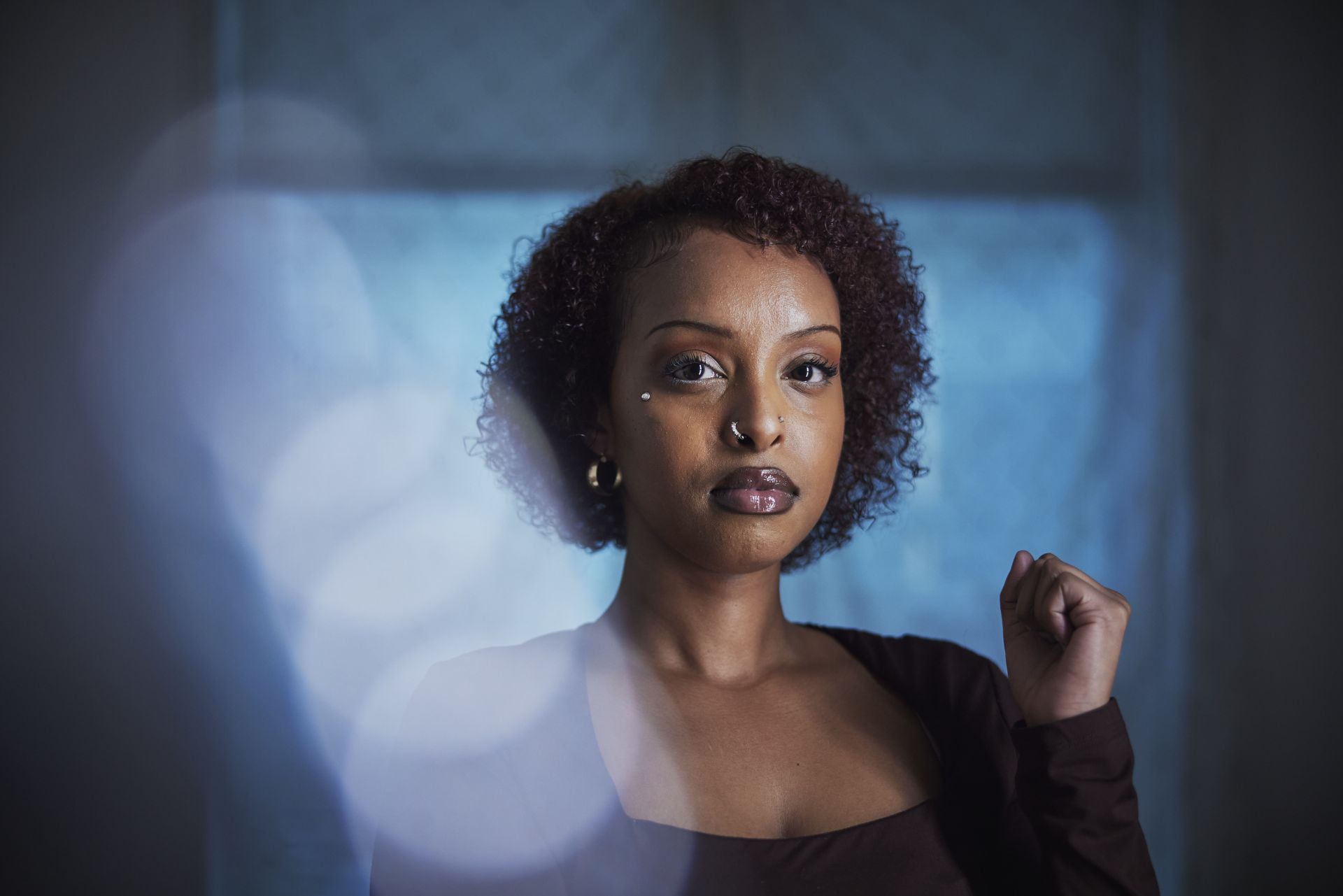
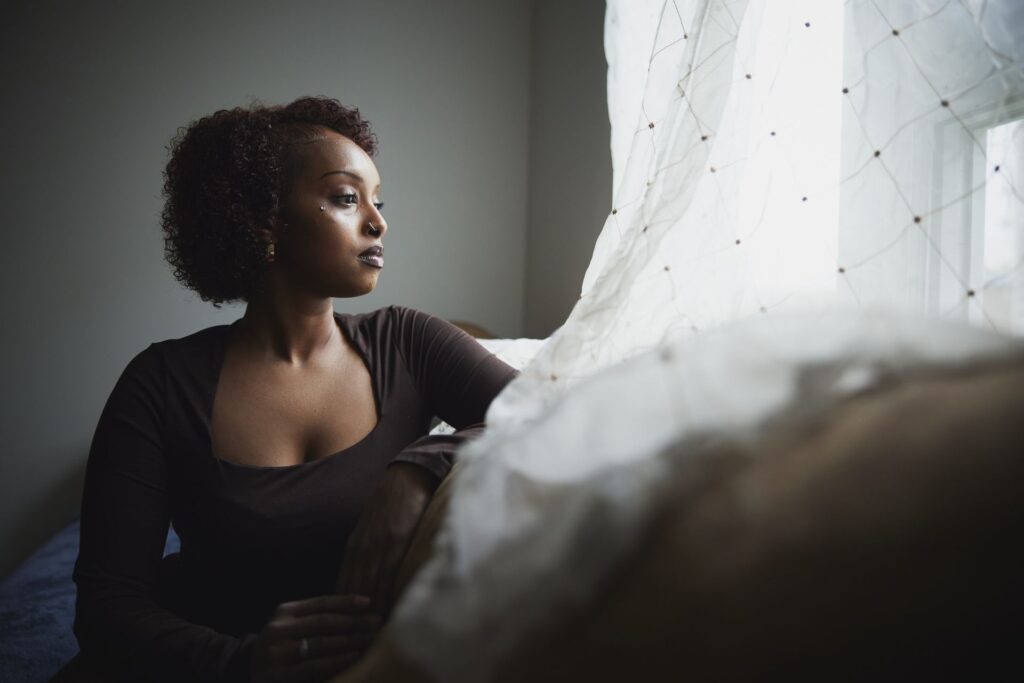
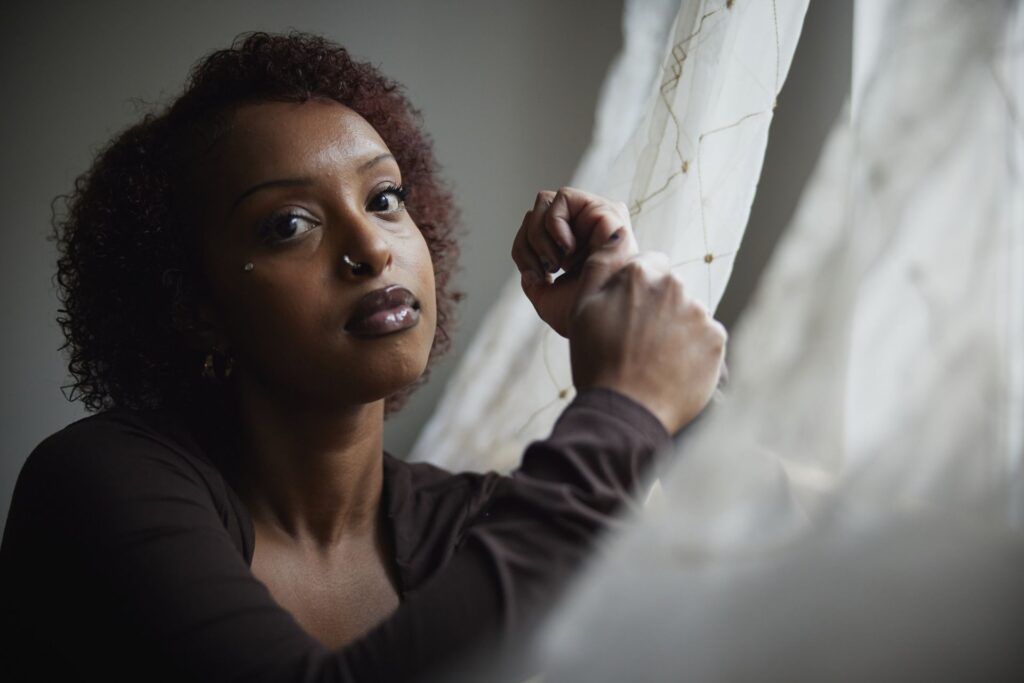
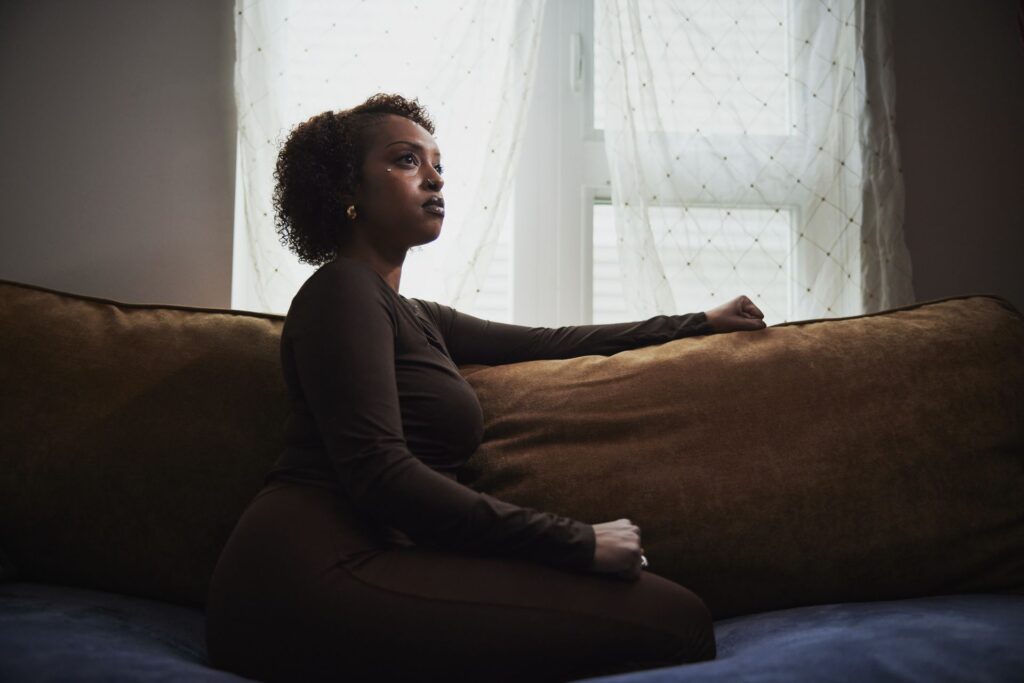
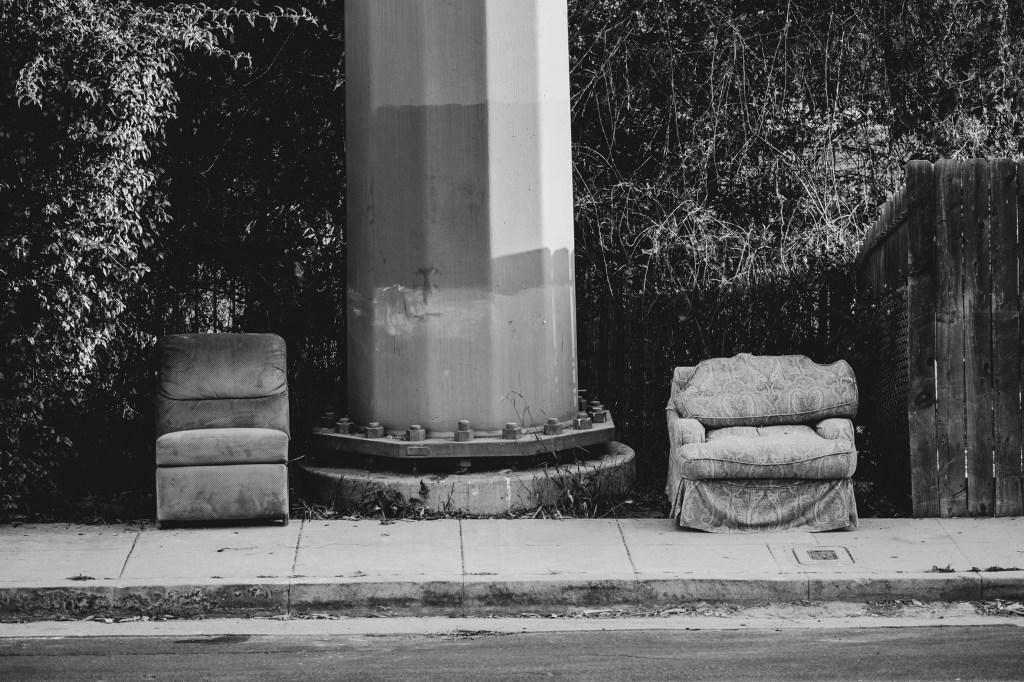

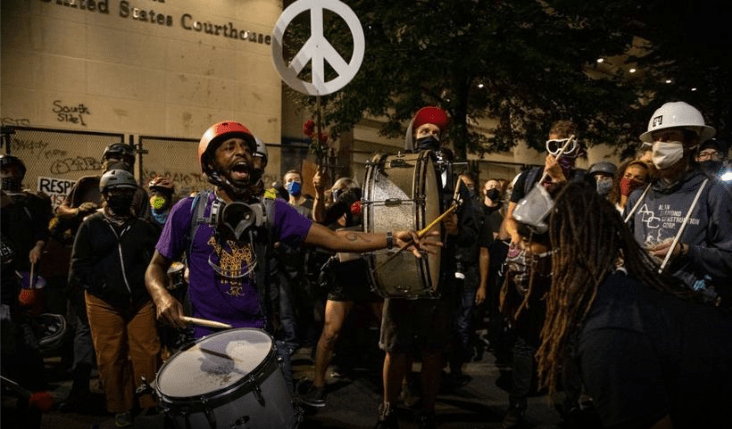
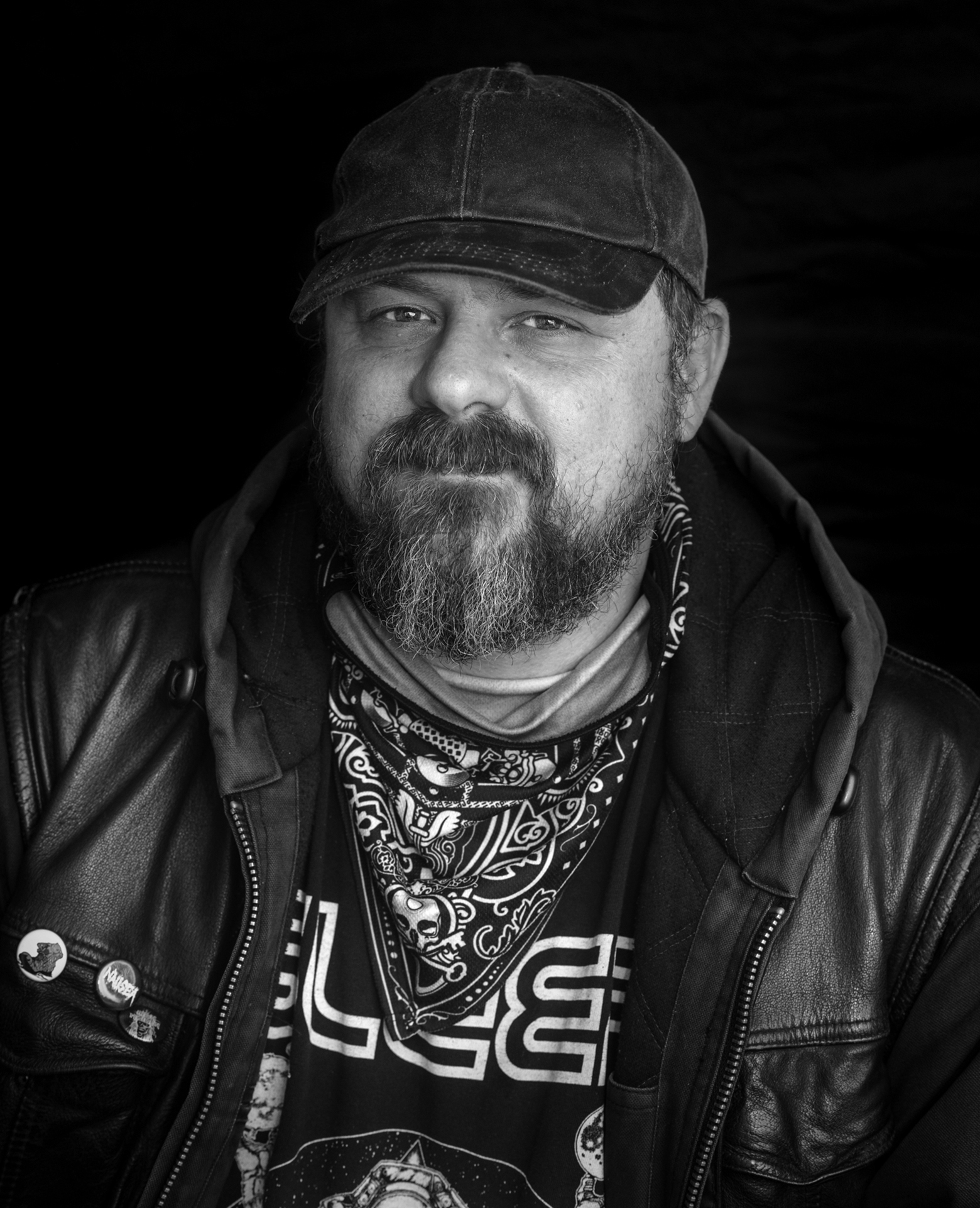
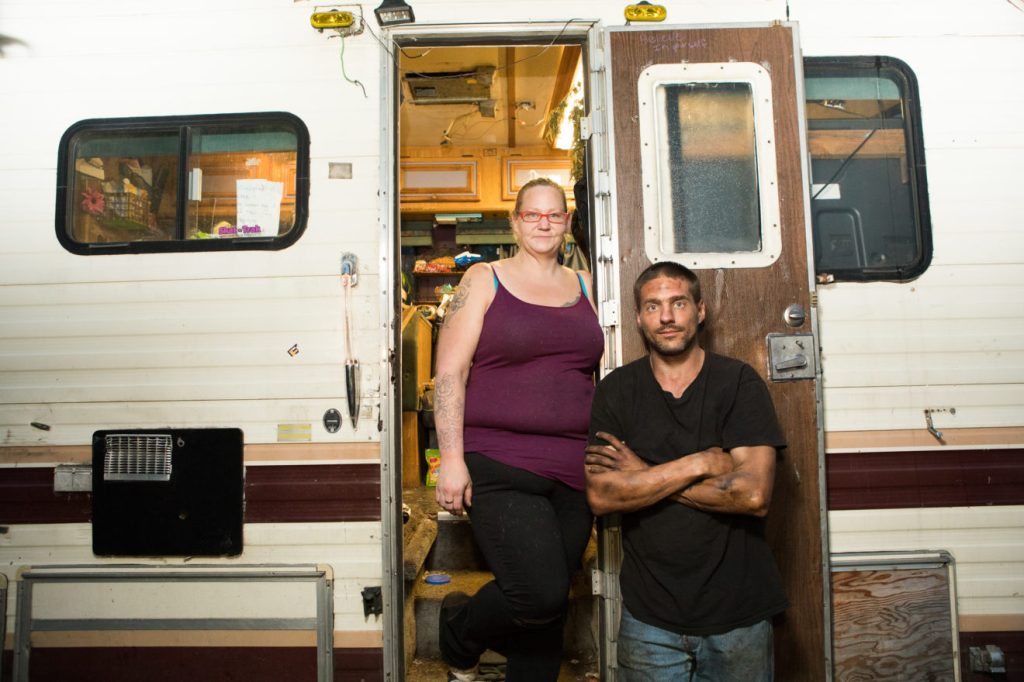
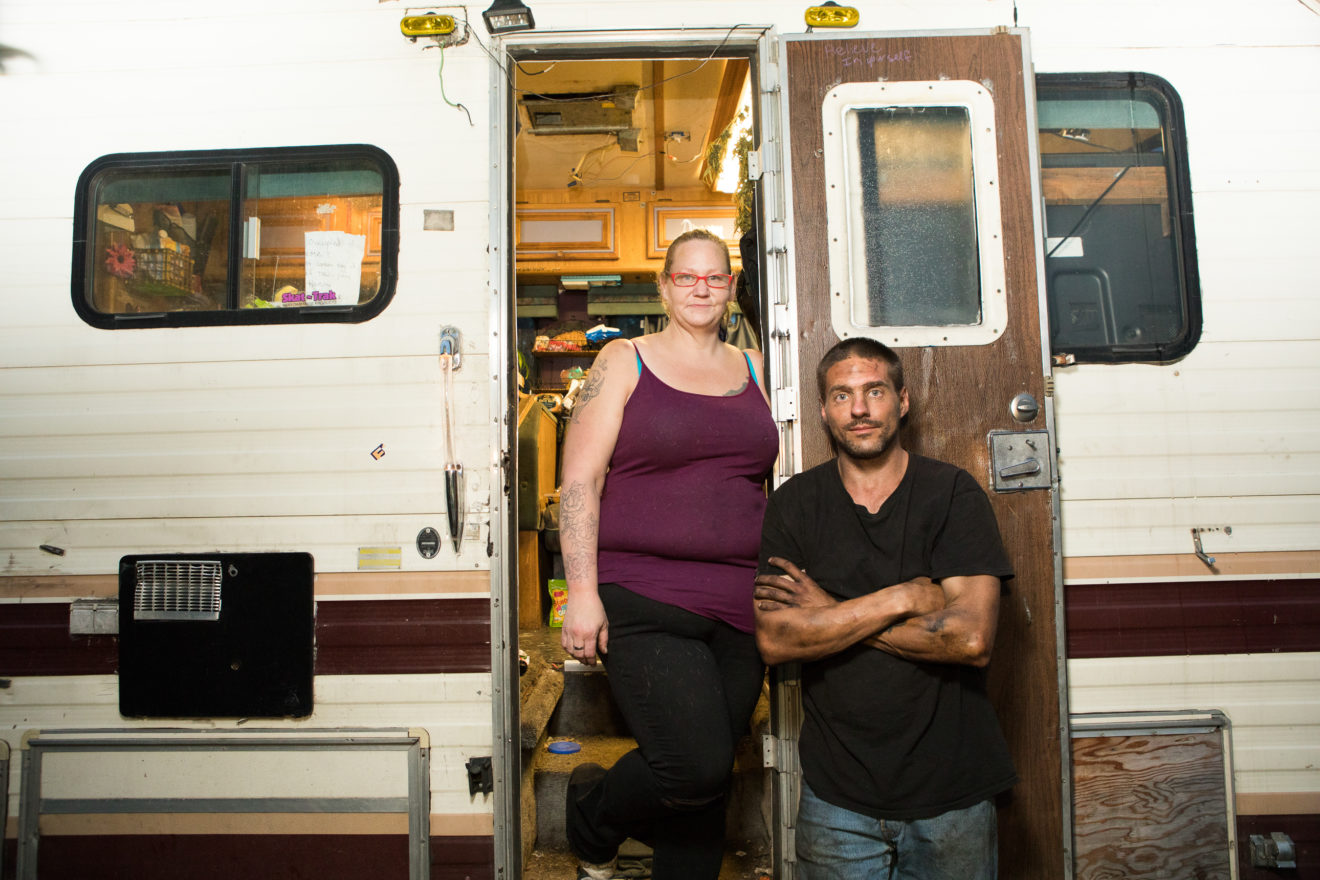


![Homeless people arrive at the San Deigo convention centre, now being used to house some of the city's homeless population during the coronavirus pandemic [Mike Blake/Reuters]](https://thacherschmid.com/wp-content/uploads/2020/05/d56308fdf2f647bc888d392a984a3094_18.jpg "Inside the US's coronavirus convention-centre homeless shelters")