I play violin and viola on the 2019 album East Forest x Ram Dass, a collaboration between the electronic musician and producer and the legendary spiritual teacher. The first release from the album hit #5 on Billboard New Age and #2 on iTunes Electronic.
The first, and my favorite, is “I am Loving Awareness (feat. Krishna Das),” a song featuring Grammy-nominated vocalist Krishna Das which has roots in classical Indian music; I play meditative, droning violin and viola.
I also play some bluesy/modal licks and pizzicato on “Home.” You can hear it here.
In June 2018, Trevor Oswalt aka East Forest was invited to Ram Dass’ home in Maui to join in conversation and record brand new teachings from the legendary teacher. After capturing these words of wisdom, East Forest returned to his studio in the high desert of Southern Utah to compose the soundtrack.
I connected with Oswalt at a SE Portland studio in 2018 for the tracking.
East Forest calls the music “a direct antidote for a highly polarized nation that is deeply in need of a universal voice of wisdom, connection and unconditional love.”
The
idea seemed simple enough. Last year, Portland passed a law to ease the
pain of renters being forced out of their homes or facing large rent
hikes.
Officials
and housing advocates in particular were worried about those facing
“no-cause” evictions. Such renters aren’t compelled to relocate because
they damage property or fail to pay rent; their landlords just want them
out.
The
ordinance requires landlords to pay tenants from $2,900 to $4,500 for a
no-cause eviction, a rent increase of 10% or more, a “substantial
change” to the lease or a lease nonrenewal.
Now,
landlord groups that have sued to overturn the law hope they will
prevail when the Oregon Court of Appeals hears the case in January, even
as tenant advocates nationwide study the ordinance as a tool to prevent
renter displacement.
“As
far as I know, no place else has taken this sort of approach,” said
Emily Goldstein, a senior organizer for the Assn. for Neighborhood and
Housing Development in Manhattan.
The
group hopes to educate the public and officials about the ordinance and
possibly “replicate and improve” the law in the New York region.
Jamey
Duhamel, a policy advisor for Portland City Commissioner Chloe Eudaly
and co-author of the ordinance, said cities across the nation have asked
for information about the law. “I think our relo ordinance is unique,
and the only one of its kind in the country,” she said.
In California, where Proposition 10 was defeated in the Nov. 6 election, tenant advocates see Portland’s ordinance as a kind of Plan B to protect renters.
Outside
Oregon, tenant advocates see the law as a viable tool to mitigate what
Josh Butler, executive director of the group Housing Long Beach, calls “a rental housing catastrophe.”
The Portland ordinance is a “really great first step for a city to
take,” Butler said. “I see it more as displacement mitigation.”
In
their lawsuit challenging the ordinance, Oregon landlord groups argue
that, by discouraging rent increases, it violates a state law
“preempting” local rent control. Multnomah County Circuit Court Judge
Henry Breithaupt disagreed and upheld the law last year, triggering the
landlords’ appeal.
John
DiLorenzo, the lead attorney representing landlords, called the law the
wrong fix for the problem, comparing it to “the doctors of old who
thought that applying leeches would help a patient.”
Ron
Garcia, president of the Rental Housing Alliance of Oregon, called it
“draconian.” Garcia’s group represents 2,000 members, 60% of whom are
small “mom and pop” landlords.
“I’m a guy who owns a duplex, and I’m getting stymied by city government,” Garcia said. “I want my property back.”
Tenant
advocates far from Portland see the law as a way to help renters
targeted for mass evictions in a deregulated rental marketplace.
Minnesota’s
Twin Cities have seen a surge in evictions in apartment buildings with
as many as 700 units, said Tim Thompson, president of the Housing
Justice Center, an advocacy group.
Minneapolis
and four suburbs recently adopted tenant protection ordinances, he
said, after discussions that included the Portland law. Minneapolis is
now considering a tenant “bill of rights” package, which could include
mandatory relocation payments.
The number of renters in the U.S. is near its high-water mark for the last half-century, a Pew Research Center study found. In cities up and down the West Coast, gentrification and eviction have led to increasingly volatile political battles.
In
Portland, 123,157 of the city’s 265,700 occupied housing units — or 46%
— are rentals, Martha Calhoon, spokeswoman for the Portland Housing
Bureau, said. The bureau’s most recent “State of Housing”
report found that almost every neighborhood in the city is now
unaffordable for “extremely low income” individuals, and many black,
Latino and single-parent households.
Duhamel
called Portland’s ordinance a “really big and important protection for
tenants in a moment of crisis.” However, “it doesn’t solve all of our
problems,” she said.
The
law allows landlords to apply for an exemption if they meet criteria in
any of 12 categories, and it does not stop a landlord from raising rent
9.9% each and every year.
But
Portland’s law mandates payments that could make a difference to many
ousted renters: $2,900 for a studio or single room occupancy, $3,300 for
a one-bedroom unit, $4,200 for a two-bedroom and $4,500 for three or
more bedrooms. Nationwide, the average renter’s net worth is a fraction
of the average homeowner’s: $5,400 versus $195,400, the Federal Reserve
found late last year.
The
law, Ordinance 188219, went into effect in February 2017. Three
Portlanders who received payments since then said in interviews that it
empowered them to face the daunting challenge of finding a new home in a
tight market.
“Who
has three months of money in the bank that they can just pick up and
move?” Amanda Potter, 37, asked, referring to the usual payments
required to execute a lease. “We rent because we are not in a position
to buy.” Potter and family lived in a Portland neighborhood for 15
years, but received a no-cause eviction notice in July 2017. They ended
up 10 miles away, in Troutdale.
Sophia
Jarvis, 29, was served an eviction notice in February 2017. Finding out
about the ordinance, she said, “was the first whiff I had ever caught
that there was anything on our side as tenants.”
“It
was the difference between us feeling like we would end up living on
the street or sleeping on a friend’s couch — or being able to stand up
for ourselves,” Jarvis said.
In
2016, actor Adam Lisser and his parents sold the North Portland duplex
he lived in. He remained in his unit as a renter, and a year later, the
company they sold to handed him a 90-day no-cause notice. The landlord
never tried to get out of paying the relocation fee, he said. On the
other hand, “it was just radio silence,” he said.
Lisser pursued the issue “like a pit bull,” and he and two roommates shared $4,500.
“Having
that extra cushion allowed me to look for a new place from a position
of strength,” Lisser, 35, said. “If I didn’t have the relocation
assistance, I feel like I would have experienced a lot of paranoia and
uncertainty.”
Is the relocation assistance law working?
Matthew
Tschabold, assistant director for the Portland Housing Bureau, sighed
when asked about its effectiveness. “That’s something we’re still
working on,” he said. From community-based partners, he said, the bureau
has heard “it is having a stabilizing effect.”
One
possible measure of the law’s effectiveness is the number of cases
heard in local eviction court. Studies have shown that only a small
percentage of overall evictions land in eviction court, but it’s clear
that the number of residential eviction cases in the Portland area is
declining.
Data
provided by Multnomah County, one of three counties that include parts
of Portland, shows that residential eviction cases have declined for a
decade, from a high of 6,713 in 2008 to 5,353 last year — a 20% drop.
(So far this year, the numbers are similar to 2017.)
Housing
experts say the decrease could reflect various factors, particularly an
improved economy, but Ann Witte, an attorney who has helped tenants in
local eviction courts for four decades, sees it differently. “It is
clear that this approach that the City Council took is working for
cutting down evictions,” she said.
Since
March, when the bureau began tracking data, 198 landlords have applied
for exemptions. Calhoon, the housing bureau spokeswoman, said “roughly
half” of those who apply for exemptions receive them. Landlords have
made 168 payments to renters, she said. However, they’re not required to
report payments, so the true number is unknown, and likely higher.
Are landlords trying to skirt the ordinance?
Tschabold
wouldn’t characterize landlords’ actions that way, but said the housing
bureau occasionally fields “interesting” queries about how the measure
can be applied. But such instances are rare — only “one landlord out of
tens of thousands,” he said.
Katrina
Holland, executive director of the Oregon Community Alliance of
Tenants, which operates a tenant rights hotline, believes otherwise. “We
see a lot of different methods that folks try to use to get around
relocation assistance,” Holland said. “We’ve seen efforts from some
landlords to try to trick tenants into thinking that they’re trying to
make a choice to leave.”
An
organizer with renter advocate group Portland Tenants United agreed
with Holland. “It’s true that some landlords are abusing [the
ordinance],” Margot Black said, “but that doesn’t mean it was better
before there was relo.” She called the ordinance a “paradigm shift.”
Tschabold
said the housing bureau is prioritizing education and outreach,
responding to what he called a rapidly changing rental landscape.
Landlords,
meanwhile, are placing their hopes in the appellate court. Garcia, the
president of the Rental Housing Alliance of Oregon, believes the public
dialogue over rent has been hijacked “by a small minority of radical
tenant rights groups” who scream the loudest at City Hall. “The people
that I speak for feel like the city has betrayed them,” he said.
Illegal short-term rentals posted on Airbnb may keep more than 1,500 units out of the Portland housing market—even after the city’s much-publicized clampdown on Airbnb takes effect this winter.
The finding comes at a bad time for the 47 percent of Portlanders who rent: A recent report from Metro found the Portland metro region needs to add 48,000 affordable units to keep up with demand, and the current wait time for people wanting to live in Portland’s affordable public housing is 14.5 years.
Despite two years of behind-the-scenes negotiations between the city and Airbnb—negotiations that were intended to convince the San Francisco company and its local hosts to follow Portland’s rules regarding short-term rentals—the best available data suggests little will be done to rein in Airbnb hosts who illegally rent out entire homes for most of the year.
Airbnb opened its Portland offices in Old Town in 2014, the same year it signed a first-of-its-kind agreement with Portland that legalized short-term rental programs and required Airbnb to stick an 11.5 percent hotel tax on its reservations.
The agreement with the city did not require Airbnb to share its data on its hosts or guests, nor did it appoint city staff to actively enforce these new short-term rental rules.
In 2014, Portland also began requiring permits for Airbnb rentals—which the city called “accessory” short-term rentals—within residences containing up to five bedrooms. These permits require that hosts live in the unit they rent out via Airbnb (or any other short-term rental service) for at least 270 days of the year. That means hosts technically can’t rent out more than one residence at a time.
Currently, data from industry watchdogs indicate that as many as half of all Portland Airbnbs—conservatively, more than 1,500 units—still violate the city’s 270-day rule.
As one of the most successful Silicon Valley businesses exploiting the “sharing” economy, Airbnb’s disruption of the hotel industry has been welcomed by many. But few know the impact the service is having on housing markets; across the country, Airbnb has refused to share data on hosts and rentals. The company claims doing so would violate the privacy of its hosts—but its hoarding of data may also provide cover for illegal rentals offered through the service.
In lieu of data from Airbnb, groups like the team behind InsideAirbnb.com have begun to collect their own. The open-source site uses bots to scrape Airbnb’s site for calendar data and guest reviews.
InsideAirbnb data calculates that Portland has 4,852 total listings—2,424 of which are entire homes or apartments that have “high availability.” The group’s website says units like these “probably don’t have the owner present, could be illegal, and more importantly, are displacing residents.”
The site also determines that 1,532 units—representing 31 percent of InsideAirbnb’s Portland listings—have a host who operates more than one rental unit, which automatically violates the 270-day rule.
While Airbnb spokeswoman Laura Rillos dismissed InsideAirbnb’s data as “unreliable,” the company declined to provide data to refute it.
Another independent Airbnb analytics company, Airdna.co, shows data similar to that of InsideAirbnb: 5,185 active rentals in Portland, 43 percent of which are “available full time.” That means 2,229 could be violating Portland’s 270-day rule.
As part of negotiations that are expected to wrap up by the end of the year, Portland officials hope to get new data from Airbnb that will allow it to crack down on certain types of violations.
Sophia June, a spokesperson for Mayor Ted Wheeler’s office, says the city hopes to specifically receive data points that include the first and last name, or the business name, of the person listing the property, along with their mailing address, phone number, and email address. Also included in the proposed dataset will be the address of the rental property, its number of rooms for rent, and a signed promise by hosts that they’re complying with city codes.
In exchange for this transparency, officials say, the city will curtail its current requirement that all properties listed on Airbnb get an in-person review by a certified building inspector. June says Airbnb’s “frequent hosts,” however, will still be subject to in-person inspections.
While the proposed changes will certainly reduce overall Airbnb violations, they won’t affect the 1,573 Portland Airbnb units that appear to be breaking the 270-day rule.
That means Portland tenants could continue to be pushed out of rentals by landlords who decide to cater to the more lucrative Airbnb market, even if doing so breaks Portland law.
Last April, artist and recent Portland State University graduate Jude Boatman was evicted from her Kenton apartment when the unit was converted into an Airbnb.
It was a “great neighborhood, great house, super close to my work,” Boatman says. The unexpected eviction impacted Boatman, who has been homeless in Portland in the past.
“It’s like a trauma that lives with you forever,” she says. “Housing is always a scary thing for me, because it’s hard to find.”
In August, the Portland City Auditor’s Office used InsideAirbnb data to investigate the city’s ability to regulate its short-term rentals. The resulting audit found only 22 percent of Airbnb hosts had applied for and received the required city permits, and that “lax” enforcement of the regulations was having an “unknown” effect on the city’s housing crisis.
Local real estate experts say the short-term rental market is particularly hard to understand—not only is privately held data hard to come by, but many businesses like Airbnb are known to constantly and quickly change their practices.
Patrick Barry, whose real estate appraisal firm tracks apartment trends, calls Airbnb’s local industry a “shadow” market.
“I don’t think anyone really knows what the actual impact is,” says Barry. He believes the thousands of new apartments that are becoming available in Portland each year have a “much bigger impact” on housing affordability than Airbnb.
Chris Smith, a member of the Portland Planning and Sustainability Commission that helped create the city’s Airbnb regulations, sees Airbnb’s illegal listings differently.
During a housing crisis like Portland’s, Smith says, “even small changes in supply can make a difference.”
This isn’t Portland’s first attempt to mitigate the impact of short-term rentals in a city with a housing crisis. Earlier this year, the city assessed two new fees on short-term rentals; together, they’re projected to annually contribute more than $1 million to the city’s efforts to support affordable housing.
The pending agreement, officials say, is part of a larger overhaul that will include a citywide rental registry, the continued prioritizing of building thousands of new units of affordable housing, and collecting taxes and fees on short-term rental companies like Airbnb.
First, the city will have to improve its ability to track and respond to Airbnb violations.
Since the city adopted new short-term rental regulations in February 2017, the Bureau of Development Services (BDS) has issued 186 citations to property owners for operating without the city-required permit, for fines totaling $440,500.
None were for violating the 270-day rule, which BDS Supervisor Mark Liefeld calls “extremely difficult to enforce.”
Portland’s enforcement system is entirely complaint-driven and relies on publicly posted reviews from Airbnb guest reviews—not data provided by Airbnb or its hosts.
“Everything is set up where the burden of proof is on the city,” says Liefeld.
There is no dedicated, full-time city staffer tasked with enforcing the city’s short-term rental regulations. While such a position could locate, fine, and restrict Airbnb hosts who violate the law, such a position would cost about $70,000 annually.
City documents obtained through a public records request show that on November 8, 2016—the same day Wheeler and City Commissioner Chloe Eudaly took office—the city’s Bureau of Revenue and Financial Services threatened Airbnb with $1,663,500 in fines if it didn’t provide addresses for each of its rental locations and host contact information by the end of that month.
The city has extended that deadline twice already. Thomas Lannom, the city’s director of revenue, says the city’s threat of actually collecting those fines was “dropped pending the outcome of our negotiations.”
Meanwhile, Airbnb’s Portland lobbying team is one of the most powerful in city hall. In a January 4, 2017 email to the mayor’s office obtained by the Mercury, Airbnb lobbyist Dan Jarman requested that the city “stay” its hand—or face the consequences.
“While we work to find a legislative solution,” Jarman wrote, “we ask that your office commit to a stay of enforcement, which could terminate discussions before they begin.”
Marshall Runkel, Eudaly’s chief of staff, claims the city has the upper hand in negotiations with Airbnb.
“I don’t think that we’ve stayed enforcement,” says Runkel. “I believe that we are holding [Airbnb’s] feet to the fire.”
Nationwide, Airbnb aggressively lobbies local governments—and when that hasn’t worked, the business has also gone to court to battle much larger cities, including San Francisco and New York City. In New York, Airbnb is currently fighting a new city ordinance that requires the company to hand over data that includes some tenancy information.
In the three years since Portland City Council declared a “housing state of emergency,” the city’s seen more than 15,000 new apartments pop up across town.
Yet despite new tenant protections, tenant strikes, and lawsuits, rents in Portland have fallen for the rich and risen for the poor. According to some, Airbnb’s growing reach isn’t helping.
“We believe it is critical that local policies ensure that affordable housing is available for local residents,” says Katrina Holland, the executive director of the Community Alliance of Tenants. “Lax enforcement, both in the short-term and long-term rental market, encourages landlords to skirt safety and livability standards and puts tenants at risk.”
Airbnb says its business model has minimal impact on the Portland housing crisis but offers little data to support the claim.
In the past, the company cited a 2016 study by ECONorthwest as evidence that its model doesn’t adversely impact Portland’s long-term rental market. Paid for by Airbnb, the study found only 83 Airbnb listings in Portland at the time were breaking the 270-day rule—a sharp difference from the thousands found by InsideAirbnb and Airdna.co.
An official inside city hall who asked to remain anonymous tells the Mercury that an Airbnb lobbyist privately confirmed the company’s illegal hosting operations have swiped at least 1,300 units from the housing market.
In a prepared statement to the Mercury, Airbnb spokeswoman Molly Weedn noted the company has removed 500 Portland listings found to be in violation with its “One Host, One Home” policy.
“Airbnb is an economic lifeline for Portland families and in fact, 58 percent of Portland hosts say they use Airbnb to help afford staying in their homes,” writes Weedn.
And from the mayor’s office, Wheeler emphasizes that consensus is the best approach to regulating short-term rentals.
“My first choice going forward would be for [Airbnb] to see that we have a mutual benefit in getting it right,” Wheeler tells the Mercury. “I’m not taking any strategy off the table, just to be crystal clear.”
Short-term rentals are “very lucrative, and desirable for people who come here,” adds Wheeler. “What we don’t want to do is have a significant portion of our housing stock taken up by people from Palm Springs when we have people in our own community who are struggling to keep a roof over their head.”
This story was published in the Portland Mercury. A “Priced Out: Gentrification Beyond Black and White” podcast about the story with Cornelius Swart can be heard here.
Guardian study of two US cities finds crime is likelier to go down than up in neighborhoods that host city-sanctioned encampments
They stood in a rainy parking lot under fir trees, 60 homeless men and women, young and old, patient and weary. The glow of a single lightbulb outside the “office” – a shack of plywood, duct tape and plastic sheeting – illuminated their faces.
It was the 9pm check-in at a homeless village called Right 2 Dream Too in Portland, Oregon. The code of conduct was read aloud. Then the roll call began: one by one, people showed ID and stepped through the chain link fence, towards portable toilets, bedrolls, warmth, sleep and safety.
Most people don’t associate this kind of order and security with homelessness. Indeed, homelessness and criminality are often conflated. But a Guardian investigation in two US cities where such highly organized homeless villages are common, Seattle and Portland, found that their presence was not generally accompanied by a rise in crime in their neighborhoods. In fact, crime was likelier to go down.
For five of 11 villages surveyed, crime in a broad range of categories decreased in the surrounding neighborhood after they were established. In four cases, any change was small, within single digits. In two, crime increased.
The Guardian’s data is “consistent with the position that homeless villages are not generators of crime”, said Kenneth Leon, a criminologist at George Washington University, and could be part of a “crime prevention ecosystem”.
The numbers show “there’s no evidence homeless encampments add to crime”, wrote Mike Males, senior research fellow at the Center on Juvenile and Criminal Justice in San Francisco, calling the figures “an important finding”.
There is a distinction between these villages and the ad hoc, curbside agglomerations of tents and tarps that have come to symbolize the surging homelessness crisis in many cities across the western US. All these villages have the sanction, explicit or tacit, of officials, are largely self-governing, and have defined boundaries and codes of conduct.
Take Othello Village, comprised of 29 tiny homes, which was established on the border of two residential southern Seattle neighborhoods in March 2015.
Sharon Lee, executive director of the Low Income Housing Institute in Seattle, which sponsors seven “tiny home” villages, including Othello, said the property used to be a “hot spot” – “a vacant, derelict, dilapidated lot full of trash and garbage [where] people would do their drug deals”.
Now, Lee jokes, it’s a “gated community”. It has a fenced perimeter, gatehouse, locking doors, foot patrols, arbitrators for squabbles and “eyes on the street”.
Using Seattle and Portland crime statistic “dashboards”, the Guardian pulled crime rates for the neighborhoods in which Othello and the other homeless villages are located, comparing the number of incidents that occurred before and after their establishment.
In Othello’s case, crime in the two Seattle neighborhoods it straddles went down an average of 31%, versus a 4% rise citywide.
Lee believes the the creation of an organized village engenders a psychological shift. People “literally cry when we show them that they can move into a tiny house and give up their tent”, she said. “If you go to a village and there’s food and you can shower and there’s a warm place and you can keep your place and lock the door, it takes away your need to hustle or commit a crime or go in a store and steal some food.”
Neighbors have noticed. “It keeps getting better,” said Manzil Pradhan, manager of Jim’s Market and Gas, a gas station and mini-mart next to Othello Village. “Now when I work here at night, it’s good. I can get out after midnight; I feel safe now.”
Camp residents also take measures to keep crime down. In Portland, residents of Right 2 Dream Too perform foot patrols. On a recent night, a man named Leo L, 59, carried a walkie-talkie and what he calls his “extra hand”, a picker-grabber to snare trash and cigarette butts. He never carries a weapon.
Rows of tents at Camp Second Chance, a city-sanctioned homeless encampment in Seattle. Photograph: Jae C Hong/AP
“Believe me, if we see something going on, it’s going to be handled,” he said. “We don’t tolerate nothing.”
When Right 2 Dream Too moved in mid-2017 to its current home in Portland’s commercial Lloyd Center neighborhood, crime went down 10%, versus a 7% citywide rise. Crime went up 28% in the neighborhood it vacated.
“I love these guys being here,” said a man in a guard shack near R2DToo who requested anonymity because he wasn’t authorized to talk to media. “A lot of people were really skeptical, but they’ve been cool. I don’t even find needles out here any more.”
The Texas State University criminal justice professor Marcus Felson said the data indicated such villages could serve to “contain” crime.
“In general, removing problems from outdoor and public locations to more concealed locations is good for community life – even if the problems are not solved,” Felson said. “Such removal minimizes conflicts and escalations, including police contacts.”
Police spokespeople in both cities declined to discuss the findings. The Portland police spokesman Sgt Chris Burley said the city did not track crimes around authorized encampments, and that crime rates for an entire neighborhood did not necessarily reflect crime trends at specific locations within that neighborhood.
But the Seattle police sergeant Eric Zerr, whose team reaches out to people living in impromptu tent clusters, vehicles and under bridges, said he was “very hopeful” about the village model. “It’s just safer there.”
Researchers stressed that the data did not show a causational relationship between the villages and lower crime.
“It doesn’t settle the question, but with all academic things, we always say more research is needed,” George Washington University’s Leon said.
Othello Village. The crime data is grist for the mill in the debate over city-sanctioned homeless villages. Photograph: Jenny Riffle for the Guardian
On occasion, camp residents are alleged to commit serious crimes. And in two Seattle neighborhoods, crime significantly increased after a homeless village was established: in the Georgetown neighborhood, crime rose 31%; and in Ballard South, it climbed 17%.
Experts aren’t certain of the reasons. In the Georgetown neighborhood, the assistant police chief Marc Garth-Green told the Seattle Times in December he wasn’t sure why property crimes had risen to fourth-highest in the city. In those areas, isolation and lack of social services could push crime up.
The crime data is grist for the mill in the debate over city-sanctioned homeless villages. San Jose and Oakland, in California, are ploughing ahead with them, while San Diego recently constructed huge group tents and Las Vegas is repurposing shipping containers.
“I don’t think it should be sitting comfortably for anybody in the wealthiest country in the world to say: ‘Yes, we should be creating semi-permanent shantytowns,’” said Eric Tars, senior attorney at the National Law Center on Homelessness and Poverty. “But they can actually play a productive role.”
The following date ranges were used in comparisons: Tent City 5: November 2012 – February 2015 compared with November 2015 – February 2018.Othello Village: March 2012 – February 2015 compared with March 2015 – February 2018. Tiny House Village: January 2013 – February 2015 compared with January 2016 – February 2018. Georgetown Village: March 2016 – February 2017 compared with March 2017 – February 2018. Licton Springs Tiny House Village: April 2016 – February 2017 compared with April 2017 – February 2018. Camp Second Chance: April 2016 – February 2017 compared with April 2017 – February 2018. Tent City 3: November 2016 – February 2017 compared with November 2017 – February 2018. Ballard Nickelsville: November 2012 – February 2015 compared with November 2015 – February 2018. Kenton Women’s Village: June 2016 – February 2017 compared with June 2017 – February 2018. Right 2 Dream Too: June 2016 – February 2017 compared with June 2017 – February 2018. Hazelnut Grove: May 2015 – September 2015 compared with May 2016 – September 2016.
You could say Ana Maldonado goes out of her way to get to Portland Community College’s new DREAM Center.
First she walks, then takes light rail, then a bus. That brings her to the PCC campus closest to her house. There she meets another student, Ignacio Garcia, and they carpool to another PCC campus one more hour away.
Why does Maldonado — an immigrant recipient of DACA, the Deferred Action for Childhood Arrivals program — go to all this trouble?
“To learn how to use my voice,” she explained. “I’ve never felt so much support before as I do this year because of the DREAM Center.”
The DREAM Center appears to be the first of its kind at any institution of higher education in Oregon. When it opened Jan. 22, it arrived on a wave of support in the Pacific Northwest but amid roiling waters nationally over the Obama administration program that shielded young immigrants from deportation.
PCC President Mark Mitsui said the center reflected the wishes and philosophy of the PCC Board of Directors, which in December 2016 declared the school a “sanctuary” institution.
“It certainly is consistent with our values, our mission as an institution, and you can even argue that it is embedded within the historic mission of community colleges,” Mitsui said.
The center is simple — the sparsely decorated Room 101 of Building 2 of the PCC Rock Creek campus. It features cubicles, a school clock and a bank of computers underneath a large banner, “DREAMers Resource Center,” festooned with two monarch butterflies.
The beautiful insects have been a symbol of immigrants for decades due to their ability to migrate across the U.S.-Mexico border, and they have often been adopted by “Dreamers.” It’s not lost on some that the monarchs are being reviewed for addition to the list of federally protected endangered species.
One recent day at the center, Maldonado joined fellow DACA recipients Garcia and Keidy Caballero and talked about the challenges they face. DACA’s fate is uncertain. President Trump moved to end its protections by March 5, but a federal judge has stayed that move. Efforts to protect Dreamers legislatively have stalled in Congress.
As Maldonado, Garcia and Caballero spoke, their words were often weighted with an emotion that contrasted with peals of laughter and lively discussions coming from several students working with mentors. There was obvious camaraderie, and language see-sawed between guttural English and mellifluous Spanish.
Garcia said his sense of having to struggle harder than other students started on his first day at the college, during new student orientation.
Garcia said he was brusquely told to “just fill out your FAFSA,” a financial aid form.
“But I’m not able to submit my FAFSA,” he said. “They didn’t know what DACA was. I had to explain it to them.”
Led by coordinator Jhoana Monroy and Multicultural Center coordinator Liliana Luna, the center offers legal services, assists with DACA paperwork and provides a host of services, including career and academic counseling.
Portland has sometimes been called America’s whitest big city, but that doesn’t mean there isn’t broad support for Dreamers here.
In the Pacific Northwest, the center is a dot on a timeline of “sanctuary” declarations that have pushed back against the Trump administration’s anti-immigrant policies. With 90,000 students and four campuses, PCC is the largest institution of higher education in Oregon.
Many polls show that overwhelming majorities of Americans support Dreamers staying put. That’s a clear mandate, says PCC President Mitsui.
Still, the continuing political limbo has Luna, who calls herself “DACA-mented,” feeling a weariness that surpasses even droopy-eyelid college standards.
Liliana Luna helps run the center for “Dreamers” at Portland Community College’s Rock Creek campus.
“I cannot explain to you how exhausted I feel,” she said. “Physically, mentally, emotionally.”
While Maldonado hopes to someday be a teacher, Garcia a computer scientist and Caballero a nurse, Luna is in a master’s program to become a therapist helping Spanish-speaking immigrants.
Brought by her parents on a plane at age 15 to the U.S. to escape cartels in Nuevo Laredo, Mexico, Luna cried “the whole way here,” she said. She still wonders what happened to her beloved box of Barbie dolls since she heard the home was taken over by a cartel.
She’s finely tuned then to what she calls “a constant battle, a constant attack” that DACA recipients struggle with.
“I was having a conversation with students [at the center] about how a lot of us might go through depression or anxiety without knowing about it,” Luna said.
Asked about the possibility of immigration agents raiding the center, which also serves DACA recipients’ families, Luna shared a thought that invokes her violence-filled past in Mexico — “I remember seeing a lot of my friends dying” — and her adopted country’s horrific pattern of school shootings.
“What I am more concerned about is racist people that are going to come and shoot us,” Luna said. DACA recipients are “very visible,” she said. “I do feel that we’re targets to a lot of people.”
She’s already been a target for ridicule. After she appeared in a local news story about the center, Luna received a stream of offensive, racist threats and was reported to immigration authorities even though she’s a legal resident, thanks to DACA.
Luna shared screenshots that included racist caricatures showing Trump holding up a puppet with stereotypically Mexican features. She received messages like this one: “Ms. Luna. You know it’s illegal to be here. You have to apply. Also you know Muslims follow a cause to take over and kill. Right?”
Such violent thoughts seem far away from the suburban Rock Creek campus. It’s a peaceful place, a stone’s throw from farm fields and nurseries, in which the region’s history of migrant farmworkers is echoed in many students’ chestnut brown hair and the campus center’s “Farm Cafe.”
College officials say they have no statistics on how many students are in DACA. Luna estimates the group numbers 300 to 400 among the college’s 90,000 students and “maybe 200” at the Rock Creek campus.
There are about 689,000 DACA recipients nationwide. The Migration Policy Institute, an independent think tank, estimates that about 10,000 Oregon residents are in the program.
All three say they cherish their roots in Mesoamerica, but feel some sense of distance. Caballero hasn’t been back to her native Honduras since she was brought here 12 years ago. Maldonado hasn’t been back to Mexico since she was brought here nine years ago. Garcia went back to Mexico just once, he said, to visit a sick grandmother.
That trip to Oaxaca, his first in 17 years, showed just how American the bespectacled computer science student has become — culturally if not legally. Occasionally, he said, he couldn’t understand his grandmother’s indigenous Zapotec, or family members’ speedy, slang-filled Spanish.
Now, the new center, Garcia said, offers “like, kind of a family.” Another way to understand it: Consider the “R” in the DREAM acronym (Development, Relief and Education for Alien Minors), first coined for the original bipartisan congressional bill in 2001: relief.
“It was just nice to see people that looked like me,” Garcia said of his first visit after the center’s opening. “I didn’t have to explain what DACA was. I didn’t have to explain my struggle, because they already knew, because they’ve gone through it. And that was like the [first] moment when I felt like I belonged to PCC, like I mattered.”
Forgetting isn’t always a bad thing. The planet’s coming apart at the seams, and hey, weed is legal now.
But even in a nation as ahistoric as America—led by a president who never got the memo about poverty, slavery, or anything—memory is sanity. Lose one, you lose the other.
This loss is at the heart of rock ensemble Typhoon’sOfferings, out January 12 on Roll Call Records. It’s the group’s fourth full-length, their first since 2013’s White Lighter, and one of the most ambitious, delicate, heartbreaking recordings ever by a Portland artist. Coupled with almost 40 dates across North America (their first stateside tour in three years) and a first-ever European jaunt, it could take the band to new heights.“To me it really is a record of this period we’re living in, this moment in time,” says Kyle Morton, the group’s lead singer and songwriter.
That doesn’t bode well for 2018.
“The spiral is unspooling, the center couldn’t hold,” Morton intones on “Ariadne,” in one of numerous creepy-yet-infectious moments on this dystopian magnum opus. “We choked on our inheritance, and hell on earth is cold. Pray, I forgive you, brothers, sisters, thread my neck into the noose. It’s my only offering, and I pray that you refuse.”
Just how far Offerings will take Typhoon depends on the public’s ability to embrace dark themes, complex arrangements, and words like “chiaroscuro” and “consanguine.”
It’s heady, but authentic: Morton is a humble, well-read, curious Portland artist. When not running operations at Mississippi Studios or diving into circuitry pre-tour at Old Town Music, he spends time at Another Read Through, Cinemagic and Beacon Sound. In conversation, he casually drops phrases like “sine qua non” and references as diverse as Samuel Beckett, Westworld, Dan Deacon, Mark Zuckerberg, Dostoyevsky, Žižek, even “Peter Pan and his happy thought.”
The band’s artist page on Roll Call Records describes the new album as the sound of “a Fellini film, a Bosch painting, and a Rorschach drawing.”
Yet there’s nothing overly intellectual about Offerings. It hits home, viscerally, by reflecting two truths: the internal, like a loved one’s dementia, or Alzheimer’s, or those little pills you take every morning and night; and the external, like America’s collective current cognitive dissonance, or Portland’s deepening homelessness crisis.
Why such a dystopian record, Kyle?
A sigh. Morton doesn’t mince words, and everything he says or sings is leavened with humor. “I would say because we’re getting there. Look, I root for civilization, but it’s the underdog in this situation.”
Morton’s voice is a gossamer thread that connects all of Typhoon’s work. It’s built with strength and vulnerability and holds the listener in a quavering grip that intensifies.
On the shimmering “Coverings,” Morton shares the songwriting for the first time with a Typhoon band member, violinist and vocalist Shannon Steele. It’s a good thing.
“You gotta learn how to live on an ever-shorter tether,” Steele sings on “Bergeron,” in the steal-the-show mode à la Régine Chassagne of Arcade Fire. Steele’s lead vocal on “Coverings,” levitating above lush guitar lines reminiscent of Band of Horses, is one of the album’s best moments, a song you want on loop.
“She just sort of has this crystal-clear high voice that no matter what else is going on, it kind of sits above everything and is ethereal and heavenly,” Morton describes.
But Morton’s narrator, a man who is losing his memory and mind, is the unifying vision on Offerings. He says it’s informed partly by his own suffering, which started with a tick bite and Lyme disease during his childhood. Yet he manages a light touch, even describing his own suffering:
“Inasmuch as my own finitude and mortality and struggles with health things from one day to the next, whether it’s a major hospitalization or having to feel fatigued and shitty for weeks on end, it really is kind of…,” he pauses, “how to put it? Did you watch Westworld at all, the HBO show?”
Other explications of his approach to making art by working from the wound similarly end with humble disclaimers, via cultural references: “I don’t think I write or make music out of any overflowing talent; it’s kind of more the opposite, out of my own pain and scarcity and poverty. I’m kind of ripping off Beckett.”
Morton says his health is “stable” right now, “fingers crossed.” “It seems to have kind of reached a workable plateau,” he notes.
Yet the recording of Offerings proved an occasionally taxing deep dive, Morton recalls.
“As the writer, you have to have a broader view than the character that you’re writing, but there were times when I spent so much time thinking about memory loss that I really did start to feel like I was exhibiting the symptoms.
“And we were all working—music doesn’t pay the bills just yet. Things started feeling very cyclical, and like time was looping.”
Will music ever start paying the bills for Typhoon?
The group’s 2010 full-length Hunger and Thirst and 2011 EP A New Kind of House, on Portland label Tender Loving Empire, have each sold more than 14,000 copies, the label confirms. 2013’s Roll Call Records debut White Lighter peaked at #105 on the Billboard 200, selling 25,000 copies in the US alone.
“Pre-orders for [Offerings] have surpassed all prior records and tickets across the country are moving quickly as well,” says band manager Mark Jourdian; that includes selling out of 1,000 blood red LPs as well 1,000 autographed CDs.
It’s a long recording at 70 minutes, whose wonders and delights can be spiny and spicy. Morton won’t make predictions about the album—and friends are hedging their bets.
“I have a bunch of friends who said, ‘This is my favorite thing you’ve done, [but] I don’t think it’ll be a commercial success,’” Morton says. Or, “‘Best thing you’ve ever done, it’s not going to work.’”
Then again, NPR Music’s Bob Boilen reportedly cried upon first listen. Besides, commercial success has never been top priority for Typhoon; Morton describes it as “a byproduct that we’re looking for.”
Offerings is a continuation of the band’s emotionally complex vibe, akin to older songs like “Dreams of Cannibalism” or “Young Fathers” (albeit with less horns). It’s sombre but fun.
The haunting video for “Rorschach” is maybe the best indication of the album’s potential. Directed and edited by Matthew Thomas Ross, it’s a mesmerizing work that starts with a sequence of Morton in what seems like a 1950s institutional setting, sitting across from a clinician who shows him disturbing Rorschach images. It ends with a fiery climax that seems a metaphor for a descent into insanity.
“Oh, oh, how you gonna hold on, how you gonna hold on / You know that you can’t,” the group sings in the rollicking, intense, symphonic rock ditty—a line not on the official lyric sheet.
Enter a cClockwise from top left: Devin Gallagher, Kyle Morton, Toby Tanabe, Tyler Ferrin, Pieter Hilton, Shannon Steele, Alex Fitch, Dave Hall
Throughout their ambitious, unique journey, Typhoon has always centralized band-as-family, bringing anywhere from eight to 11 musicians—not including their supporting cast and friends. Along the way, they’ve forged connections in Oregon music scenes from Salem to the Orange House to Pendarvis Farm and Pickathon.
It’s also one of a couple of themes music journalists have at times leaned too much on when covering Typhoon, Morton says. “I think the size of our band has been overrepresented,” he says, laughing. “I [also] think the water puns are lazy.”
Perhaps, in focusing on the logistical problems of taking up to 11 musicians on the road, the media have misunderstood how logical and essential it is—in a world gone mad—to create a separate, sane world of music through people. The approach is even suggested by the name of their Instagram page: Typhoon Family Vacation. Besides Morton (guitar, vocals) and Steele (violin, vocals), Tyler Ferrin (guitar, keys), Toby Tanabe (bass), Alex Fitch (drums), Dave Hall (guitar), Devin Gallagher (mandolin) and Pieter Hilton (drums) recorded Offerings.
“We’re down to eight,” Morton says. “Just eight. And it might be seven on the next tour. We’re all sort of getting older and we all have jobs. I’m being a little more flexible these days with who can make it on this tour.”
“I love all these people,” he adds. “They’re sort of my other family.”
The couple just bought a house in the Roseway neighborhood. So Morton’s been having “fun” fixing broken shower knobs turned projectiles (thanks to water pressure), refinishing floors, etc. Of course, we have to ask: You two pregnant yet?
“Not as yet, despite all my best efforts,” comes Morton’s laughing response.
Morton took over engineering during the recording of Offerings. In DIY fashion, the band laid down tracks in a big basement room at the Oregon Portland Cement Building next to the Hawthorne Bridge.
As Morton tells it, the process of creating a dystopian album about a narrator who is “losing all his memories, losing everything that constitutes him as a person,” at times turned into “total masochism.”
“I’ve had suffering in life, but this was totally self-inflicted,” Morton says. “It’s a big record, had a wider scope than anything I’ve done before.”
Musicians engineer their own sessions a lot these days, but they still don’t think like studio engineers. At one point, on “Empiricist,” Morton went down a REAPER wormhole using the audio software. He realized he had laid down 300 tracks on that song alone, a no-no given the demands that can put on a computer’s hard drive. Of course, something went wrong.
“There was a certain point where all the folders in my effects basically got misallocated,” Morton recalls. “I was up all night trying to work backwards from this thing. At this point I realized that this recording was probably going to drive me into the insane asylum.”
Hinting at the stages of grief, the album is organized in four movements (Floodplains, Flood, Reckoning and Afterparty) that represent the phases the main character goes through: realization, struggle, acceptance, death. On “Wake,” “Unusual” and “Ariadne,” Morton says, there are choral parts somewhat inspired by Steve Bannon, for which he sought “a cultish feel, or old gospel-ish feel but with a creepy undertone.” Other techniques Morton used include creating dissonance using vocals from all the notes in the chromatic scale as well as layering the same track 100 times, he says.
So when catharsis happens at the sound of a door opening 8 minutes into its finale, the 13-minute track “Sleep,” it’s strange and satisfying: a chorus of perhaps the whole band in typically perfect harmony, reduced to sound like a drunken Pogues singalong in an Irish bar, crossfaded into a funky, jangly groove reminiscent of Modest Mouse or The Shins.
The lyrics are a tangled code not included in the official lyrics; perhaps sometimes musical heartbreak should be mysterious. Their form hides in an aural mist that parts to reveal silhouettes like, “Our strength was in the moment when we were weak.”
It’s the kind of complex, unique sound that might fairly be described as a “Portland sound,” if such an ephemeral thing exists. “Oh yeah, there’s something,” Morton says when asked—then also struggles to describe it. “I don’t know if it’s seasonal affective disorder, or kind of the grunge tradition in the city, but it’s just there.”
‘Offerings’ is out Friday, January 12 and you can catch Typhoon at the Crystal Ballroom with Wild Ones and Amenta Abioto when the band’s North American tour winds down at home on Friday, February 23.
Tim Boyle, CEO of Columbia Sportswear, has threatened to relocate the Portland headquarters of one of his brands, citing safety concerns. How to resolve the issue is leaving the city divided
Threats by the billionaire CEO of Columbia Sportswear to relocate one of his brand’s headquarters out of downtown Portland over homelessness concerns have prompted protest and introspection in the city.
Tim Boyle threw down a gauntlet on 10 November in the Oregonian newspaper when he wrote that its Sorel brand, which produces footwear, was considering moving. Its employees, Boyle said, were being “threatened” and “menaced” by people “near our office,” or “camping in the doorway”.
“I am so concerned about the safety of our employees at the Sorel headquarters that we are taking the next 90 days to re-evaluate our location decision,” he said.
Boyle’s op-ed never used the word “homeless”, a fact which he pointed out in a second statement and in the media, but many in the city read between the lines, not least in the reference to camping. A demonstration in front of his downtown flagship store seemed to have led to its closure for a day recently, and Boyle has upped the ante with continued public statements. The imbroglio is another cold splash of water for believers in “Portland exceptionalism” – the notion that the progressive city is immune to broader social problems.
“We have daily defecation in the building’s atrium,” Boyle said on Oregon Public Broadcasting last week.
Boyle’s talk of feces isn’t the only touchy issue in which the company is enmeshed: unlike North Face, REI and Patagonia, the company didn’t proclaim its opposition to the Trump administration’s shrinkage of national monuments in Utah on its home page. (It did, however, sign an industry group’s letter.)
“I think Tim Boyle may have a legit complaint about people hanging out,” said longtime advocate Ibrahim Mubarak. “But to put an ultimatum before a city official to get rid of these houseless people or I’m going to leave the city, that’s cruel. Everybody knows the houseless community don’t have nowhere to go.”
Through Columbia Sportswear, Boyle declined an interview request.
The actions of Portland mayor Ted Wheeler in the wake of Boyle’s comments seem conflicting.
On 30 November, the mayor tweeted that “homelessness is not a crime” and added that “it’s irresponsible to conflate homelessness and crime”. In the days leading up to that tweet, however, the mayor’s office pushed for the designation of eight blocks of “pedestrian use zones”, one of which includes the Columbia Sportswear flagship store, co-located with 40 employees who work at the Sorel headquarters. The result is that homeless people are forbidden from sitting or sleeping on the sidewalk, historically a highly controversial type of restriction in Portland.
Intriguingly, in a discussion on Oregon Public Broadcasting of the context in which he wrote his op-ed, Boyle related that the mayor had “asked me: ‘Listen, we need more policemen on the street’”, to which Boyle replied that he would “help”. In e-mailed comments, the mayor’s spokesman, Michael Cox, said “there is nothing in this segment that implies” that the mayor asked Boyle to write the op-ed.
In the space of five minutes on a crystalline, windy Thursday, the situation on a corner in front of Columbia Sportswear encapsulated the controversy.
First, Toby Bean took a break from politely panhandling and protested Boyle’s portrayal. “There are some crazy people out here. But regular homeless people are pretty courteous.”
Next, a 50-something white man in tattered clothing passed, sing-song chanting to himself a scary, rapidfire barrage of expletives and racial slurs. (Oregon was ranked 49th of 51 states and Washington DC this year for overall mental health services.)
A minute later, a passerby, Joe Lieneweber, 35, staged a mini-protest by defiantly sitting on the ground despite the ban. “I’m probably wearing Columbia attire right now,” Lieneweber said, taking off his jacket and discovering a label for prAna – a brand purchased by Columbia in 2014 for $190m. “I love their stuff, but I can’t really get behind it anymore.”
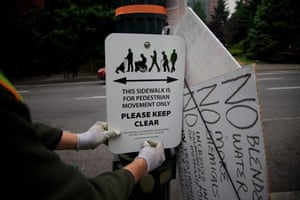
People from Portland Habilitation Center replace signs around Portland, Oregon. Photograph: Benjamin Brink/AP
Public-safety statistics do not appear to fully validate Boyle’s concerns. While Portland’s police-officers-per-capita numbers are low compared to US cities, FBI crime statistics show crime is down locally on a broad range of measures.
“I think that we can safely say that our crime stats are much lower than they are in a lot of other cities,” said police spokesman Sgt Christopher Burley. The Portland police bureau “does not capture” housing data and cannot assess whether homeless people commit more crimes than others, Burley said.
Boyle has said he’s received a lot of support since speaking out. And even those on the other side acknowledge it is not cut-and-dried.
“It’s hard for me to read [Boyle’s statements] as anything else but: ‘I really don’t want homeless people outside of my business,’” said Gregory McKelvey, co-founder of Portland’s Resistance, which was formed in response to Donald Trump’s election. But he noted: “My mom actually is on the opposite side of this issue. She works downtown, and she’s like, ‘Sometimes I feel unsafe’. I obviously had to think about that. That could be a valid point.’”
Ironically, it’s possible some of those camping in Columbia Sportswear’s doorways are wearing its jackets. In November, Columbia donated 25 boxes of clothing to a nonprofit that manages nine shelters in the metro area. It’s one of many philanthropic efforts by the company and its employees.
This article was amended on 12 December 2017 to correct a reference to the Trump administration’s shrinkage of national monuments in Utah, and to reflect the ambiguity in Tim Boyle’s comments regarding the context in which he wrote his op-ed.
The soft voice from inside the tent could barely be heard over the howling wind, freeway noise and wild flapping of the tarp. So Tiffany Grigg, perched on a milk crate in the mud, leaned in to listen.
It was a 45-degree November morning, and the gray-and-turquoise tent sat in the middle of a forlorn field next to Interstate 84 east of Portland. Empty cans of Steel Reserve malt beverage and a nearby four-wheeled walker hinted at hard times.
Grigg ignored the pelting rain and listened to the homeless man inside the tent for what seemed an eternity before finally bouncing back to the relative shelter of her Toyota 4Runner. There had been no breakthrough, no epiphany, but she had made a connection, and that was the point.
“When was the last time a person sat with him that didn’t want his [debit] card, or booze?” asked Grigg, an outreach coordinator with the Clackamas Service Center. “It took that long for him to start talking about himself, for real.”
Part of what makes Grigg’s job matter isn’t just how, or why, she does it. It’s where.
“Your wording is everything,” she corrected McQueen, offering as an example, “What can we do to help you get to where you want to go?”
“It’s going to take some sitting down by the fire in the dirt with him,” Grigg told two other deputies about a client they planned to visit. “What if you could take a ball to throw with him? He’s intimidated by you guys.”
Grigg also partners with local faith communities, retrieving blankets from a modular container in a church parking lot. Because of her faith, she says, she doesn’t hesitate to take solo trips well after dark. Is she ever afraid?
“I’m never by myself. I’ve got God,” she said.
Plus, she explained, night is a preferred time for her target population.
“People are more comfortable moving in the dark,” Grigg said. Homeless people “get stared at during the day.”
During a late-night November outreach effort to the camps, Grigg went over fences and down steep, muddy inclines under bridges. She alternately joked with or scolded people who came up to her for blankets, boots and batteries.
One man literally danced a jig after shucking Adidas sandals to don the socks and leather boots Grigg handed him in the cold drizzle.
“Heroin addict!” the man yelled at her, with a rough laugh.
“I prefer the term ‘Junkie — Retired,’ ” Grigg shot back lightly.
The man had no tent to stave off the cold and ubiquitous damp, and he clung tightly to the two blankets Grigg gave him.
“You eat, and stop moving, you’ll be good,” Grigg told him.
A homeless woman got a blanket too. She paused on her way back to sleep in a car.
“She’s gotten me out of a lot of situations,” the woman said. “She’s my lifeline. She makes me feel safe. She comes at the right angles.”
Nearby, Grigg worked on a man’s tent, which had been ripped open by an intruder and was taking on water.
“Watch MacGyver work,” Grigg joked, maneuvering a zip tie.
Then Grigg, who moved remarkably fast even in three pairs of pants to fend off the cold and wet, headed under more bridges — muddy, damp, graffiti-filled places along Johnson Creek.
She woke a man who yelled out before recognizing her. She laid a blanket on him.
Grigg then dug through plastic bins in her truck to produce an unexpected item: a pair of foam earplugs. She grinned ear to ear as she held them up.
“The flapping of the tarps could bother him,” she said.
Since Grigg started at the service center, Mason estimates, she has helped 280 people get off the streets.
But Grigg declines to take credit.
“I have not gotten anybody indoors,” she said. “They have gotten themselves indoors.”
Released in November 2017, “Baralku” by Emancipator shot immediately to the top of the iTunes Electronic album charts. I play the lead hook on the title track and a blues solo on the album’s first single, “Goodness.”
Billboard’s review notes that the violin “consumes a large amount of the album’s melodic space — with surprising flexibility.” That’s certainly a tribute to Doug’s crafty production work, which is always leavened with strings, and the work of Ilya Goldberg, aka Lapa, the strings player in Emancipator Ensemble.
Despite Increased Enforcement—and Misinformation—the Agency No Longer Has Public Information Staff in the Pacific Northwest
AROUND the same time US Immigration and Customs Enforcement (ICE) was sending out erroneous media releases about mass arrests in Portland and Seattle last month, it was “creating terror” with unreported stings in Woodburn, Oregon, says the president of a farmworker organization.
Readers across the region were confused in late September when ICE media releases repeatedly exaggerated the arrests of undocumented immigrants in the Pacific Northwest.
First, ICE proclaimed 33 arrests in Portland, until the agency was forced to admit the number was actually four. It did much the same in Seattle—claiming 33 arrests before offering the actual number: one.
Meanwhile, ICE agents were conducting raids on two farmworker families in Woodburn, affecting 15 people, says Ramón Ramírez, President of Pineros y Campesinos Unidos del Noroeste (PCUN), the Oregon farmworkers union.
“Those 15 people are terrorized—we had to bring in counselors,” Ramírez says. “Fuck all those numbers.”
The erroneous media releases and concurrent lack of info regarding a raid in Woodburn underscore a larger truth about local attempts to figure out what’s really going on with ICE: It’s practically impossible.
As concerns about the agency’s actions have reached a fever pitch, two media professionals assigned to the Pacific Northwest left the agency. ICE currently has no local spokesperson for the region.
“I think that the fact that they don’t have any [local] media folks is very dangerous, because what’s essentially happening is the public is not aware of what’s going on, what [ICE’s] actions are in the community,” Ramírez says. “I think it’s deliberate, so the public doesn’t know. And that is very dangerous.”
Pacific Northwest journalists who cover the agency say the way it handles information is a joke. Reporters the Mercury spoke with asked to remain anonymous so they could be frank without risking their jobs.
“Every time you try to get ahold of them, it’s kind of a shit show, honestly,” says one. “You don’t know when you’re going to get somebody, [or] how long it’ll take [them] to get back to you.”
“I don’t honestly wait for them to publish stories anymore,” he added.
Another used a different expletive to describe the agency’s repeated peddling of false or misleading information.
Meanwhile, the Oregon Department of Justice announced Tuesday it is joining nine other states in suing the US Department of Homeland Security, of which ICE is a part, for failing ro release enforcement records.
The September gaffe isn’t the only misstep by ICE’s PR team since President Donald Trump took office and began cracking down more harshly on undocumented immigrants. The agency’s “Declined Detainer Outcome” program targeted sanctuary jurisdictions like Portland and Seattle, which don’t hold undocumented immigrants facing criminal charges despite federal requests.
Under the program, ICE’s website showed which jurisdictions decline federal requests most, plus a list of “notable criminal activity” by individuals—a move that depicted majority-Latinx undocumented immigrants in agency custody as hardcore criminals.
The program was discontinued on February 17, after just three weekly reports, amid criticism for being an effort to “shame” sanctuary cities. Salon.com, for example, compared it to Breitbart’s use of a “Black Crime” tag.
ICE’s practice of making it difficult to interview detainees also helps keep the undocumented-immigrant-as-criminal narrative alive.
“We’ll reach out to the individual to see if he or she is willing to provide signed consent to meet with you,” a spokesperson told this reporter last month. “If the detainee consents, we’ll make arrangements for you to meet with him or her.”
But when a source found a willing interviewee in custody, Angel Alonso Lujan-Gonzales, the agency added bureaucratic roadblocks: Before an interview could be granted, the detainee’s attorney would have to sign a form, and the agency didn’t respond to a request for the attorney’s contact information.
“They find no benefit in having an information outflow that they’re not totally in control,” says Leland Baxter-Neal, a Portland immigration attorney. “More than ever that’s true under [ICE Acting Director] Tom Homan.”
ICE says it’s planning to replace its two recently departed media relations staffers, but its current lack of any local spokespeople suggests the region is a low priority.
“There’s nobody in the Pacific Northwest at all? Wow,” says Andrew DeVigal, a journalism professor at the University of Oregon. “That seems to be a challenge.”
For a month, until last Thursday, ICE’s media webpage listed Rose Richeson as spokesperson for the region, even though an email autoreply it made clear Richeson had departed. ICE updated the webpage after the Mercury asked about it, but did not respond to emailed questions.
Richeson’s replacement, Virginia Kice, also just retired.
“Oops—you’re too late. I retired at the end of September,” Kice’s autoreply announced. Even before that, Kice declined to respond to questions about ICE policies, saying, “we are severely short-staffed” and “underwater right now.”
It’s business as usual, says one of ICE’s national spokespeople.
“Turnover is a very normal part of the public affairs business and we are working to backfill positions that have been recently vacated,” wrote Sarah Rodriguez from ICE’s main media office in Washington, DC.
Using email to avoid verbal communication is also apparently standard operating procedure. “We just have a process, that all media reporters submit their inquiries to the ICE media [email] address,” said spokesperson Angela Price, also in DC.
Given the agency’s tendency to respond to questions with terse answers, the process leaves huge gaps in information. That might be the point.
“If they’re a government agency that’s under the umbrella of an elected official and if it’s taxes that’s paying for these services, you would think there’s a greater need for transparency for activities they’re conducting with the public,” DeVigal said.
A reporter and an immigration attorney the Mercury spoke with described ICE as short-staffed in Oregon. Others speculated that representing the agency at the front lines of Trump’s xenophobic, anti-Latinx, anti-immigrant policies—especially with stiff resistance across Cascadia—is a tough job.
Mat dos Santos, legal director of the ACLU of Oregon, says the agency’s public relations reflects its main strategy: “to keep things as opaque as possible [and] increase enforcement irrespective of the Constitutional or human costs.”
“We just don’t know what happens,” dos Santos said, noting the recently bungled press releases. “Even their sort of modest attempts to be transparent feel more like marketing to Trump’s xenophobic base—and by the way, they got [the numbers] wrong.”
In September of 2017 Emancipator released a single, “Goodness,” in advance of a full album due in November called “Baralku,” on the artist’s own Loci Records.
The song, on which I play a slow bluesy doublestop shuffle on violin and take a brief solo, hit #43 on the iTunes Electronic song charts. Billboard, which premiered the song, described it as “a jazzy delight … easy on the mind, body and soul.”
In September of 2017 East Forest released an LP “Cairn,” featuring Keith Sweaty, on which I play violin and viola. It hit #200 on the iTunes Electronic music charts.
I play on three tracks on the album, the first, “Fresh Start,” as well “Tiny Choices” and my personal favorite, “Snake Skins,” which you can listen to here:
In Portland, which prides itself on being a beacon of progressive politics, the practice of using prisoner work crews is painted as a win-win – but that’s not how some see it
In many places in the US, the fraught job of clearing out a homeless encampment is given to professionals. In San Francisco, Los Angeles and New York, for example, the job often falls to city employees in public works or sanitation departments, who might get paid upwards of $16 an hour.
But in Portland, which prides itself on being a paragon of progressive politics, inmates at the county jail get $1 a day – enough to buy a Butterfinger at the commissary – to do the work.
Some of the inmates sifting through or dismantling homeless dwellings were previously homeless themselves, making for a bizarre merry-go-round. The job can make it feel as if their worlds are colliding.
Jeff Nelson was homeless for 13 years and on an inmate work crew for six months. He remembers dealing with a well-tended tent in Portland’s Hollywood neighborhood – like one he might have lived in himself.
“You looked in there, and the bed was all made, and family pictures, and that was someone’s home,” he said. “And they made us take that down, and throw it in the fucking trash. And it’s like, what are you doing?”
He added: “It’s just straight up bullshit, but that’s the way the system rolls, and we have no choice [but] to roll with the system.”
That system was on full display one recent morning. Two homeless women with cigarettes in their hands watched as an armored truck with flashing lights pulled up to their campsite. A sheriff’s deputy let out five jail inmates in orange jumpsuits, who grabbed trash-picking tools and plastic bags.
“I don’t think it’s right,” said Amber, 25. “They don’t know if the inmate is going to have to see their partner, their mom, or someone they know.”
Her friend, Heather, said she recently saw a work crew member with whom she had been intimate when he was homeless. “He was across the street cleaning my campsite,” she said. The sight made her despair. “I told him that I loved him,” she said.
It is practices like this that suggest the grittier complexities beneath Portland’s international image as a beacon for neo-hippies and foodies.
The city of Portland pays a contractor, Pacific Patrol Services, $117,557 a year to clear homeless camps, some of which is done in conjunction with teams of inmates from the county jail. The Oregon department of transportation, or Odot, meanwhile, pays up to half a million dollars a year for jail inmates who take care of the land it owns along freeways, said spokesman Don Hamilton. These crews now focus exclusively on homeless camps, he said, whereas five years ago homelessness was only a minor focus.
As homelessness has increased in Multnomah County, inmate work crews hired by Odot have shifted from cleaning roadside litter and landscaping to cleaning up homeless camps. Photograph: Amanda Leigh Smith for the Guardian
In Portland, as elsewhere, the practice of using prisoner work crews is painted as a win-win for the public, with inmates being rehabilitated as public spaces are improved. The sheriff’s office stresses that inmates with certain types of sentences are eligible for reduced sentences based on their participation in crews. Yet increasingly, deploying them in this way is coming under criticism in the Pacific Northwest, where they have been engaged to clear homeless encampments in at least three cities.
Last year, the Human Rights Commission in Seattle adopted a resolution raising “serious moral issues” with the practice. “Penal labor is widely considered a vestige of slavery, and the commission is concerned with our city perpetuating the practice,” the group wrote. In response, the city stopped the practice after 23 years. The nearby city of Olympia similarly took steps away from the practice last year, partly because of hazards to inmates, such as being stuck by empty needles.
But in Portland, there has been no such shift. Hamilton paused when asked whether he had reservations about using inmates to clear homeless camps.
“That’s not really a concern of what Odot needs to look at,” he said.
During a recent sweep, inmates worked amid verdant undergrowth to break down and clean up a camp, dismantling and disposing of tents, mattresses, bicycle parts, clothing and trash. They held plastic bags open for one another, and dropped used syringes into a sharps container.
“Anything’s better than sitting in a cell all day, losing your fucking mind,” said Alex Sosa, 25. “Smelling everybody’s farts from the baloney they serve you every day.”
Three inmates listening to Sosa, all tanned from cleaning camps through the summer, laughed. As they described it, their work is important and necessary. All four said they were in jail for driving under the influence – the sheriff’s department doesn’t assign anyone to crews outside the jail if they have committed a person-to-person crime, said spokesman Lt Chad Gaidos.
Although none of the four inmates said they had ever been homeless, the people in the camps are sometimes familiar to them. “We see the same faces out here in the camps that are in our dorm, in the jail,” said one of the men, Colby Robillard, 26. “I recognize their faces.”
Deputy Jana McCallum stood with her hands on her utility belt and watched the work from behind wraparound sunglasses. She said there is a “vicious cycle” involving jail, homelessness and the work teams, and had once found a former crew member living in a homeless camp.
“He looked healthy when he was in jail, because he got a chance to clean up. And then he gets back out and you can tell he’s been weathered,” she said. “He comes up to me and he says ‘Hey, how you doing McCallum?’ And I said, ‘Good – you’re looking kind of tired.’ He says, ‘I’m high right now, and I’ll probably see you guys in a little bit.’”
Such interactions underline the connection between homelessness and incarceration. Between one-quarter and one-half of homeless people have a history of incarceration, a 2013 study noted, and a fifth of all homeless people in the UK have committed a crime to get off the street, according to a 2010 survey.
Being homeless doesn’t necessarily lead to crime, but a criminal record can mean rejections when applying to rent property, for instance, while drug use, which is more common on the streets than among the general population, raises the risk of encounters with police.
As difficult as Portland’s inmate sweeps are for many of those involved, not least those who careen between homelessness and the work crews, they can also have an unintended, cautionary effect.
Robillard, the inmate, said the upsetting things he sees while cleaning the camps serves as a reminder of how close he has come to the edge in his own struggles with drugs. If his DUI wasn’t a wake-up call, then the camp cleanups are.
“I never want to get to that point,” he said, glancing at the nearby camp. “I don’t want that to be me.”
A few feet away, a few minutes later, a homeless man named Dave D gave a similar warning about incarceration while loading up six shopping carts. “Better not to get in trouble,” he said.
Homeless villages offer residents what shelters often can’t: a sense of safety and a chance to reconnect
PORTLAND, Ore. — Helping to build the homeless village where he lives has given Bob Brimmer’s life focus, he says.
More than that, living there has helped him heal from a tough childhood that included stays in homeless shelters in upstate New York.
“My dad died when I was in ninth grade from a drug-induced heart attack, and then my mom lived in Section 8 housing,” says Brimmer, 23, who has an associate’s degree in math and science.
Brimmer’s income would have “spiked” his mother’s rent if he’d stayed with her, since the cost of her federally subsidized apartment was based on her household’s ability to pay. Brimmer saw it as a reason to leave. He started “couch surfing” with friends, but they lost their apartments, so he used his last tax return to buy a three-day Greyhound ticket to Portland. He had no place to stay when he got here.
Brimmer wears a trimmed, reddish beard and dreadlocks, which he pulls back in a ponytail. He favors jeans, or work pants with paint specks, a white T-shirt and boots. He anchors the leash of his black Labrador to a rope tied in a hangman’s noose around his waist.
“When I first came out here, I kind of fell into that trap of just getting drunk every night — I’ve got, like, six bucks; that’s two pretty powerful drinks, like Schlitz or Four Loko,” Brimmer says. “You drink two of those and you’re going to be pretty schwilly. But once you start relying on that, eventually the depressing effect kicks in.”
Enter Joe Bennie, a board member and former resident of Hazelnut Grove, a homeless village in North Portland’s Overlook neighborhood that was founded in 2015 as a group of tents. Bennie, who has construction industry experience, taught Brimmer tricks of the trade while building the village, which has developed into a cluster of 16 or so tiny houses, with a bathhouse and a tiny library filled with several hundred books.
Residents share an outdoor kitchen at Hazelnut Grove, which has no running water or wired electricity. PAMPLIN MEDIA PHOTO: Adam Wickham
Brimmer lives in a bunkhouse at the north end, woven into the woods alongside North Greeley Avenue. The village’s spine is a rickety, raised plank walkway that residents jokingly call the “Raised Walkway of Death,” or “Captain Jack Sparrow’s Flight.” One disabled resident who is a veteran travels the precarious route in her electric wheelchair, a feat which is astonishing — and scary — to watch.
“If it weren’t for Hazelnut Grove,” Brimmer allows, “I am pretty sure I would have went the wino route of homelessness, to be honest.”
Keys to Healing
On June 19, officials announced that the number of men, women and children living in shelters and on the streets in Multnomah County jumped by nearly 10 percent over the past two years. In the face of this continuing crisis, one unconventional housing solution appears to be gaining followers, and even becoming a Rose City export — the homeless village.
Dignity Village, shown in March, turns 17 years old this year. PAMPLIN MEDIA PHOTO: Lyndsey Hewitt.
Put simply, a homeless village is a group of houseless people living together and sharing self-governance, trash, water and toilet service, and a social support system. Portland is near the fore of the movement, led by the grassroots group the Village Coalition, and is home to what is probably the country’s oldest continuously sited homeless village, Dignity Village, founded in 2000.
Three others followed: Hazelnut Grove, Right 2 Dream Too, which recently moved from Old Town to a parking lot near the Moda Center, and Kenton Women’s Village, Portland’s newest and most mainstream version, which opened with public and neighborhood backing in North Portland’s Kenton neighborhood on June 10.
Homeless villages don’t work miracles, supporters acknowledge, but they do give chronically homeless residents a secure place to sleep and keys to healing that shelters and transitional housing programs can’t always match.
While a homeless village can evolve from a tent camp, access to a locking door may be its most basic single element. For a homeless person who struggles just to find a safe, legal place to sleep, a locking door means possessions won’t get stolen if there’s an appointment. Sleep is possible without threat of physical or sexual assault.
Such security is a critical feature of Kenton Women’s Village’s 14 “sleeping pods,” designed by architectural firms, shepherded by Portland State University’s Center for Public Interest Design.
At Hazelnut Grove, the tents staked in 2015 are gone, and “everyone is living behind a locked door,” says Vahid Brown, Housing Policy Coordinator for Clackamas County and Village Coalition steering committee member.
In May, the Village Coalition discussed plans to help Right 2 Dream Too, which lets its “overnighters” sleep in a covered, outdoor common space, secure 22 new 8-by-8-foot sleeping pods. In June, 10 of the pods, built by Benson High School students, had been installed at the village’s new site.
A lockable door is not a rental contract, or a mortgage. But houseless people say it’s a huge step up from a sleeping bag, or a sidewalk.
One Dignity Village tiny house being restored by Rick Proudfoot, the village’s spokesman, features a wooden sculpture of a dragonfly above its door. Photo by Thacher Schmid.
Most dwelling units in Portland’s homeless villages are unsophisticated, made from plywood and other materials gifted by the ReBuilding Center and other donors. Still, they are much-loved, with personalized, artistic details. Some have small porches, shaded windows, small places to sit.
There are usually windows — each of the Kenton Women’s Village’s pods has windows that open — and sometimes a second floor, but a twin-size bed takes up most of the floor space. These aren’t the luxe-craft tiny homes seen on the HGTV series “Tiny House Hunters.”
This is about dignity, supporters say, as the founding village’s name suggests.
People Who Know You
Focus on the physical aspects, and you might miss the most important thing about homeless villages, Brown says: social infrastructure.
“There’s a secret sauce that the village movement is trying to get across,” Brown says. “This isn’t just about having a safe place to sleep and a door they can lock. It’s about the community that emerges within the village.”
Forty-six percent of homeless adults live with severe mental illness and/or substance use disorders, according to the National Alliance on Mental Illness.
Dignity Village resident Scott Layman is one of them. He says Dignity Village provides a support system that helps him live with schizophrenia and support others struggling with mental illness.
In May, a tiny-house-size pile of charred plywood told a sad story near the north end of the community. Layman says the person who lived there left a candle unattended, defying a rule against open flames. The owner’s house was destroyed, and three adjacent houses damaged, before, before villagers and firefighters extinguished the blaze. Later, during a village council meeting, the resident laughed about the episode.
The council put the man, whom Layman believes might have untreated mental illness, on a 90-day leave from the village.
Layman recalls his own struggles with mental illness. Before he found Dignity, Layman was hearing voices, living in “zombie houses,” and camping in the woods. “The village gave me a place to land, to get me going in the right direction,” Layman says. “If I’d had to keep going I might not be with us right now.”
Layman tries to give back to others who suffer from mental illness. “I try to help as many of those as I can,” he said, his voice breaking, staring at the charred pile.
Hazelnut Grove residents Tequila Gordon (left), and Loki Hamilton build a flower box for the tiny-house village. PAMPLIN MEDIA PHOTO: Adam Wickham.
Top local officials, including Multnomah County Board Chair Deborah Kafoury, have taken note of the village’s peer support mechanisms.
“I think I have been more supportive of those organized villages as opposed to some of the camping that’s springing up,” Kafoury says. “Having some type of social contract, it’s amazing. They support each other. For a lot of people who are struggling to end their homelessness, with other issues they bring along, having a support system around you is crucial to your staying on track.”
Trauma is both a cause and a consequence of homelessness, according to the National Health Care for the Homeless. Supporters say villages offer a community with whom isolated homeless people can reconnect.
“When you lose housing, a lot of your links to society are untethered,” Brown explains. “The alienation just accumulates day after day, as you’re treated and seen by the rest of the community as an outcast. Healing that rift requires more than just getting housing.”
Moving Forward
The Village Coalition, a grassroots group made up of village residents, formerly homeless individuals and their allies, thinks villages are part of the solution.
“Business as usual doesn’t meet the scale of the problem,” says Village Coalition steering committee chair David Bikman.
Kenton Women’s Village, which the Village Coalition was instrumental in planning, could become the feather in the movement’s cap. It is Portland’s first village developed as a partnership among activists, governments agencies, neighbors, architecture firms and a social service provider, Catholic Charities of Oregon.
The 96-square-foot “sleeping pods” at Kenton Women’s Village, which opened in June, don’t provide much living space, but they do offer residents a safe place to sleep and to store belongings. PAMPLIN MEDIA PHOTO: Jaime Valdez.
It’s too soon to assess the success of this “pilot” project and whether it can be replicated. But its political support, physical beauty and comparatively low cost — $175,000 is budgeted for the next fiscal year — may give it broader appeal than Portland’s other three villages.
At a June 9 media event, there were plaudits. Catholic Charities Executive Director Richard Birkel said the Kenton Women’s Village “may very well be the most creative application of what we know” in helping to put homeless people on the path to permanent housing.
“There’s so much good that will live on and carry on into the future,” said Michael Cox, spokesman for Mayor Ted Wheeler.
As for the 14 women who were notified of their acceptance to the village, “Their reactions were crying, screaming, like ‘I feel like I won the lottery,’” said Catholic Charities Case Manager Bernadette Stetz.
Their enthusiasm is shared by others who know the struggles of living on the streets, people such as former Hazelnut Grove resident Jaison Kirk.
“Villages are part of remembering who we are as humans,” said Kirk.
This story is part of “Giving Ground,” an investigative series exploring the rise of the homeless village movement. It is produced by the Open: Housing Journalism Collaborative, a joint project of Open: Housing, Pamplin Media Group and KGW. Look for other stories in this and related series at OpenHousing.net.
On June 10, 14 residents moved into 14 tiny houses in Portland’s first government-supported homeless village.
Just 18 days later, two residents were gone.
One was evicted for “highly disruptive” behavior, said the director of the nonprofit that co-manages Kenton Women’s Village. Another voluntarily returned to the streets to get away from what she described as verbal abuse and constant conflict.
But another resident, Jewel Ramirez, has decorated her tiny house with photos of her family. “I love it,” she said.
The contrasting reactions reflect the problems — and the promise — of a project that charts new territory in Portland, marrying public funding and nonprofit oversight with a type of shelter that was born out of protest. Homeless villages have popped up on their own in Portland and in other cities in the past, and they’ve been run by their own quasi-governments.
Kenton Women’s Village, however, is part of a grand plan to fight homelessness and has been surrounded by buzz and the support of top local officials, including Mayor Ted Wheeler and Multnomah County Chairwoman Deborah Kafoury.
Executive Director Richard Birkel of Catholic Charities of Oregon, which co-manages the village, said the early struggles reflect the village’s “hybrid” model, one that he said has “never been done before.”
“There are dominance issues” among residents, Birkel said. “Who’s going to rise to the top; who’s going to be the alpha? We’re monitoring that carefully.”
Already, the agency is adding a second village manager position and a nighttime guard, upgrading mental health services and changing the village’s physical layout to add privacy.
Birkel acknowledged missteps. In retrospect, the nonprofit should not have declared an initial 30-day period of “rest and recovery” before offering some services, he said. “Some women were ready and needed intensive services from Day One, and we should have been providing that.”
The village’s “sleeping pods,” which look like little cabins, have no heat, air conditioning, plumbing or wired electricity, but they do have lockable doors and solar panels to power a cellphone. Modular containers serve as shared kitchens and bathrooms. Trucks pass in front of a locked 6-foot fence, and the howls of cars at a nearby racetrack alternate with horns blasting from passing freight trains.
Federal and state cuts to social services and affordable housing programs, combined with Portland’s growing homeless population — up 9.9% since 2015 — have spurred officials to look more closely at the village model. Other cities, such as San Jose and Seattle, either have homeless villages or are considering them.
The pods afford autonomy and privacy for less money than a traditional shelter, advocates say. “If you don’t like somebody, you can go in your own pod,” Ramirez said.
“It is very democratic,” she said. “You get into your routines, you get to know each other and their boundaries. All in all, I think it is a very positive thing for me.”
Ramirez is diabetic and nearly deaf, surviving on a $735 monthly Social Security payment. Sixty-one percent of the county’s homeless population — 4,177 people by a recent count — report living with disabilities such as a mental illness, chronic physical condition or addiction.
Two of Ramirez’s fellow villagers, April Langworthy and Lynette Ingalls, shared a high-five last month to celebrate Ingalls’ three months of sobriety.
“I quit doing dope to get in here,” Ingalls said. Her drug of choice, she said, was methamphetamine.
Village residents April Langworthy and Lynette Ingalls celebrate Ingalls’ three months of sobriety. (Thacher Schmid / For The Times)
The recent count, released June 19, found the region’s homeless population is getting older and is disproportionately made up of people of color — dynamics reflected at Kenton Women’s Village. Ten of the village’s original 14 women are 50 or older, and four are women of color, Catholic Charities staff said.
The hard times are harder to quantify. Ramirez was 6 when she was taken away from her mother. One of Langworthy’s two adult children died serving in Afghanistan.
As Langworthy and Ingalls talked in the parking lot outside the village’s fence, they were interrupted by other women from the village. A shouting match ensued.
“Community living is just tough,” Langworthy said.
Disabilities such as mental illness and addiction probably contributed to the village’s struggles — Birkel called disability a “huge” factor.
The chaos was bad enough that a homeless man living under a tarp in the parking lot noticed it. The village is “pretty cool,” said Noah Haskett, 30, “but every time I come around there’s always conflict with the women.”
The woman who returned to the streets said two residents used racial slurs against her, more than once.
Birkel said that he has “no knowledge” of the use of racial slurs at the village, and that his organization doesn’t accept such behavior. Still, he said, “I’m not sure what staff could have done, except point out that it’s unacceptable.”
Such ambiguity may be related to tensions in the village’s “hybrid” model.
“A purist might say, ‘This isn’t really self-governing,’ and I would say, ‘That’s correct,’” Birkel said. “We’re trying to use some of the brilliant elements from self-governance, but we can’t replicate that correctly.”
The city of Portland and Multnomah County have budgeted about $350,000 for the village’s first year, Denis Theriault of the Joint Office of Homeless Services said. About $218,000 of that is going to Catholic Charities, a county document shows.
Ibrahim Mubarak, co-founder of two other homeless villages in the city, Dignity Village and Right 2 Dream Too, said government and big nonprofits don’t understand grass-roots self-governance.
“If the city starts it, it’s not going to be successful, unless they have the houseless people leading it, because they don’t understand living on the street,” Mubarak said.
Kenton Women’s Village is meant to be a way station, not a final destination. The goal is to help residents find permanent housing, Birkel said, which differentiates it from Portland’s other villages. Indeed, residents sometimes do languish at homeless villages: At Dignity Village, three residents said in interviews that they have lived there seven to 10 years.
“People aren’t going to be here five years,” Birkel said. “They’re not even going to be here 14 months.”
The village’s sponsors hope a community will develop, and there are signs that is indeed happening. Birkel said women are working together to paint their pods and plant community gardens. Seven residents were paid $20 apiece to create the Kenton Women’s Village Water Station at the Portland Marathon; afterward, each put half her take toward a first-ever village barbecue.
The group also rallied around a woman who recently lost her husband.
“To watch the community respond to her and her grief was amazing,” Birkel said. “I think these are early signs that the community is beginning to gel.”
This story was first published in the Los Angeles Times.