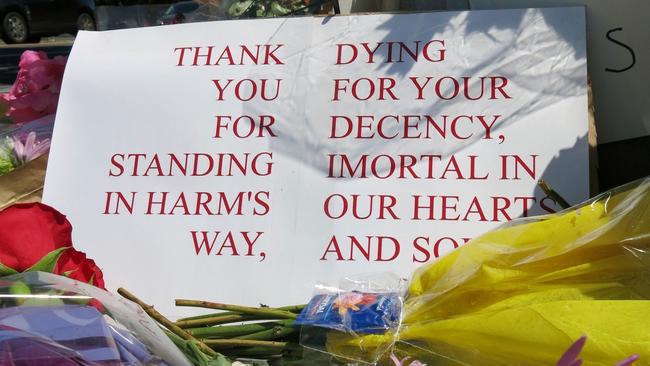
• Portland praises its heroes after fatal stabbing

    When he was in college, Taliesin Namkai-Meche took an introductory religion class on Islam and impressed his professor with a deep desire to understand how others see the world.

    Rick Best spent years in Muslim countries as an Army platoon sergeant in Afghanistan and Iraq.

    And Micah Fletcher won a Portland poetry competition in 2013 with an entry about prejudices faced by Muslims.

    Those details, reported by the Oregonian newspaper, may help explain why the three men acted in a way that has much of Portland praising them as heroes.

    On Friday night, they found themselves in the same train car in Portland’s light-rail system when a 35-year-old white supremacist named Jeremy Christian began shouting anti-Muslim slurs at two teenage girls, one of them wearing a Muslim head scarf, police said.

    The details of what happened next are still unclear, but when the men intervened and placed themselves between the girls and Christian, he pulled out a knife and stabbed each in the neck, police said. Best, 53, was killed at the scene, and Namkai-Meche, 23, died at a hospital. Fletcher, 21, remained hospitalized Sunday and was expected to recover.

    “Their actions were brave and selfless and should serve as an example and inspiration to us all,” Portland Mayor Ted Wheeler said. “They are heroes.”

    “I hope that the three families of the three heroes recognize the significance and the magnitude of what their loved ones did,” said Harris Zafar, spokesman for the Ahmadiyya Movement in Islam mosque in southwest Portland. “It’s inspiration that they’ve given frankly to the entire country.”

    He said the Muslim community in Portland aimed to collect $60,000 in donations for the victims’ families. “There is an overarching sense of gratitude and really just affection that the Muslim community wants to convey,” Zafar said.

    On Sunday, the home page of the Oregonian featured a photograph of Namkai-Meche’s mother, Asha Deliverance, forehead to forehead with a young Muslim woman in a head scarf at a vigil held at the transit center where the attack occurred.

    “That was a very stark image for me,” Zafar said. “It just showed that the inspiration is not just from the three themselves who stood up, but clearly this is part of their families — look at the courage that even the mother is showing.”

    Namkai-Meche graduated last year from Reed College in Portland with a degree in economics and was an intern at a consulting firm. The college said it was planning a memorial.

    “His enthusiasm was infectious,” Namkai-Meche’s family said in a statement. “We lost him in a senseless act that brought close to home the insidious rift of prejudice and intolerance that is too familiar, too common.”

    Best, who had three teenage sons and a 12-year-old daughter, worked for the city’s Bureau of Development Services, which planned to make counselors available when the staff returns to work Tuesday. He made news in 2014 with an unsuccessful run for Clackamas County commissioner in which he refused to accept campaign donations.

    Fletcher was on his way to work at a pizza shop when he was attacked.

    When his poem about anti-Muslim prejudice won the contest in 2013, he told the Oregonian, “I just hope that people are listening and try to do something about it.”

    The suspect, Christian, was arrested and charged with murder and attempted murder. He could also face hate crime charges, police said.

    He was photographed by a newspaper in April giving a Nazi salute at a Portland rally, and his Facebook profile contains neo-Nazi statements such as, “Yep. Im a nazi [sic],” “Hail Vinland” and “I will defend the Nazis.”

  • White supremacist identified as suspect who fatally stabbed 2 after anti-Muslim rant

    A 35-year-old white supremacist with a criminal record has been identified as the suspect under arrest in connection with the stabbing death Friday of two people on a light-rail train in Portland, Ore., who intervened when he began to hurl anti-Muslim epithets at two women, one who was wearing a hijab.

    Jeremy Joseph Christian of North Portland was jailed early Saturday on two charges of aggravated murder, attempted murder, intimidation in the second degree and felon in possession of a restricted weapon. Christian is being held without bail, and could face additional charges when a district attorney presents the case to a grand jury, police said.

    The incident occurred on a light rail line during rush hour Friday. The two men who were killed appear to have been good Samaritans who stepped in to protect the women from racial slurs. A Facebook post from his mother said one of the two men who was killed was Taliesin Myrddin Namkai Meche, a recent graduate of Reed College.

    “Taliesin Myrddin Namkai Meche, My dear baby boy passed on yesterday while protecting two young Muslim girls from a racist man on the train in Portland,” the post said. “He was a hero and will remain a hero on the other side of the veil. Shining bright star I love you forever.”

    LATfoto1
    Police investigate a deadly stabbing on a Metropolitan Area Express train in northeast Portland, Ore., Friday, May 26, 2017. (Jim Ryan / Associated Press)

    Police said the names of the victims, including another man who was injured, will be released Saturday afternoon after autopsies are conducted.

    Larry Blackwood was riding in an adjacent car as the train car filled with commuters pulled in to the Hollywood Metropolitan Area Express — known as MAX — light rail station, and described hearing a woman’s “gut-wrenching” scream: “He’s stabbing people, he’s stabbing people!”

    He jumped off the train, he says, and faced a horrific scene.

    “As I ran off the MAX, I seen two people bleeding out of their necks,” says Blackwood, 27, a lunchtime cook at Portland City Grill on his way home from work. “Literally from the front to the back [of the car], there was blood everywhere. There was a man screaming, ‘Please, help my son, he needs a doctor!’”

    “Witnesses describe his verbal behavior as wide-ranging in the ethnicities he was yelling about,” Sgt. Simpson said. “I wouldn’t say he was just focused on one particular religion or ethnicity, I would say he was ranting about many things.”

    A Facebook profile that appears to be that of the man in custody contains neo-Nazi statements like “Yep. Im a nazi [sic],” “Hail Vinland” and “I will defend the Nazis.” The page is filled with vitriol such as “I want a job in Norway cutting off the heads of people that Circumcize [sic] Babies”) and shows Christian to have been a participant in right wing rallies in 2017 in Portland.

    Imam Mikal Shabazz, director of the Oregon Islamic Chaplains Organization, said late Friday Police Chief Mike Marshman’s office made it clear to him they view the crime as a hate crime.

    “More than the fact that this individual was alleged to have made Islamophobic statements, when the chief’s office called, they did confirm that they’ve come to the conclusion that this is a hate-related crime, and they held off doing so until they had enough reason to say ‘Yes, this is what it was.’”

    The attack occurred on the first day of Ramadan, the holiest of Muslim holidays.

    “Certainly it’s not lost on us that this horrific act occurred on the beginning of Ramadan,” Simpson said. “While we don’t yet know the motivations behind the attack, what we do know is there was some hate speech used leading up to the attack and that’s certainly very concerning.”

    Police are asking the public for help and hoping to obtain statements from other potential witnesses — starting with the two young Muslim women, one of whom reportedly wore hijab, a cloth that covers the hair. Like many on the train, the pair didn’t stick around after the attack.

    “I realize even saying ‘two young Muslim girls,’ you could go from East African to Central European. But that’s how they were described to us,” Simpson said.

    There have been recent hate crimes in metro Portland, one of the most heavily Caucasian large U.S. cities. Last year, 19-year-old Larnell Bruce was run over by an admitted white supremacist in a parking lot in Gresham, a suburb.

    But there’s been nothing targeting Muslims that rises to this level, police say.

    “If this turns out to be classified that way, certainly [there’s been] nothing of this caliber,” Simpson said.

    Friday night, people in Portland’s Muslim community were just beginning to grasp it, and reactions were emotional.

    “It’s just starting to reverberate out through the community what actually happened,” Shabazz said.

    Musse Olol, chairman of the Somali-American Council of Oregon, got the news after leaving a meeting with police and Muslim leaders to talk about security during Ramadan. Normally, he said, he would spend the first hours of the monthlong holiday worshiping.

    Instead, Friday night he was working the phones until the wee hours.

    “It’s the timing, that is what makes it very difficult,” Olol said. “It’s close to home. It’s too close for comfort. It’s worrisome.”

    Olol began weeping as he spoke of the two yet-unidentified men who died in the attack.

    “Most of the imams I talked to wanted to know who were these good Samaritans,” Olol said. “These two guys are the heroes, the story should be about them, not the terrorist and the girls who happened to be in the wrong place at the wrong time.”

    Read the rest of the story at latimes.com.


  • Lords of Portland: Portugal. The Man Stake Their Claim as the Rose City’s Best Band

    The success of Portland-based psych pop rockers Portugal. The Man is hardly just cup-runneth-over talent. The band’s released a dozen EPs and LPs dating back to 2005, all on top of an oft-hectic tour schedule.

    The group’s last effort—the 2013 Danger Mouse-produced, Atlantic Records debut Evil Friends—did not disappoint artistically or commercially, hitting #28 on the Billboard 200. But the guys got lost in a thicket during work on follow-up Gloomin + Doomin, says lead singer and songwriter John Gourley. Ironically, it may have all been due to the band’s own prolific recording abilities, which led them to start tons of songs they never finished. It was as if they began building a new house, bigger than any previous, but never thought to leave a doorway.

    “So we’re going along, working on Gloomin + Doomin, and we’re thinking about it like, ‘Oh, this is an important record,’” Gourley says. “Everything we’ve done, it’s important for us. [But] you get caught up in your own game and… you start to think about all these stories you’ve heard, about having like a hundred [unfinished] songs.”

    It took a trip back to his hometown of Wasilla, Alaska, before Gourley recognized that what worked for Prince, Elvis Costello or Paul Simon might not be right for Portugal. The Man.

    “You learn something every time you go into the studio,” he says. “The thing I learned about this band is to ask the question right at the beginning: How many songs do we want to write and record and put out on this album? Because you only really need that many. Nobody should be recording a hundred ideas, and laying them down like they’re good.”

    Back in Wasilla, there was a “tough love” conversation with his dad, who asked why things were taking so long, and the moment Gourley found his dad’s ticket stub from the original 1969 Woodstock music festival.

    Gourley and PTM ultimately made one of the most courageous, difficult decisions any artist can make: They threw out three years of work and started from scratch—with “new, full-on, musical boners,” as the group’s online bio jokes.

    Hard at work: Carothers and Gourley
    Hard at work: Carothers and Gourley

    Their new album? It’s called Woodstock. The early single “Feel It Still” suggests Gourley’s not exaggerating when he says this one’s special.

    “I feel like we made an album that sounds like a classic 2000 CD binder,” Gourley notes. “It’s our best record, and I look at that in many different ways. It feels really good.”

    It’s not unprecedented for a major label artist to chuck a whole album, but was PTM given a longer rope? The label won’t discuss it. An Atlantic Records spokesperson described it as “fairly unusual, not something I’ve ever run into before.” Meanwhile, the band’s website jokes, “there was the constant threat that the band’s record label might have them killed.”

    The changin’ times also had something to do with PTM’s reboot to a more politically charged aesthetic, Gourley says.

    “A lot of this record came about watching the way Trump uses Twitter,” he explains. “We were watching [the election] go down, like, ‘Man, this dude is so good at deflecting and just shutting this down, and stringing along the most fucked up, racist groups of people.’”

    John Gourley on top of the world
    John Gourley on top of the world

    The way the Alaska-born, Stumptown-adopted Gourley talks, being a Northwesterner, or Portlander, is about being fiercely organic: a lust for life and nature, buying local, rejecting artifice.

    Gourley speaks softly and laughs frequently. In a place and at a moment where many an artist would be cagey, he’s open—even transparent. He sports a hipster mustache with its own Instagram page but denies it holds special powers. “That facial hair will not get you anywhere in Portland if you don’t have something behind it,” he laughs. “The power is in the mind: I know where I’m at, I know what I do.”

    The twin currents that charge Gourley, and PTM, are reminiscent of those that have marked many a great artist:

    Play. Work.

    On the one hand, there’s child mind, humor, a melody that shimmers and dances, like Gourley’s own pitch-perfect falsetto. It may come from his five-year-old daughter, drunken antics with bandmates, his unique visual art.

    Gotta get up to get down
    Gotta get up to get down

    It’s in the group’s Twitter feed, dubbed Lords of Portland, and the video for late-2016 single “Noise Pollution,” which features Gourley doing pushups in an icy Alaskan river, perched 40 feet up a birch tree, and driving a magical, winking Pontiac Fiero (watch below).

    “That is the way I live my life—jump in the mud,” Gourley says. “You can’t be scared of fucking this thing up.”

    On the other hand, Gourley, like the band, has a work ethic you ain’t got time to fuck with. He’s highly competitive. He respects and understands the sacrifices needed to succeed at this level of the industry.

    “It’s so important to me to step on to the field, point to left field, and hit a home run,” Gourley explains. “There has to be a competitive edge. You got to want it more than the next guy.”

    There are compromises, the 35-year-old admits.

    Though the pushups were “the coldest I think I’ve ever been in my life,” Gourley didn’t actually climb that tree—he was placed there by a forklift. But it’s still badass.

    “I was just so wrecked,” he laughs. “The insides of my thighs were so bruised.”

    So, just how socially conscious is Woodstock? The album’s countercultural vibe reflects the progressive politics of the city of Portland itself.

    An interactive video for “Feel It Still” was produced by Wieden+Kennedy and features local rapper The Last Artful, Dodgr, who Gourley calls a “true Lord of Portland.” It allows viewers to click icons to make contributions to the ACLU, climate change, and undocumented or indigenous groups. (Watch the video at the end of this article.)

    The video’s press release mentions #theresistance. But just as the key lyric, “I’m a rebel just for kicks, now,” is double sided, Gourley says he can’t do overtly political stuff. Racial and gender equality or clean water are just human—common sense.

    “I don’t think of these as political issues,” Gourley says. “At the end of the day, we’re all just people.”

    “We have to discuss this stuff, we’re losing sight of what America is. And we’re a patriotic band, man. The thing that drives me crazy is when you hear these comments: ‘You’re a musician—stick to music.’ You know what I do that you don’t? Travel around the world and experience other cultures on a daily basis.”

    Gourley and Carothers in the studio
    Gourley and Carothers in the studio

    No matter the travels, Gourley and the band are super loyal to the Rose City.

    The group recorded much of Woodstock at band members’ studios in NE and SE Portland, Gourley says. (Gourley and bassist/vocalist Zach Carothers grew up in Alaska, while drummer Jason Sechrist was raised in Portland. The band is rounded out by keyboardist/vocalist Kyle O’Quin and guitarist/vocalist Eric Howk.) When not recording or touring, favorite PTM spots include B-Side Tavern, A & L Sports Pub, Le Pigeon and the Doug Fir Lounge.

    “Portland is just a great city. It’s our favorite city in the country and I’m really glad we chose that as our base when we moved out of Alaska,” Gourley says.

    The Lords of Portland moniker is a reference to the group’s perch atop the local music scene, homage to the band’s crew, and a vehicle for playing under-the-radar shows.

    Gourley says the first Lords of Portland show was in Atlanta, and the idea is to “charge a small amount at the door and split it with everybody involved. It’s about supporting a group of friends and supporting your community and representing your community,” he says.

    Zach Carothers writing alongside Danger Mouse

    The Last Artful, Dodgr’s cameo in the “Feel It Still” video, Gourley says, highlights the depth and breadth of the city’s music scene—a sonic diversity also featured on Woodstock. “You always have to progress,” Gourley says when asked about the multitudinous sonic influences and multiple producers on the new album (including superproducer Danger Mouse, Beastie Boy Mike D, and longtime partner Casey Bates).

    “It is so important,” Gourley says. “Living in Portland, I’ve seen it with bands: You get trapped in this bubble. You play the same bars every night, you play with the same bands every night. Part of having The Last Artful, Dodgr in the music video was showing how broad the music scene in Portland is. Dodgr’s music is one of the most exciting things happening in music right now.”

    Read the rest of the story on Vortex’s website.

  • Joseph Raise Their Voices—and the Crowd’s—at Crystal Ballroom

    Some artists engage audiences by bringing the funk and getting booties shaking.

    Roots pop ensemble Joseph doesn’t do much of that. But during its sold-out show at Crystal Ballroom on April 28, it did something even more amazing: Singing sister sirens Natalie, Allison and Meegan Closner got 1,500 riveted concertgoers to fill their lungs, open their throats and join in without inhibition, while clapping until their hands sang, too.

    Natalie, stage left, shook her curly locks and directed traffic with acoustic guitar. Meegan, stage center, in ponytail and red kerchief, stretched her arms wide during high notes. Her twin Allison, stage right, hair in a bun, did what looked like tai chi with her hands.

    The women’s pipes are truly a force of nature. Rarely, if ever, will you hear vocalists as locked in, with such astonishing harmonic intimacy, range, breath control, mic control, tone, balance and power.

    Despite the name, Joseph is not contemporary Christian music. Still, at times the all ages show was a churchy barn-burner. It makes sense, because at their best, Joseph’s music can facilitate the best singing-in-the-shower moments you’ve ever had.

    That may be why they’re among Portland’s most successful artists now, touring internationally while riding the success of their second album on ATO Records, 2016’s I’m Alone, No You’re Not. The sisters, named for a small town in the heart of the Wallowa Mountains, have been a comet since 2014’s debut album and living room tours.

    “This is the biggest show we’ve ever headlined—thank you!” Meegan Closner said.

    There was plenty of crowd chatter during weaker songs, but when they played “White Flag,” the song that hit No. 1 on the Adult Alternative chart, the energy popped. An audience that was two-thirds women hollered, “Burn the white flag!”

    It’s not clear how long the group has included the three men who played drums, bass, guitar and keyboards behind them, but the band’s web site and Facebook page both still portray Joseph as a sister trio. There was also a musical disconnect between the sisters and the rhythm section—at times, for example, the electric guitar was completely inaudible.

    If the Closners can better integrate the rhythm section—perhaps by writing and arranging songs with a rhythmic complexity equal to the melodic—it’s scary to imagine how good they’ll be.

    Then again, it’s tough to have your cake and eat it, too. Innovative production, funky drums and bass or monstrous guitar hooks would take up sonic space currently occupied by the Closners’ honeyed, spine-tingling harmonies and simple, three-chord tunes. Eschewing rock for a lullaby, the sisters brought the house down and left on a high note with the second encore and last song of the night, inspired by their mom: “Sweet Dreams.”

  • Some landlords abusing a state fund for poor renters

    “He just cussed me out,” Washington recalls. “I mean, it really turned into a bitter situation.”

    Things progressed from there, and by the time a small claims suit against Washington was complete last October, court documents show she owed landlord Marcus Hale $4,031. Washington, a working single mom whose household income is low enough that she qualifies for federal rent assistance, was able to argue the total down, but was still charged $2,600 for scratches her couch made to a new hardwood floor at the property on SE 190th.

    “I didn’t think it was fair,” she says. (Hale did not return a phone call.)

    Which is why it’s lucky Washington’s debt was ultimately paid. “I don’t know who they were, but they sent me a notice in the mail that it was paid for,” she says. “That was amazing.”

    The woman’s savior was the Housing Choice Landlord Guarantee Fund. Created as a concession to landlords in a 2013 law that banned discrimination against tenants based on source of income, it supports the largest rent assistance program in Oregon: Section 8. The federal program brings in nearly $200 million annually, which goes to 13,000 landlords and helps 32,000 Oregon households—8,418 in Multnomah County.

    For the last several years, the guarantee fund has helped Section 8 succeed, supporters say. But now, it’s running low—it has $115,000 remaining as of January after paying out $611,439 in claims—and House Speaker Tina Kotek says it’s been the target of “abuses” by landlords.

    Kotek’s hoping to change that. This legislative session, the speaker has introduced House Bill 2944, which would require that landlords prove they’re owed damages to a judge instead of a court clerk, and stop a state practice of attempting to collect fund payouts back from tenants.

    Under the guarantee fund, anyone who rents to low-income voucher holders can claim $500 to $5,000 in reimbursements if a tenant doesn’t have the money to pay what’s owed for damage to a property. The fund essentially provides insurance that can help convince landlords to open their doors to Section 8 participants, who earn 50 percent or less of their area’s median income.

    But testimony in support of HB 2944 reveals two problems plaguing the fund: “abuses” by landlords, in Kotek’s words, and money.

    “I’m more worried about the fund running out myself,” says Jim Straub, a legislative advocate for the Oregon Rental Housing Association. “If that fund runs out, the risk goes up for landlords, and you’re going to see them mitigate that risk.” That could come in the form of higher security deposits or stricter screening criteria, he says.

    Straub was one of the key partners who worked to craft legislation that led to the guarantee fund. Without this $5,000 backup plan, he says, the risk of renting to low-income tenants is simply too great for many landlords.

    Kotek’s concern is different.

    “I’m not worried about the fund running out, what I’m worried about is abuse by landlords,” she says.

    The way things currently stand, Kotek testified February 23, a landlord can bring a “faulty” claim, like damages from normal wear and tear, and win a payout—typically in the form of a default judgment when a tenant doesn’t show up to court.

    Under the proposed “emergency” bill, which takes effect upon passage, the state would only pay following a hearing in which a landlord proves damages. State officials would also stop trying to force tenants to pay the fund back.

    Within the $74 billion state budget picture, the guarantee fund is small potatoes. And Lindsey O’Brien, of Kotek’s office, says HB 2944 “has nothing to do with the financial health of the Landlord Guarantee Program.”

    Yet the bill will protect the fund financially if it reduces exaggerated claims, and also by stopping a fruitless collections process.

    Oregon Housing and Community Services (OHCS), which administers the fund, says payouts to landlords have been averaging $30,028 per month in the last six months. “At that rate, and assuming no new funding, the fund is estimated to run out midway through June,” OHCS spokesperson Ariel Nelson says.

    The 2017-19 governor’s budget includes $280,418 for the guarantee fund from the state’s general fund—money that could replenish the fund when the next budget kicks in this July. But at the current spending rate, that influx would last less than seven months, Nelson wrote.

    Of claims to the fund, 54 percent have been between $4,000 and the maximum $5,000, state documents show. John VanLandingham, a tenant defense attorney for Oregon Law Center who helped create the fund, says there are some landlords for whom it’s like “free money.”

    One big reason: 82 percent of the fund’s court judgments are “default.” The tenant never shows, and the landlord wins.

    “It would be better if the defendant showed up and challenged the landlord,” says VanLandingham. “But these are low income people, and they’ve got all these life issues going on.”

    This story was first published in the Portland Mercury. Read the rest of the story at the Mercury.

  • Blitzen Trapper Connects Rock ‘N’ Roll With Theater
    Image courtesy Portland Center Stage.

    At Portland Center Stage, during a positioning-focused tech rehearsal for its upcoming Wild and Reckless theater production, Blitzen Trapper guitarist Erik Menteer starts gyrating his hips. His whammy bar squeaks as it dangles and bounces.

    During any of Blitzen Trapper’s live concerts, the moment would have passed unnoticed—just typical rock-‘n’-roll antics. But here, it was a collision of worlds.

    “Is there a way to silence that?” asks a voice over the sound system.

    Menteer complies, smiling.

    For the band, Wild and Reckless: A New Concert Event With Blitzen Trapper, is at once a step into unknown territory and a return to familiar ground. The play has the band learning the language of theater, but its key themes and imagery are drawn from the Portland of old and provide a commentary on modern American society.

    “In theater, everything is so planned out,” says Blitzen Trapper singer and primary songwriter Eric Earley. “At a rock show, we’re totally nonverbal.”

    The play features classic Blitzen Trapper tunes like “Black River Killer,” along with new material. Earley says the production—co-directed by Rose Riordan and Liam Kaas-Lentz and featuring professional actors Laura Carbonell and Leif Norby—bridges a gap between “low” and “high” art forms.

    “Rock shows are about passion, energy and alcohol,” Earley says. “Theater tends to be more about this controlled ideological presentation. But also, there’s like an age thing that’s going on. In theater, generally the age is much older. Rock’n’roll covers every age.”

    Promotional materials bill the play as a “futuristic vision of Portland’s past.” Earley says the look of the play was inspired by sci-fi horror films of the ’80s, and Blade Runner specifically. The PCS creative team’s video-based set design displays a simulacrum of colorful graffiti and photos, including the underside of the Hawthorne Bridge. Beloved spots like Satyricon and Chopsticks are also part of the play.

    “It’s not really about Portland, it just takes place in Portland,” Earley says. “I’m still undecided as to what’s better, the Old Portland or the New Portland.”

    The story explores addiction and homelessness, and draws from Earley’s own experience with homelessness two decades ago. There’s a drug, called Lightning Dust, which seems inspired by black tar heroin. And there’s a girl, simply called “the Girl” and played by Carbonell, whose relationship with Earley’s character he describes as “the nonfiction part” of the story. A set-design element called the Reaper features 1980s-era rusted street lights, broken glass and duct tape. When the Girl does Lightning Dust, she’s scarred by lightning that travels through the Reaper. It’s all meant to suggest a nation gone awry.

    Read the full story at Willamette Week.

  • Portland Record Label Lands on Hate-Group Registry
    Death in June merch, image from Soleilmoon.com.
    Death in June merch, image from Soleilmoon.com.

    A record label headquartered on Northeast Portland’s Alberta Street has been declared a racist organization by the nation’s leading watchdog of white-supremacist and hate groups.

    On Feb. 15, the Southern Poverty Law Center listed Soleilmoon Recordings among 25 new hate groups across the United States.

    Owned and operated by Charles Powne, Soleilmoon is a nearly 30-year-old “boutique” label that sells what Powne calls “dark industrial ambient” music, mostly via mail order. Its mailing address is a post-office box located between brunch spot Helser’s and Alberta Co-op Grocery.

    And its top-selling product is the music of an alleged neo-Nazi band from England.

    Powne says he’s “mystified” by the hate-group listing. “The solution to bad speech is not to shut it down, but to overcome it with more speech,” he says.

    The designation revives concerns about the white-power movement in Oregon, which constitutes seven of state’s 11 hate groups, according to the SPLC.

    It also raises questions about creative freedom, free speech and guilt by association.

    The election of President Donald Trump has emboldened white-nationalist groups across the U.S., and sharpened their opposition. The SPLC, based in Montgomery, Ala., tracks racist groups and hate attacks. It recorded 42 hate incidents in Oregon in the month following the Nov. 8 election.

    But conservative critics have accused the SPLC of political overreach, and of demonizing unpopular speech. The group’s release of new hate-group listings comes as college campuses and conservative organizations argue over how large a platform to afford racist provocateurs like Milo Yiannopoulos.

    Soleilmoon Recordings sells MP3s, CDs, vinyl records and T-shirts of 123 artists, including Throbbing Gristle, the Legendary Pink Dots and Merzbow.

    But it’s music that critics have identified for years as neo-Nazi that pays the bills. Powne says Soleilmoon brings in more than $100,000 a year, and Death in June—the controversial, far-right project of British neo-fascist Douglas Pearce—is its top-selling artist.

    On Death in June’s official website, Soleilmoon is listed as the band’s official distributor. Death in June accounted for more than half the label’s digital sales, and moved “a couple thousand” units last year.

    The SPLC says Death in June is the main reason for Soleilmoon’s hate-group listing.

    “The label’s owner makes such a concerted effort to promote and cast [Death in June] as, basically, the centerpiece of the label’s project that we couldn’t ignore it any longer,” SPLC spokeswoman Rebecca Sturtevant wrote via email. “The label also sells acts like NON, which is Boyd Rice’s experimental noise project.”

    Read the rest of the story at wweek.com.

  • Crystal’s ‘Trapper Keeper’ & Rent Well’s beacon for technically homeless

    You could tell how seriously Crystal O’Connor was taking Joan Mershon’s Rent Well class on a recent Saturday just by looking at her three-ring binder. Impeccably organized, layered with color-colored Post-It notes, it was every bit the 2017 equivalent of a Trapper Keeper.

    “When my whole life is out of control, at least I can control what’s in this binder,” she said.

    O’Connor, 39, used to have a real Trapper-Keeper growing up in Portland in the 1980s. Since then, her life has taken a few twists and turns, and her embrace of organization now is about getting back into an apartment — the step officials have told her is required to bring her son home from “juvy.”

    O’Connor is homeless, among the thousands of metro-area families and individuals who meet HUD’s definition of “homeless,” but are “doubled up” or “couch surfing,” not on the street and in the public eye. In O’Connor’s case, she’s currently crashing at her cousin’s with two children, while the teenage son languishes in juvenile detention.

    Crystal O’Connor. Photo courtesy of O’Connor.

    It’s not clear what the current numbers for this homeless-but-still-sheltered group are in Portland — the category was estimated at 12,000 two years ago during the 2015 biannual Point-in-Time count, more than three times the 3,800 on the streets at that time. A new count conducted last month may soon give a clearer picture. However, given Portland’s continuing red-hot housing market forces and steady news of huge rent increases, the number could be a lot higher in 2017.

    A year ago, O’Connor says, her husband left her and her three kids with only her minimum wage cashier’s income ($1,400 gross per month, she says) to pay $1,350 a month rent for a three-bedroom apartment at Hamilton Park Apartments near SE 122nd and Division. Amazingly, for months, she scraped by while paying a hundred percent of her income on housing, using her tax return to hang onto the family’s “home base.”

    With 100 percent of income going to housing, though, moving out was only a matter of time. The straw that broke the camel’s back, she says, was an already-approved, signed $500 rent assistance check that county workers never mailed. During a two-week period around Christmas, the family was on the streets, and O’Connor’s teenage son made a poor decision that landed him behind bars. (She declined to discuss specifics or share his name.)

    “I was supposed to get $500 from the county, but they never mailed it,” O’Connor says. “It was to help with the remainder of my rent, but they forgot. I called and called and called, and finally somebody got back to me and they said ‘well we just found [the check], we forgot to put it in the mail.’”

    “I said, ‘Well, it’s too late, I’m getting evicted.’”

    Eviction is far from the only barrier O’Connor’s faced. She’s gone to counseling in the past to cope with anxiety and post-traumatic stress, she says, but “right now I really don’t have the time.”

    Also: it never helps when your therapist can’t stay awake.

    “The last therapist I saw fell asleep during both our sessions, so I haven’t been back since,” she said.

    Are you &*@#$! kidding?

    “It’s awful,” O’Connor responds, a melodious laugh sparkling through the cellular signal, suggesting a sense of humor is a key to her continuing resilience. “I was like, I’m better off talking to my friends. They don’t fall asleep when I’m talking to them, they care about me, they’re listening to my thing, they’re not dozing off, pen falling out of their hands.”

    O’Connor’s eviction came a few months before the Portland City Council passed a new ordinance requiring landlords to pay moving costs for tenants — an ordinance O’Connor’s Rent Well teacher, Joan Mershon, discussed at length with her students. (The ordinance covers tenants who move due to “no cause” evictions or steep rent hikes, and would not have applied to O’Connor, who was evicted for nonpayment of rent.)

    O’Connor says she had to get a storage unit, struggled to pay for transportation costs and “lost a bunch of my stuff because I couldn’t take it with me, and [the landlord] fined me for leaving it there.”

    Finding Mershon’s class has been an eye-opener for O’Connor, she says: like many individuals experiencing homelessness and poverty, O’Connor was never taught some of the basics of how to, uh … rent … well.

    How has Rent Well been for you so far, Crystal O’Connor?

    “Really informative. I learned a lot of things about my credit, background checks, my responsibilities as a renter, also what is and isn’t okay when it comes to landlords,” she says. “In the past I’ve had things happen that didn’t make any sense because I didn’t know anything about it.”

    “I think people need to know, the housing crisis isn’t just affecting people living in tents on the street, it’s affecting other aspects too,” O’Connor says. “It’s affecting our youth too, when they become homeless. There needs to be more help for people who are really trying.”

    It’s a time of major growth and change for Rent Well, an innovative program which has flown under Portland media’s radar since its origins in 2009. Around that time, says current program administrator Caitlyn Kennedy, Rent Well separated from a similar program called “Ready to Rent,” which is still offered online at readytorent.org.

    On July 1, Kennedy’s employer, Transition Projects Inc. took over a Portland Housing Bureau contract for Rent Well from longtime administrator Home Forward.

    “I almost physically leaped over the table when I found out about this [job opportunity],” Kennedy says, laughing.

    Why so inspired?

    “Rent Well had been my favorite part of my job prior,” Kennedy says. “I was a housing specialist at a [domestic violence] shelter. I worked with all the individuals who were trying to get out of the shelter and get housed with no budget. Rent Well was a way people could start piecing together their own plans, start determining their own life and successes.”

    Kennedy says it’s “a dream” to now run the program that helps people get their housing stability back. Like Ann Witte, the local tenant defense attorney we previously covered, Kennedy knows all too well how complex and daunting landlord-tenant and fair housing laws can be for would-be renters trying to overcome generational cycles of poverty.

    “So many light bulbs happen constantly,” Kennedy says.

    These days, Kennedy trains and certifies instructors in the greater metro area: Multnomah, Washington, Clackamas, Clark and Cowlitz Counties. The class is a 15-hour curriculum that offers a toolbox — hope — to renters with barriers.

    The most common barriers for Rent Well students are landlord debt, poor credit, criminal history and evictions.

    Read the full post on my blog about poverty in the Portland area: Poor for a Minute.

  • Run the Jewels Deliver an Early Concert of the Year Contender at Crystal Ballroom
    Killer Mike and El-P at the Crystal Ballroom. Image: Henry Cromett.
    Killer Mike and El-P at the Crystal Ballroom. Image: Henry Cromett.

    At the Crystal Ballroom on Feb. 6, Run The Jewels’ Killer Mike and El-P delivered an early contender for concert of the year, marching through an indefatigable 70-minute set in delirious lockstep with a riveted Crystal Ballroom crowd.

    Yeah. It was like that. Sold out. Hands in the air. Bass in your face. Dry-ice-meets-marijuana. Many mesmerized. Killer Mike’s pal Bernie Sanders sat in on background vocals, and a bird landed on his shoulder during a high note. (OK, maybe that was just the contact high.)

    There was no one song, no one moment, no one star. Reflecting the pair’s power-to-the-people politics, their approach was balanced: El-P’s dextrous, sinewy beats under a flurry of turntable scratching from DJ Trackstar; Killer Mike’s velvety, virtuosic, Hennessey-laced flow; the constant call-and-response between rappers and crowd.

    A cloth with a political message on it was thrown to Mike, who caught it, then read from it: “Fight Racism. Fight for Equality.” A minute later, opener Gangsta Boo, formerly of Three 6 Mafia, joined on “Love Again (Akinyele Back),” one of the few songs they played from earlier albums, which ended with: “Pussy is power!”

    To read the full article, click here: wweek.com.

  • Portland could be getting a major new music venue

    Portland might soon be getting a new large-scale music venue.

    Documents show that homegrown entertainment company Monqui Presents is seeking to build a 3,000-capacity concert venue where a couple of aging warehouses sit in industrially-zoned Northwest Portland, across the street from Montgomery Park.

    Representatives from Monqui declined to comment, saying only that “it’s too early in the game.” But staff from Monqui and its developer, Langley Investment Properties, met with two Northwest Portland neighborhood associations in recent months to share plans.

    Minutes from the Northwest District Neighborhood Association meeting in December show Monqui will use the new space as “creative offices, a music venue and music production.”

    Google Street View photo of site of proposed venue.
    Google Street View photo of site of proposed venue.

    The preliminary architectural plans for the new development, submitted by LRS Architects, reveal a two-story structure with a mezzanine.

    The scale is significant. The development covers a full half-block, between NW 26th and 27th and Vaughn and Wilson. At 3,000 capacity, the new venue would be comparable in size to the more formal, seated Arlene Schnitzer Concert Hall and Keller Auditorium, and about twice the size of the Roseland Theater and Crystal Ballroom.

    “I think it’s exciting, because they’re going to be able to bring shows that otherwise wouldn’t be accessible to Portlanders,” says Doug Appling, also known as electronic music producer Emancipator. “I don’t know if it will lead to more growth, like, ‘If you build it, they will come.’ As a music fan, hopefully it will bring maybe some larger acts that might normally skip over Portland on their tours.”

    Currently in the city’s land use review process, the project faces hurdles.

    Read the rest of the story at wweek.com.

  • Power & Music To The People

    Portland Musicians Embrace the Challenge of Making Important Political Music

    Cover illustration by Showdeer
    Cover illustration by Showdeer

    Pop music is the meat at the BBQ joint, says rapper Mic Crenshaw—it’ll fill you up with empty calories “and weigh you down, and slow you down.”

    Political music, the sounds of the Struggle, Crenshaw says, “is like one of the sides—it’s something extra that you get.”

    This story is about the sides: the greens, cheesy macaroni, cornbread, spicy sauce.

    On the heels of a national election that threw down a gauntlet, Portland’s musical artists are responding with music more ecstatically political than anything we’ve ever heard. Long at the forefront of local protests, PDX musicians say they’re increasingly putting adrenaline on paper, taking the bullhorn to the studio.

    The trend reverberates across scenes and cultures.

    “You stand for something or fall for anything,” says rapper Cool Nutz, Terrance Scott, who has a new, hyperconscious album, “Pig Ears & Chitlins.” Scott says the new release “relates to a number of things from gentrification, race issues, and just overall issues that affect people of the minority and color.”

    “I need something to do right now, I feel so helpless,” says Leona, bassist/vocalist in punk trio Mr. Wrong, who called the election a “punch to the face.” “Making music about what’s going on is all I want to do. It helps me and then I can hope that it will effect some kind of greater change.”

    “It would be hard not to write political music in this climate,” says singer-songwriter Sean Flinn of FLINN, who just released a gorgeously spare political tune called “Shadow Boxing.” “I think that we’re going to see a lot more of it. Activism is on the rise, civic engagement is on the rise, social commentary is on the rise, and political music is on the rise.”

    Local hip-hop emcees will be near the fore of this movement. On Cool Nutz’ Pig Ears & Chitlins, Crenshaw goes full warrior in a political-poetic interlude:

    “Your ideas of reality have you confused / Let’s be clear / You fear my aggression because you attack my complexion / But what you call riot is insurrection / What you call violence, self-defense and protection / Since prior to this society’s inception / I haven’t existed an instant, a second / Without being against persistent, and consistent oppression.”

    “Black Music,” a breakout track on the record, features emotional turns by Crenshaw, Mic Capes and a searing, shimmering chorus by April Cason-Etuk: “We gonna keep on making black music / like black oil they just wanna use it / But we can’t stop doing what we doing / We are the beginning, it’s proven.”

    Portland rapper Aminé gave the nation his own moment of electrifying political music on Jimmy Fallon’s Tonight Show in November. His single “Caroline,” with more than 250 million streams on various platforms, included a new verse: “9-11, a day that we’re never forgetting / 11-9, a day that we all regretting / If my president is Trump, then it’s relevant enough / To talk, put it on TV and not give a [****].”

    Then in the first month of 2017, another PDX hip-hop emcee, Foday, released a blistering anti-Trump anthem. The video for “Never” includes footage of local post-election rallies and is followed by the spoken-word poem “Thoughts on our President.”

    Emcees Mic Capes, Glenn Waco, a leader at Don’t Shoot Portland rallies, and Rasheed Jamal formed the Resistance in 2011—long before the post-Trump Portland’s Resistance protest movement hit local headlines.

    Emcees Mic Capes, Glenn Waco (a leader at Don’t Shoot Portland rallies) and Rasheed Jamal formed The Resistance in 2011—long before the post-Trump Portland’s Resistance protest movement hit local headlines.

    “Everybody feels equally offended right now, or at least we think we do,” Jamal says. “But black people are sitting back like, ‘Word?’ It’s like duh, muthafucka, I been feeling like this.”

    Read the whole story in Issue #11 of Vortex Magazine, at select locations in Portland. Or get Vortex delivered to your door with a pay-what-you-want subscription.

  • Shy Girls’ Minimalist Electro R&B Silences Chatty Doug Fir
    Shy Girls' Dan Vidmar. Image by Aubrey Gigandet.
    Shy Girls’ Dan Vidmar. Image by Aubrey Gigandet.

    By Thacher Schmid

    The turning point of the sold-out Shy Girls show at Doug Fir Lounge on Jan. 25 came during the start of the next-to-last song, “What If I Can.”

    “This is one of my favorite songs on the new album,” producer, songwriter and vocalist Dan Vidmar announced, shyly folding an arm across his belly as a syncopated, smoky drum loop and sly, spacious melody ramped up.

    To that point, Vidmar had engaged the crowd with a combination of new and old tunes, but chatter increased as he and his backing trio performed several relatively unknown, slow-tempo songs from long-awaited, just-released debut album, Salt.

    Then, like a rubber band slowly snapping, the crowd’s gaze came back. As keyboardist Akila Fields’ waves of synth crashed in, Vidmar’s shimmering, vulnerable vocals brought a churchy vibe into the room. Toward the end of the song, a monstrous, unified riff from saxophonist Noah Bernstein and guitarist Ingmar Carlson inspired vigorous head nodding and sashaying.

    It was a hypnotic, heavily produced homecoming show for Vidmar, who now lives in Los Angeles. In a rare aside between songs, he recalled the moment a few years ago, living in a loft around the corner from Doug Fir, when his first single, “Under Attack,” “kind of launched my career.” The final song of the hourlong show, “Trivial Motion,” underlined the ways in which Vidmar’s new album owes a debt not just to minimalist R&B but to ’80s pop. Then, Vidmar let go of the layered production and elicited cries from the crowd in an encore duet with Akila Fields that highlighted Vidmar’s wondrous pipes.

    Rapper the Last Artful, Dodgr opened the show with an energetic opening featuring four dancers and stage presence to burn. She performed “a couple of new joints” that highlighted her dynamic collaboration with producer Neill Von Tally, holding court through technical problems and winning over the crowd with authenticity, marvelous range and a rapid-fire flow. Her album, Bone Music, comes out Feb. 3.

    This article was published in Willamette Week.

  • Lost Woody Guthrie Song Tells Story of ‘Vanport’s Flood’
    Vanport flood survivors
    Survivors gather on high ground to watch the destruction of Vanport. May 30, 1948. Photo by Allen deLay (1915-2005) ©Thomas Robinson

    In 1948, America’s greatest folk musician, Woody Guthrie — known for “This Land Is Your Land” and numerous other songs about American life and the plight of working people — penned a piercing ballad about Oregon’s worst disaster, Vanport.

    “Vanport’s Flood,” he called it.

    The song is the only known Guthrie song about the Pacific Northwest outside of the “Roll On” Columbia River songs he wrote for the Bonneville Power Administration (BPA), Guthrie experts say. It also may be one of his last important creative efforts before Huntington’s Disease took its toll on his ability to write and play music.

    Vanport historians say its lyrics touch on important, still-controversial truths about the Vanport tragedy.

    The song was lost to history after its publication in a long out-of-print 1963 songbook, even as Vanport and Guthrie have remained noteworthy.

    Portland Mayor Charlie Hales declared May 30, 2016 a “Vanport Day of Remembrance,” and there will be a second in 2017. There’s been an article in the Smithsonian Magazine, The Skanner documentary series called the “Wake of Vanport” and events by Vanport Mosaic. Zita Podany authored a book of photos, and Portland Community College professor James Harrison is working on a history.

    vanport Flood sheet music med

    The sheet music was published in “The Nearly Complete Collection of Woody Guthrie Folk Songs,” by Ludlow Music, copyrighted 1963. The Woody Guthrie Center shared sheet music after a reporter investigated a throwaway reference in a 1969 Oregonian story.

    “I had never known that this had ever been published in any form,” Seattle musician and former BMI Foundation / Guthrie archives fellow Joe Seamons said. Seamons shared a copy of Guthrie’s original typewritten lyrics, but didn’t know of the published sheet music.

    Evocative lyrics stun survivors

    Sitting in a Northeast Portland cafe and staring at the sheet music, Vanport survivor and community liaison for diversity initiatives at Portland State University Ed Washington smiled, then shook his head.

    Several times, Washington began speaking, then stopped, fascinated, his gaze returning to the paper.

    “He really captured it,” Washington said, chuckling. “I’m like ‘geez, that’s right. ‘The radio and handbills, they told us not to run.’”

    “I mean, really, the opening lines, ‘But all these waters, they broke in on us.’

    ‘Drownded just like rats.’ He’s kicking booty there, without really just coming out kicking. That’s Woody, it really is. I think it’s amazing. I had never seen this.”

    “They said, ‘Don’t worry, there won’t be danger until Tuesday. These dikes and dams are holding,’ and that’s exactly what they said.’”

    The song’s lyrics tell the story of the May 30, 1948 flood in classic Woody Guthrie fashion, describing a complicated moment historians are still working to unravel. The flood destroyed what was then the second-largest city in Oregon — the largest housing project in the nation — in minutes.

    But all these waters, they broke in on us,
    Not a warning, not a chance,
    By this wild Columbia River,
    Trapped and drownded just like rats.

     And if this dike starts breaking,
    We’ll tell you so in time,
    So’s you can pack your things and move,
    But everything’s just fine.

    “It’s pretty graphic, there’s no question about it,” said Bill Murlin, the BPA archivist who discovered the “Roll On, Columbia” recordings and other material from the period in 1941 when Guthrie was living and working in the Pacific Northwest. “As far as why it’s not been cited in any of the Vanport history, I find that something of a mystery myself.”

    Despite reassurances in a “DON’T GET EXCITED” handbill slipped under doors by the Housing Authority of Portland that morning, a railroad dike owned by Union Pacific caved in around 4 p.m. Vanport residents scrambled to save children and precious possessions and escape churning, fast-moving waters.

    “It was horrible, because of the congestion. You only had one way out,” recalled survivor Oregon Sen. Jackie Winters. “Then you had the additional congestion of sightseers, because they had heard what had happened.”

    “There was one woman, I believe she dropped an infant,” Sen. Winters said, her voice dropping to a whisper. “Those images stay.”

    Many Oregonians risked their lives to save Vanporters from the churning waters, or opened their homes to survivors – but some, The Oregonian reported the next day, showed up to stare and eat popcorn.

    “It was basically a spectator sport, if you will,” said PCC’s Harrison. He noted that the song’s lyrics contained symbolic details. “When you mention rats, one of the things that the ex-Vanporters reported, there was a rat problem there. There were thousands of rats that were seen scurrying out during the flood,” Harrison said.

    “I think [Guthrie’s song] captures the essence of what many people felt,” Harrison said. “Historical accuracy, that’s another question mark, and a question mark that I am working on.”

    Read the rest of the story at theskanner.com.


  • Through the ‘Eviction Mill’


    kellygreengraphicWHEN ELENORE WILLIAMS’ family of seven moved into a new apartment in 2013 and found it infested with fleas, she says, management’s response was to give her a bottle of Hot Shot insect killer spray.

    “The landlord did not make repairs,” Williams wrote in court documents. “[The] dishwasher hasn’t worked [in] over a year, my son caught a skin disease called PLEVA from the fleas biting him… Mold in [the] bathroom has not gotten done, which caused my son to [begin] taking a steroid inhaler.”

    The squalid conditions didn’t matter when Williams’ landlord decided they wanted her out for nonpayment of rent. After vacating La Tourelle Village—her 80-unit East Portland apartment complex—on September 13, Williams’ family is now homeless. They’ve been sleeping in their car and crashing on a family member’s floor after money ran out for motel rooms. Williams says she’s afraid she’ll lose her job. (La Tourelle Village managers did not return the Mercury’s calls.)

    It took less than a month—between the eviction case’s July 22 filing and August 16 resolution—for Williams’ family to find themselves homeless. Their case played out in a legal system that gets little scrutiny amid the city’s rent crisis: an evictions court that tenant attorneys and advocates call a streamlined, landlord-friendly “eviction mill.”

    Williams plans to sue, but attorneys say she’ll have to follow the normal civil court process, which can take months or years. Landlords, meanwhile, can act with alarming speed. Advocates say a lack of tenant protections makes evictions court an uneven playing field for Oregon’s 1.4 million renters.

    A new campaign hopes to change that.

    Anna Jaye Goellner

    On Thursday, September 22, the Community Alliance of Tenants (CAT) and others will launch Secure Homes for Oregon Families, a statewide campaign to add “just-cause” tenant protections and end a state ban on rent stabilization, which limits how much a landlord can raise rent. There will be a rally on the capitol steps that day. The Portland Tenants United (PTU) organized a similar rally of roughly 200 at Portland City Hall last Saturday.

    And it’s not just activists calling for change. Key lawmakers including Oregon House Speaker Tina Kotek and Portland Mayor-elect Ted Wheeler have voiced support.

    The flurry of activity, coming nearly a year after Portland City Council declared a housing “state of emergency,” amounts to the strongest momentum Portland’s seen for reforming the imbalanced relationship between renters and landlords.

    For thousands of struggling renters in Portland and beyond, help can’t come soon enough.

    “The way Oregon landlord-tenant law is written, it is heavily favorable to landlords,” CAT Interim Executive Director Katrina Holland says. “Even if you’ve paid rent on time. Somebody can just say, ‘Hmm, you don’t have a place to live anymore.’”


    PROPERTY MANAGEMENT organiz-ations argue that any solutions to the city’s housing crisis should be market-based. A spring 2016 apartment report released by landlord trade group Multifamily NW boasts that “Portland’s current development pipeline includes an impressive 21,600 proposed units.”

    “More housing is the solution, and our priorities are to help increase supply and educate politicians on the fact that simply adding fees and making business harder has the reverse effect on the problem they want to solve,” Multifamily NW Executive Director Deborah Imse wrote in an email.

    The regional housing crisis of the last year has brought a wave of new housing construction, along with tepid first steps into inclusionary zoning, a statewide rule requiring 90-day notices for rent increases after a year of tenancy and, in Portland, a 90-day notice requirement for no-cause evictions.

    It’s also brought new homeless camps citywide, and unprecedented outcry over the camps along the Springwater Corridor.

    Amid the chaos, so-called Forcible Entry and Detainer (FED) eviction courts—like the one in room 210 of the Multnomah County Courthouse—have escaped scrutiny. Yet advocates say the process for legally tossing people from their homes is contributing to the city’s woes, and that the impact is felt most keenly by low-income and minority renters.

    “The [Oregon] landlord-tenant law requires a trial within two weeks of your appearance in eviction court,” says attorney Ann Witte, who has represented Portland-area tenants for 40 years. “It’s treated like… the biggest emergency. And that raises issues of due process of law.”

    Witte isn’t the only one saying this.

    “The landlord is given a very advantageous scenario—they get to have their case heard very quickly,” says attorney Peter Fels.

    Anna Jaye Goellner

    AT 9 AM on a recent Friday, landlords’ attorneys in room 210 start calling names.

    “Is Dominique here? Phyllis? Michael? Gregory?”

    Crickets. One third of renters on the docket do not appear, leaving an eviction on their record that can torpedo rental applications for years—particularly in a market that has among the lowest vacancy rates in the nation.

    Those who do show listen to Judge Julia Philbrook’s admonishments to work out deals. Most go out to the hallway and confer with landlords’ attorneys in hushed tones, then return—some with red, teary eyes or dazed looks.

    A landlords’ attorney returns at one point, sits, then wipes his pen with hand sanitizer.

    It’s easy for a landlord to call a tenant before a judge in Oregon for a lease violation or nonpayment of rent. Only landlords can bring a case in FED court. (With no-cause evictions, landlords typically don’t even need to take tenants to court: They serve the notice, and the tenant moves out.)

    Tenants frequently don’t show, and when they do, they often don’t have a lawyer, Harvard sociologist Matthew Desmond finds in his 2016 book, Evicted. The book argues evictions are a cause, not just a condition, of poverty.

    “Courts have shown little interest in addressing the fact that the majority of tenants facing eviction never show up,” Desmond writes. “The principle of due process has been replaced by mere process: pushing cases through. Tenant lawyers would change that.”

    In Portland, neither the Legal Aid Society of Oregon nor St. Andrew Legal Clinic fights evictions as a regular service. Low-cost legal services like these are stretched so thin they can only help one in 10 who need it, Fels says. Tenants can contact CAT, if they even know about it. Fels, who has represented tenants in Oregon and Washington, says Clark County, Washington, outshines Multnomah in this area.

    “The judge will say, for anybody who’s a low-income tenant, ‘You want to talk to a lawyer, [a] lawyer’s available,’” Fels says.

    And advocates say Portland’s streamlined eviction court hits the most vulnerable the hardest.

    “I find that most of my clients are poor, and not well educated, and far more likely to be nonwhite than the population would lead you to expect,” Witte says.

    Recalling a Multnomah County judge who used the word “renters” as an epithet, and a Clackamas County judge who called her a “bottom feeder,” Witte says eviction court is so demarcated by class that winning can seem like a myth to renters.

    “The idea of tenants really being able to win is still a dream, a hope,” she says.

    Rachel McCarthy, a spokesperson for the Multnomah County Courts, emphasizes that evictions court prioritizes meeting statutory requirements and being fair. She notes the court is considering new assistance for tenants—an idea that echoes Wheeler’s proposal for an “Office of Landlord-Tenant Affairs.”

    “We recognize the importance of eviction cases and that many of the tenants appearing in FED court are unrepresented,” McCarthy wrote in an email. “We are looking at ways to assist people in better navigating the FED system, including having more orientation for the process.”


    COURT DATA suggests something most people entrenched in the city’s rental crisis wouldn’t expect: It appears eviction numbers are actually down.

    McCarthy shared court data (see graph, this page) showing a significant reduction in total Multnomah County evictions court cases over the last decade—from 7,603 in 2007 to 5,493 last year. Obtaining good data from before 2014 can be tricky, she notes, due to a former court computer system “which did not distinguish” between types of court judgments.

    There’s a pronounced absence of substantive studies on local evictions, but one thing is clear: While cases going through the courthouse appear to have decreased, activists on the ground say they’re seeing a frenzy of eviction activity.

    “The business of renting housing is kind of the Wild West,” says PTU member Gabriel Erbs. “Landlords don’t need permits to rent, so it makes tracking data very difficult.”

    Erbs and the PTU asked Multnomah County Chair Deborah Kafoury earlier this year to mandate that landlords file all eviction notices with the county, not just ones that go to court. County spokesman David Austin says the county’s charter doesn’t allow such a move.

    Holland says CAT’s renter hotline is “swamped,” and the small nonprofit has struggled to keep up with demand.

    Multifamily NW’s Imse, on the other hand, sees no evil. “In 2013 a Multnomah County report found very few no-cause evictions,” she said in an email.

    Ironically, Imse’s assertion is drawn from a Multnomah County Health Department study that favors just-cause protections.

    The paragraph Imse refers to reads: “Out of 2,166 evictions over a four-month period, 4.7 percent filed in Multnomah County courts were no-cause evictions. However, data collected from a recent survey by the local tenant advocacy organization, Community Alliance of Tenants, demonstrates that 89 percent of callers who received a no-cause eviction reported that they did not receive a FED notice, and 86 percent of those callers did not believe their no-cause eviction was justified.”

    The Health Department study, while narrowly focused, echoes other research showing that renter displacement and homelessness have enormous societal costs. Not only that, Witte says, they burn a hole in the safety net.

    “I just feel like [in] every one of my cases, we have people who are being assisted by other units of the community… that help people get the money together to move in, and offer classes on how to be a good tenant, and all of the nonprofit community working really hard on homelessness,” Witte says. “And then what does the court do? Not a thing. Evict. Evict.”

    Imse says no cause evictions remain an important tool landlords need to protect renters from one another.

    “‘No cause’ notices are a rarely used tool that function to protect the other (good) residents from crime, unruly neighbors, etc.,” Imse wrote. “In reality, ‘no cause’ notices don’t exist; there is always a cause. However, in the event of gang activity or other outrageous behavior that other residents would be unwilling to testify against, it is an important tool.”


    CHARLES ORELLI is a Vietnam War veteran who has lived at the Unicorn Inn on SE 82nd for a decade. The Unicorn rents by the week, but Orelli says he pays monthly. Things were fine until he and landlord Mike Wang disagreed over repairing an air conditioner unit.

    “I’m a hairy Italian guy, and I got to have air, because you can’t breathe in here,” says Orelli. “I woke up sweating on that pillow. [The landlord] got pissed off, next thing I know it was an eviction notice being handed to me.”

    Court records show the case against Orelli was filed as a “10-day notice for a pet violation, a repeat violation with stated cause, or without stated cause in a week-to-week tenancy”—a catch-all category. It was dismissed without prejudice, perhaps due to Orelli’s “singing like a canary” to CAT.

    Orelli says Wang then raised his rent from $822 to $888—the bulk of Orelli’s $1,072 monthly Army pension.

    “I have nine grandkids,” says Orelli, 59. “I can’t even give them a Snickers.”

    Wang says Orelli’s account is fiction, that he’s bent over backwards to help the man, and that the rent increase had nothing to do with the air conditioner.

    “I would say one rent increase in almost 10 years is very generous,” Wang adds.

    Wang says he doesn’t want to see people homeless, but due to his own health issues and Orelli’s lack of cooperation, Wang “didn’t want to leave my brother dealing with somebody like this.”

    “The fact that [Orelli’s] talked to you, it’s given me something to think about,” Wang said.

    Another recent case shows just how complex landlord-tenant conflicts can get.

    Concordia University student Tyler Gadd says he lost his $750-per-month room in North Portland after receiving a 90-day no-cause notice—followed three days later by a restraining order from his landlord, Clester Johnson.

    Gadd, who called CAT, says he’s now “about to be homeless” and that the restraining order was a trick to get him out of his home.

    Reached by phone, Johnson declined comment.

    “He’s on a restraining order for a senior citizen, so you can stop talking and hang up,” she said, hanging up herself.

    Gadd insists the restraining order’s allegations are totally fabricated. A court description filled out by Johnson or her advocate says, “[Gadd] walked up to my chair with both of his middle fingers saying touch me bitch and I will poke your fucking eyes. … He is constantly calling me bitches, whores.”

    “It’s crazy,” Gadd says. “I didn’t do any of this.”

    It’s hard to know what to believe, but attorneys say landlords have been known to use restraining orders to speed evictions. Witte says she’s seeing more restraining orders used to circumvent the city’s new 90-day no-cause notice rule, passed last October.

    “We are seeing an increase in the use and abuse of all kinds of restraining orders in landlord-tenant cases” in recent months, she says.

    Anna Jaye Goellner

    A locally distributed 1999 reference book, Landlord and Tenant Law, by Portland attorney Craig Colby, states that “obviously, these restraining order statutes offer a major opportunity for abuse.” Colby says he added a line in 2014 indicating “the problem seems to have gone away.”

    “It’s interesting to hear that maybe it’s coming back,” Colby now says.

    Gadd says he decided to vacate after an attorney quoted him $3,000 to fight the restraining order. “My friends said, ‘Dude, don’t even bother.’”

    Sheriff’s deputies showed up to evict Gadd, he says, looking “super pissed.” Court staff said the restraining order was never served.


    IN A WATERSHED moment in the battle for tenants’ rights, House Speaker Tina Kotek spoke forcefully in a September 12 address that assailed “developers and property owners [who] are excessively benefitting from this crisis.”

    “Our housing crisis is a man-made emergency that demands bold action,” Kotek said at Oregon Opportunity Network’s annual dinner, parroting an argument CAT and the PTU had made for a year. “We need to reset the scales and pass policies that will help prevent homelessness, protect tenants, preserve the affordable housing we have, and increase the housing stock going forward.”

    Mayor-elect Wheeler supports a just-cause eviction standard modeled after Seattle’s, says spokesperson Michael Cox.

    “Ending no-cause evictions is part of the puzzle,” Cox says. “The other is doing something for renters receiving significant rent increases, which effectively serve as an eviction notice for those who can’t afford the rent increase.”

    Advocates for change expect significant opposition at both the city and state level from landlord lobbies, which say new laws hamstring market forces and hurt landlords by allowing bad tenants to remain.

    Advocates say “just-cause” measures still give landlords plenty of leverage to evict. Under Seattle’s ordinance, for example, landlords have 18 reasons to evict tenants including nonpayment, damages, and criminal acts.

    Kotek, Wheeler, Holland, and a growing chorus of voices say something similar, tailored to Oregon’s needs, is fair.

    “We must be uncomfortable and be willing to take on these big fights,” Kotek said, “because we want Oregon to be a place where everyone can succeed.”

  • Authenticity, ‘Emerging’ Bands and Possibly the Most Dynamic Fest in the NW
    A variety of acts, both new and established, dominated the Treefort Music Fest in downtown Boise.

    Rocking at El Korah: Photo by Christina Birkinbine

    Rocking at El Korah: Photo by Christina Birkinbine

    In its literature, Treefort Music Fest describes its bands as “emerging,” which seems an apt term for the high-risk, high-reward shows the 450-odd bands play.

    But the Boise festival itself, which just completed its fifth run, is hardly so described; in fact, it’s arguably already a Northwest institution.

    There were plenty of shimmering moments: A blistering, humid set by San Francisco garage rockers Thee Oh Sees at El Korah Lounge; Washington, D.C. rapper Oddisee’s virtuosic set at the Knitting Factory; lovely disco-inflected electro from Vancouver, B.C.’s Bear Mountain at Rose Room; ferociously sensual, tongue-in-cheek rawk from Seattle anti-sweethearts Thunderpussy at Humpin’ Hannah’s; and several more.

    And somehow, behind, underneath, connecting it all was the place itself, brisk in late March, cold after sundown, but charming, welcoming even.

    Thunderpussy's Molly Sides at Boise's Humpin' Hannah's: Photo by Maggie MattinsonThunderpussy’s Molly Sides at Boise’s Humpin’ Hannah’s: Photo by Maggie Mattinson

    “Idaho. Oooo,” Thunderpussy lead singer Molly Sides teased, looking at the audience, you know, just so—like she had a sexy secret she was just dying to tell. Perched behind two enormous American flags at Humpin’ Hannah’s, the Seattle quartet’s edgy, sensual set of ’70s pop meets punk and voluminous hair flips suggested the group is as likely as any other act at Treefort to actually, uh, emerge.

    Drummer Lena Simon showed a technical virtuosity to rival any stick-holder at the fest, though the group’s songs sometimes seemed to reach a near-cathartic intensity level only to not really go anywhere.

    But hey, punk was never about taking it to the bridge, right?

    Thunderpussy was by no means the only inspiring female-dominated act at Treefort.

    “I just want to thank Andrew, the drummer, for putting up with four girls, sisters no less, on this tour,” Australian band Stonefield’s mesmerizing lead singer Amy Findlay said with a giggle during the quintet’s classic rock set on the main stage. The group’s organ-heavy, Zeppelin-esque sound was pleasing, if not as sophisticated as the Page-Plant odysseys, and the growing main stage crowd looked intrigued but also a tad miserable in beanies and hoodies, probably because the mountain air was quickly moving from chilly to biting.

    Not that there was any shortage of testosterone in evidence.

    Thee Oh Sees' John Dwyer at El Korah Lounge: Photo by Patrick Sweeney

    Thee Oh Sees’ John Dwyer at El Korah Lounge: Photo by Patrick Sweeney

    “One last song,” Thee Oh Sees’ John Dwyer said to the sweaty, capacity crowd at El Korah Lounge near the end of a barn-burning set. “Long and thick … and only for the boys, sorry ladies.”

    Thee Oh Sees’ set tipped the hat to Boise’s storied hardcore and punk scene, and if the drumming was as intense as Simon’s, it was because there were two drummers. It was only 39 degrees outside and past midnight, but band members wore shorts and sandals, and the several hundred attendees packing the El Korah created a humid heat wave.

    Few bands can go from lush, melodic lulls to rip-your-face-off choruses as well as Thee Oh Sees, with percussionists Ryan Moutinho and Dan Rincon flowing together across airtight transitions like a funky supercomputer and Lee Scratch Perry-esque, haunting (if indecipherable) vocals from Dwyer. No Treefort audience witnessed by this writer was more riveted than this band’s.

    At times, the fest’s “emerging” sets juxtaposed amazing with surreal.

    Willis Earl Beal’s Boise Contemporary Theater show came across as so strange, so awkward that it almost seemed to defy or preempt any criticism.

    “It’s just a performance, relax,” he said. “This is a place of masturbation.”

    “Now I can’t find the fucking iPod,” Beal said during the soundcheck, not seeming to notice that the audience included children, or indeed, that there was an audience of at least 150. “I don’t want you to clap,” he continued, striding around the stage and testing his powerful, gospel-tinged vocals on the system along with his mp3 player (no band). “I like to keep it as awkward as possible. I like to feel like I’m alone.”

    Many karaoke lounges might feel similar, if not quite on the same scale.

    Waving a large maroon cape that perfectly matched his shirt, hat and pants, invoking Captain Beefheart, and turning delay and reverb up to underwater proportions, Beal sang with great power, but off-key. Meanwhile, backing tracks sounded like they were recorded on a shitty four-track with a cheap Yamaha synthesizer, bass and drums.

    “These are really boring songs,” Beal said, inviting the audience to sleep. The strangeness of the schtick, the moment, reached the point that it seemed perhaps it was all an avant-garde parody. Unfortunately, it wasn’t.

    El Korah Lounge: Photo by Patrick Sweeney

    El Korah Lounge: Photo by Patrick Sweeney

    What is authenticity at a music festival? Well, there was no Doritos Stage. In fact, the entire festival appeared to have practically no branding, unless you include Treefort itself. Instead of corporate banners or reps, there was the wristband given by the shriners at El Korah Shrine, which read in all caps, “DRINK LIKE A FISH.”

    Authenticity is also when you don’t enjoy an act, but can respect that it’s not faking a single fucking thing. Clarke and the Himselfs, for example, brought a bunch of carnivalesque, whiskey-fueled power dirges to the Neurolux. The “deconstructionist” set by the Boise six-piece, led by Clarke Howell, was strangely hypnotic, except that the overuse of a cymbal on top of densely woven psychedelic jibberish was too much—or too little.

    “Go on with your toxic love / We live in a toxic world,” Howell sang.

    Another measure of festival authenticity is the amount of love shown by the bands.

    “Don’t tell all the other festivals,” Radiation City’s Patti King said during the Portland band’s lyrical main stage set, “but this is our favorite festival in the world.” This, during the band’s last show before a European tour.

    Playing a “bunch of new songs we put out a month ago,” the group showed great strengths in lyrical material and songwriting, not to mention some of the best vocal harmonies at the festival. The group, which for a time shared a Portland label, Tender Loving Empire, with Treefort founder Eric Gilbert’s ensemble Finn Riggins, has no weak links, although the somewhat thin basslines and the group’s bright sound might be better suited for a midsize club than an outdoor main stage.

    While the group’s three-minute ditties flowed like a river through their performance, lead singer Lizzie Ellison still interrupted to pay tribute to Gilbert: “Eric Gilbert, you are the man. You will be god in heaven, or something crazy.”

    Bryan John Appleby at Boise's District Coffee House: Photo by Maggie Mattinson

    Bryan John Appleby at Boise’s District Coffee House: Photo by Maggie Mattinson

    In his lovely, hour-long set at the District Coffee House before perhaps 65 souls mostly strewn about the floor, Bryan John Appleby hammered at the heart space and showed off his own Treefort swag (a water bottle), offering peaceful Cat Stevens/John Denver moments.

    While managing not to take himself too seriously.

    “Thus concludes the intro portion of that song,” the bearded, flannel-clad songster chuckled. “I’m really excited to get into a relationship with Boise,” the Seattle-based musician noted. “I finally learned how to say her name.”

    During Sister Crayon’s high-energy set at El Korah Lounge, arguably the fest’s most iconic venue—notable for its wood-paneled, 1930s-era front hallway featuring hundreds of photos of Shriners, old (probably dead) white guys with distinctive hats—lead vocalist Terra Lopez took a break from tossing her black mane hither and thither to don a Treefort ballcap. Huge synth hooks kept 200 or 300 busting a move, and the breakbeats were funky enough to suggest shades of underground hip-hop as well as 1990s pioneers like Meat Beat Manifesto.

    The group’s latest album, Devoted, and current sound was crafted in part by producer Omar Rodriguez-Lopez of The Mars Volta fame. It’s a sly mashup of dubstep and rock, looped and live beats. Think Björk, updated for 2016 and with less discernable chordal movement and a more hook-oriented, hip-hop aesthetic.

    At one point, Lopez walked away from the microphone, yet continued singing. Amazingly, her voice stood out above the grooves and the crowd gave her voice the space it needed. It was a spooky, beautiful moment, a day after Naytronix’s Nate Brenner (of Tune-Yards fame) similarly threw out the playbook when he skipped through the crowd playing a two-toned African cowbell.

    The power trio’s nerdy math rock and matching tribal T-shirts married ambitious progressions and chord changes with complex polyrhythms. Lyrics about “living in a magazine” and “baby, I can’t afford that California stuff” didn’t offer the same energy in the live environment as on record, but there was plenty of head nodding.

    Basking at El Korah: Photo by Patrick Sweeney

    Basking at El Korah: Photo by Patrick Sweeney

    How hip is Treefort? There was a rumor amongst volunteers that a staff person from a powerful, big-money foundation was hanging out, talking with organizers about replicating Treefort in a much larger market.

    The Paul G. Allen Family Foundation is thinking about giving a “retarded amount of money” to copy the Treefort model in Seattle, one said, producing a legitimate-looking business card. Could something as intimate and grassroots as Treefort work in Seattle? Heck, maybe Bumbershoot needs a little more competition.

    But while there were long lines outside multiple venues on every night of the fest, and organizers said they expect to make real money in 2016 after finally breaking even for the first time in 2015, Treefort still felt incomplete.

    Despite the undeniable charm of Boise’s small downtown, many concertgoers appeared to struggle with logistics. The 21-and-over venues were spread out over about 50-odd square blocks—and road construction blocked several important sidewalks. Major arteries and highway on-ramps brought vehicles moving at high speeds just a few inches from drunk and high festival attendees.

    Last year, the City of Boise awarded Treefort $25,000 and gave it “Cultural Ambassador” status. In its literature and in its earnest approach to seemingly all things, Treefort expounds its progressive values. Part of this is its B Corp certification, a designation as an ethical, albeit still profit-oriented, organization.

    “We like to say that Treefort is a for-profit entity run like a nonprofit,” Treefort spokeswoman Kymm Cornelison said. The B Corporation website’s “About Treefort” section describes it as “driven by a purpose much more than the lure of profit.”

    Given the American music industry’s storied history of robber baron behavior, one has to wonder if such an unabashed “trust us” mentality can exist more easily in places like Boise, Idaho.

    In an interview shortly before the fest, Cornelison declined to share any information about the fest’s finances, but noted that “we’ve surpassed our goals.”

    Oddisee at Boise's Knitting Factory: Photo by Kristen McPeek

    Oddisee at Boise’s Knitting Factory: Photo by Kristen McPeek

    Washington, D.C. product Oddisee’s cloistered Knitting Factory performance left little doubt that Boise has its share of heads, whatever their ethnicity. Tall, angular and lyrically virtuosic, Oddisee’s singsong flow brought reminders of hip-hop pioneers A Tribe Called Quest just six days after Tribe rapper Phife Dawg’s too-early death.

    Oddisee, real name Amir Mohamed el Khalifa, is a drum with words that defies easy comparisons. The near-capacity crowd happily embraced his call-and-response chants, such as, “What’s that hustle?” You already know.”

    “I belong to the world,” the crowd hollered along with the emcee, who looked somewhat lonely on the Knitting Factory’s sizeable stage with only a DJ behind him—rocking an all-digital rig, no vinyl in evidence. The line was anthemic, and it felt healing.

    “Is it Boy-zee or Boy-see?” he asked, smiling, on his first trip to town. The audience’s cacaphonic response only confused the issue further.

    While the show was, like Thee Oh Sees and Thunderpussy’s, among the best I caught, I couldn’t help but wonder how much better Oddisee could be if he were joined onstage by a hype man to ratchet the energy up, and/or a vocalist to deepen the emotional content.

    Judging by the numbers of people wandering around peering into their smartphones, this reporter wasn’t the only person to create a custom show schedule based on numerous, diverse playlists Cornelison said organizers’ “friends” created. (Trail Mix, the best of the bunch, is a pay-what-you-can download of 60 mp3 files whose proceeds benefit Boise Rock School.)

    “I’ve been to one not-great show,” said volunteer Amanda Copps, 22, from Boise. “I feel like the app made everything more accessible.” She was 16 shows into her daunting 35-show plan. “I took a lot of time to figure it out,” she said, then snickered. “I might skip some.”

    While Cornelison and Treefort organizers have yet to release official stats and post-festival news as of publication—is it possible their hangovers may actually last until mid-April?—slack attendance was rare at the festival, a point punctuated by the Thundercat and Thunderpussy concerts. The two groups have nothing in common besides the first seven letters of their name and the fact that they both had ridiculously long lines outside their Treefort sets, which overlapped in time.

    As the fest starts to feel more like a marathon and less like a sprint, you let go of checking the app, and you go where your friends go, or you follow your ears.

    Seattle’s Mamiffer started their shimmering ambient experimental set with lots of crisp treble, eventually spattering their anti-pop canvas with what seemed like nearly all the colors of the sonic palette. The multi-instrumentalist knob-twiddlers brought oceans of synth waves crashing down, but still cultivated a peaceful center, perhaps a more EDM-oriented sibling to pioneering Duluth, Minn., indie band Low.

    The songs were not well integrated, the show nowhere near packed, but Faith Coloccia’s vocals and the sheer creative energy of the sound more than made up for the sparse attendance.

    Bear Mountain at Boise's Rose Room: Photo by Elton de Leon

    Bear Mountain at Boise’s Rose Room: Photo by Elton de Leon

    Attendance was not a problem for Vancouver’s Bear Mountain at Rose Room, however.

    “Put your fucking hands in the air,” frontman Ian Bevis hollered, and people did as they danced. Bear Mountain featured thumping basslines that’d make a Chicago house DJ proud and infectious melodies, equal parts rock and EDM.

    Bevis is quite tall, about 6 feet, 6 inches, and his stage presence, together with the ensemble’s heartbeat-on-cocaine energy, really holds your attention. His vocals grow on you, but don’t instantly command your respect. Yet their Treefort show suggested their sound is greater than the sum of its parts, and they appear to have plenty of momentum.

    Boise artist collaborative LED’s set featured the engaging spectacle of contemporary ballet dancers leaping about, but the performance was marred by technical issues that reappeared at other shows in the Rose Room. Marrying an accordion with eight dancers and solid, bluesy numbers that brought to mind Portugal. The Man, LED was better live than on record, though the crowd was half Bear Mountain’s.

    Though they weren’t on my app schedule, I was lucky to stumble upon Boise legends Built To Spill on the main stage. The group’s uber-guitar-centric set did not disappoint, suggesting the aging alt-rockers might have a thing or two to teach the many twentysomethings.

    “We’ll just keep playing until someone comes out and shuts us off,” frontman and lead everythinger Doug Martsch said.

    Including four electric guitars in a single band can be a poor choice, particularly in 2016 when digital wizardry is as likely to hold the fort. Yet when you have the kind of chemistry, melodies, arrangements and songwriting Built To Spill has, it all hangs together quite nicely. While, industry-wise, Built To Spill has probably “emerged” about as much as they ever will, their set showcased the kind of authenticity the Treefort brand, on the heels of a dynamic and exhausting fifth year, is coming to symbolize.