“Thachmo Portflolio” – Here’s an Emancipator-produced mashup of my recordings on violin, viola, Fender Mandocaster and acoustic mandolin, mostly plugged into effects pedals and Fender Twin Custom 64-15 amp, occasionally acoustic. Thanks to Emancipator for mashing this up. Gratitude to the many talented musicians, artists, studio people, promoters and fans woven into this sonic tapestry.
-

-

 Emancipator’s “Seven Seas” hit #2 on the iTunes electronic music chart upon its release in late September 2015. I play on four of the twelve songs on the album:
1993 (violin); Vision Quest (mandocaster); Delta Trance (violin, mandocaster, viola); and Honey (mandocaster). Of those, my favorites are 1993, in which I play the hook, and Delta Trance, on which I play slide on Fender Mandocaster, with a Turnip Greens pedal.
Here are 1993 and Delta Trance:
I’ve now played on three of four albums released by Portland-based producer Doug Appling, a.k.a. Emancipator.
You can find out more about Doug, Emancipator Music, his Loci Records label and the Emancipator Ensemble, now touring worldwide, on his website:
-

The first time she toured through Portland, Lizzy Plapinger saw a “Japanese work-of-art jacket” at a local vintage shop — but passed it up.
The lead vocalist for MS MR, a duo known for its lovely secondhand threads, went back on tour, but Plapinger couldn’t forget about the coat.
“I talked about it for essentially a year and a half,” she said, laughing. “And then the next time I came around to Portland, they still had it and I bought it! I still have that jacket.”
When she and Max Hershenow play the Crystal Ballroom Oct. 21, they’ll bring a sound as unique as their fashion sense. Plapinger’s gorgeous, husky vocals and Hershenow’s nuanced electronic canvases feature colors as exotic as the furs, leather clothes, and Technicolor hair featured in the band’s promotional photos.
MS MR’s lyrics and the emotional pacing of their songs can take the music to macabre places — so it’s fitting a track from their new album “How Does It Feel” is featured on the spine-tingling trailer for this fall’s feature film “Room,” based on the best-selling novel by Emma Donoghue.
“I think the balance between light and dark in the music and the lyrics and the message has always been the greatest balancing act of the band, artistically,” Plapinger said. “The first record was super candy colored, but it had such sort of gothic and macabre and dark undertones. And I think still on (‘How Does It Feel’) even though we’re maybe more in like a jewel-tone, saturated landscape, sometimes the most positive songs are hidden within a dark and brooding atmosphere and vice versa.”
The Columbia recording artists and Vassar College alums started out cultivating mystery with anonymous releases on tumblr before their 2013 debut, “Secondhand Rapture,” which peaked at 116 on the Billboard 200 chart. Plapinger also launched a successful boutique record label, Neon Gold, home to artists including Tove Lo and Charli XCX.
Hershenow and Plapinger are honest about their high ambitions — headlining the UK’s Glastonbury music festival, for example — but also in danger of a sophomore slump. The new album hasn’t quite lived up to high expectations, and Pitchfork called it “timid.”
“I don’t think it’s fair to put us next to Top 40 music when truly I think a lot of the time we are saying things that are more intellectual or layered than just going to the club and popping bottles,” Plapinger said.
Yet MS MR’s new material is more pop-oriented, more complete and detailed. The tunes grow on you, but they’re not as raw or as bold as the band’s early material. The best number, “Painted,” channels synth washes and pulsing basslines into a syncopated Latin piano hook. The repeated lyric “What did you think would happen? / When you put me in unnatural space?” could be a reference to the duo’s recording process.
Hershenow said the pair first tried writing in top-notch studios, but ended up retreating to humbler digs.
“We actually function best in a place that’s totally DIY where we retain absolute control,” he said. “We wrote it in a … little hole in the wall.”
Perhaps MS MR’s “do it yourself” preference and need for down-to-earth surroundings parallels the duo’s taste for vintage clothing. If so, Portland certainly won’t disappoint.
-


Tank farms Northwest of the St. Johns Bridge are above the Portland Hills Fault, a key reason Linnton would be hard hit by a major earthquake. Photo by Wesley Mahan
‘Perfect storm’ of hazards make Linnton the worst place to be in a natural disaster
(NW Examiner cover story, October 2015)
An airline pilot by trade, Andy Cochran is a pragmatist, a boots-on-the-ground guy with an easy smile and direct style. They’re qualities that serve him well as head of Linnton’s Neighborhood Emergency Team, a group of 22 trained by the city to respond to natural disasters.
At a spot near railroad tracks in central Linnton, Cochran unlocks a padlock on a gray shipping container and moves rakes out of the way.
“Half this stuff is for gardeners and half is for emergencies,” he says, laughing.
He digs through emergency equipment and pulls out an Icom two-way radio. In a recent drill, he says, the team planned to use the radio to communicate with Fire Station 22 in St. Johns.

“We couldn’t hear a thing,” Cochran says.
The city has ordered a new antenna for the radio. What he doesn’t say is the St. Johns Bridge may itself fail in an earthquake, cutting Linnton off from the station.
“We have really bad infrastructure up here in Linnton,” Cochran says. “It’s a great neighborhood,. I love it, but as far as an emergency, it’s a bad one.”
That isn’t the half of it.
In July, a couple of months after joining the city’s Bureau of Emergency Management (PBEM) team under an 18-month federal grant, Danielle Butsick’s email inboxes started filling up with an article, sent 30 times by family, friends and colleagues. “The Really Big One,” by Kathryn Schulz in The New Yorker, details how the next major Pacific Northwest earthquake will “spell the worst natural disaster in the history of the continent.”
The article drew a figurative target on Portland. The bullseye of that target would be Linnton.
“Together, the sloshing, sliding, and shaking will trigger fires, flooding, pipe failures, dam breaches and hazardous-material spills,” the article says. It quotes a FEMA official, “Our operating assumption is that everything west of Interstate 5 will be toast.”
PBEM spokesman Dan Douthit says the article “rang a bell that’s still resonating.” A seismic retrofit program for Portland homeowners, passed with support from Rep. Earl Blumenauer, found a mere 23 takers in 2014, he said. But when an expanded version was announced in July, 4,800 applications poured in.
The people in the know are focused on Linnton.
“We’re actually going to do a Linnton-specific risk assessment,” Douthit said, the first time PBEM has done a risk assessment for a neighborhood.
“We recently administered [$385,482 in] predisaster mitigation funds for an overall update to Portland’s Hazard Mitigation Plan,” wrote Chris Grogan of the Oregon Office of Emergency Management in an email. “Part of the update includes developing strategies to address potential issues at Linnton and determine future projects that will make the facility more resilient.”
Much of Linnton’s infrastructure was built before Oregonians realized the region has earthquakes, and facilities—some 100 years old—weren’t designed to seismic standards, Butsick said.

“We want create a balance between the need for energy infrastructure and its importance to our city and state, but we also want to do all that we can to ensure the safety of Linnton residents,” she added.
Energy hub
What’s the particular problem in Linnton?
To emergency planners, Linnton is the state’s CEI hub. CEI stands for “critical energy infrastructure,” and includes the Olympic Pipeline, petroleum tank farms, natural gas facilities, electrical substations and transmission lines and hazardous material-carrying railroad cars.
“Ninety percent of Oregon’s refined petroleum products come through the CEI hub, and natural gas is stored [in] and passes through the hub,” wrote spokesperson Ali Ryan Hansen of the state Department of Geology and Mineral Industries (DOGAMI) in an email.
“Fuel supplies are concentrated in facilities that may or may not be earthquake ready. Development started 100 years ago, with no or insufficient seismic features, and little regulation on structures. Tanks, pipes and piers may be deficient. Oregon will need those fuel supplies to respond to and recover from a major earthquake.”
Yumei Wang’s 2012 DOGAMI report may be the most important work done to date — and its assessment is troubling.
“Significant seismic risk exists in the CEI Hub,” the study says. “Some critically important structures appear to be susceptible to significant damage in a major earthquake with potentially catastrophic consequences. Multiple liquid fuel transmission pipe breaks and natural gas transmission pipe breaks are possible. Damage to liquid fuel, natural gas, and electrical facilities in the CEI Hub is likely. The waterway would likely be closed and require clean up. … Damage to the electrical grid will likely result in a blackout in the CEI Hub and elsewhere.”
Much of the Linnton CEI hub facilities lie on liquefiable sandy soil and fill, so when the shaking starts, facilities may experience lateral movement of 10 to 25 feet, likely sliding toward the river. Underground structures could be lifted toward the surface, damaging pipelines, piers and electrical transmission lines.
Liquefaction risk
Then there’s the fault line directly under Highway 30 near the Olympic Pipeline. The area is prone to landslides, and soil conditions are also liquefiable soft, sandy fill.
The main escape routes, the St. Johns Bridge and Highway 30, could both become impassable in a major quake.
Long accustomed to cohabitating with heavy industry, Linnton residents don’t mince words when asked about the Big One.
“It’ll be a short time, and you’ll be a crispy critter in a heartbeat,” said James Schulze, who has lived in his home for 25 years. “If those things go up”—Schulze nods at the enormous tanks a stone’s throw from his porch—“you wouldn’t have time to climb the hills.”
“I’ll be happy to be floating,” said resident Leslie Freres, who often stays on a houseboat. “It is kind of frightening.”
Industry mum
Linnton’s seismic risk is close to home for companies such as BP, Kinder Morgan, NW Natural, the Olympic Pipeline Co., Nu-Star Inc. and Portland & Western Railroad, a subsidiary of Genesee & Wyoming Inc. But the companies are reluctant to talk about their CEI hub facilities.
“We’re trying to reach out to them,” Butsick said. “I’m not sure if we have found the correct people to reach out to yet.”

Only Kinder Morgan responded to requests for comment for this story. An email to the Olympic Pipeline Co., owned and operated by BP Pipelines North America, was not returned. BP’s Pam Brady said she would “email the PR team,” but no response came. A phone call to Portland & Western General Manager Kevin Haugh was not returned.
Melissa Ruiz of Kinder Morgan said her company responds to and coordinates with federal, state and local agencies to ensure safety as part of its normal operations.
“We just had a drill this week in Linnton,” Ruiz said. “We do unannounced drills.”
“We pretty much have to raise our hand and ask permission for everything.”
Ruiz shared a list of inspections, contacts and drills at the Kinder Morgan facilities in Linnton and Willbridge Terminal. The company is in touch with a broad range of public agencies, fire departments, schools, parks, sheriff and police departments, and city and state officials.
But the company shared little about seismic risk, and Ruiz did not answer a question about the age of or retrofitting of Kinder Morgan assets in Linnton.
“[Local] companies aren’t going to tell you all the bad things that could happen,” Cochran said. “We can only just guess, and we can look at what’s happened in other places.”
DOGAMI spokesperson Ryan Hansen said the state senate closed a legal loophole this year that could have been perceived as a reason for energy companies not to reveal seismic risks or potential problems in their facilities.
“There is a gap, and it’s a complex one, between resilience and the current reality,” Hansen wrote. “Action by multiple players … is needed. … Senate Bill 775, which passed in this last session, contributes to that by making any vulnerability assessments, or measures to reduce vulnerability, that are intended to minimize impacts not admissible to prove negligence. For some energy companies, that may have been a barrier.”
An acronym soup of agencies have some role in crisis response (FEMA, DOGAMI, EPA, USDOT, PHMSA, OPDR, ODUC, OPEC, USGC, PBEM, NET, ECHO, LEPC), but it’s not clear how they would respond, or how those efforts would be coordinated.
“There’s a lot of players right there,” said Ryan Ike, spokesman for FEMA Region X, when asked whose job earthquake preparedness is in Linnton.
Risks on rails
It’s not clear whether Portland & Western cars in Linnton carry Bakken crude, but Linnton Neighborhood Association President Shawn Looney and other residents want to know. Looney has recorded varied hazmat placards on Linnton-based railroad cars and tractor-trailer trucks.
“Within the past year,” Looney wrote via email, she had seen diesel fuel, flammable adhesives, flammable alcohols, “Toxic, N.O.S.” [not otherwise specified], alcohols N.O.S, crude oil, butane mixture and gasoline/gasohol.
Last May, federal rules became more stringent for railroad cars carrying hazardous materials, said Gordon Delcambre, spokesperson for the USDOT Pipeline and Hazardous Materials Safety Administration. Delcambre said railroads will be required to add a thicker shell on tank cars, security plates on the front and back, greater thermal protection and other safety features depending on how hazardous the cargo is.
When a reporter listed Linnton’s seismic risks—petroleum pipelines, tank farms and hazmat-laden railroad cars—Delcambre replied: “Ouch.”
Delcambre said pipeline operators are “required to determine whether their pipelines are at risk of … earthquakes … and to take appropriate measures to protect their pipeline system.” The company is required to conduct frequent patrols before or during natural hazards, determine if a pipeline is at risk of becoming exposed or damaged and “address any threats to a pipeline’s integrity.”
Meanwhile, many Linntonites fear the worst.
“It’s totally insane to have over 90 percent of our fuel sources located in Linnton Willbridge, which is mostly a liquefaction zone,” said Linnton resident Darise Weller, who also recently started working with local emergency planners. “That’s the fuel source for the entire region, so it’s not only going to affect Linnton when it goes, it will affect the entire area. And it will go.”
“The fire department said to us, ‘In an earthquake, you’re on your own,’ because they won’t be able to get across the bridge to us,” Weller added.
True to form, Cochran sees a silver lining.
“In some ways [Linnton’s] isolation would be a good thing, because we’re a real community, we know our neighbors, everybody knows each other, and I don’t see a sense of lawlessness happening here.”
-

This story includes photos I took published by the Oregonian / Oregonlive.com.
 Clad in a white jumpsuit and red hightops, a gold armband and turquoise nerd glasses, Esperanza Spalding returned to her native Portland Tuesday with a challenging new show.
This time, she came with fists raised. Playfully.
Dressed as “Emily,” the star of the jazz-funk-fusion-poetry-theater piece she calls Emily’s D+ Evolution, Spalding took the stage for her sole encore — Joni Mitchell’s “Help Me” — as a boxer enters the ring, feinting and jabbing, if only for a moment.
It was a fitting pantomime, one of many moves the diminutive, smiling artist revealed during a virtuosic, challenging, and at times astonishing 75-minute set at the Crystal Ballroom. While the show was modestly attended, the music flowed together and broke apart in glowing, jagged tones, with Spalding’s quintet shifting gears effortlessly. The experience was at once pleasing, groovy, dissonant, progressive and thought provoking; concertgoers rarely danced, but heads bobbed enough to keep local chiropractors busy.
“Funk the fear / live your life,” Spalding and backup vocalists Emily Elbert and Corey King chanted on “Funk the Fear.”

“That’s what this show is about,” Spalding said. “You know what? Funk you, man,” she joked.
The set started ferociously and ended cathartically, weaving its way down a complicated emotional path. On “Ebony and Ivory,” Spalding, Elbert and King pantomimed a graduation processional, complete with the triumphant reception of diplomas. The piece then morphed into teletype-y spoken word, with all three speaking so quickly as to be impossible to understand, but also impossible not to feel. Then the energy shifted again, into a heavy funk groove.
Peering out at the audience almost like the 20-year-old instructor at the Berklee College of Music she once was, Spalding recalled the “myth of the noble savage.” Then she personalized it: “I learned, and I won’t do that again.”
Spalding’s previous incarnation along her path to beating Justin Bieber for the 2011 “Best New Artist” Grammy featured her perched next to a standup bass and performing modern but still traditional jazz. Her ability to take a Big Tent approach to the idiom, bringing in classical and Latin sounds (and languages) such as bossa nova while playing standup and singing like nobody’s business inspired some to anoint her as The Future of Jazz.
If she ever was that, Spalding might be even more so now that she’s revealing her rawer side, though there’s a price to be paid: On Tuesday night, the Crystal wasn’t sold out the way it did for her 2012 “Radio Music Society” show. But as Emily, Spalding became an onstage axis between two amazing systems: the first, a power trio featuring her electric bass playing, Matt Stevens’ liquid electric guitar and Justin Tyson’s drums. The second, a trio of voices anchored by Spalding’s soprano, plus Elbert and King’s gospel-inflected vocals.
 Elbert may have been a recent substitution; Nadia Washington, who sang on shows on the spring leg of the tour, was listed as the fifth member of Spalding’s quintet as recently as mid-July. Washington was not present, but Elbert held down stage left, opposite Spalding, and flowed together with King’s honeyed falsettos — while the trio play-acted with panache.
“Honey, don’t interrupt me,” Spalding said with a laugh, pretending to scold Elbert after a beautiful solo.
Just as Spalding described Emily’s origins as a “sleepless night of full moon inspiration,” the show waxed and waned like the nearly full moon above. At times the three instruments took over, at others the three singers dominated. Stevens and Spalding fed on each other’s energy, cranking out solos, bebop linguistics and chordal patterns to make an old jazzbo cry. Tyson’s drum solo left it all on stage, too.
“No makeup — this is what I look like when I wake up,” Spalding said as she introduced the set’s final song, “Unconditional Love.” Some in the audience cheered.
As brash and experimental as the Emily’s D+ Evolution material can be — and there are moments when the show teeters toward self-indulgence — the songs still bear the compositional stamp of a jazz prodigy who thinks like a bassist. And she has some of the most dextrous fingers and adept voices in the business.
She may be in the midst of a career evolution, but tunes such as “También Detroit,” “Judas” and “Funk Your Fear” feature melodies that stick in your head — and truths that may stick in your craw.
— Thacher Schmid for The Oregonian/OregonLive
-

 Two remote-controlled mechanical spiders, carefully hidden in the shadows of a tour bus. Frequent Nerf gun wars. One well-loved fedora. Many pairs of sunglasses. A planned trip to Lardo. And a quintet playing bluesy, sensitive-but-fearless rock and roll, anchored by the UK’s ascendant rock star of the moment.
They’re ingredients in James Bay‘s American tour, which stops at the Crystal Ballroom Aug. 5 for an all-ages show with Tor Miller.
Bay’s last year has included a record deal (Republic/Universal); a new album, “The Chaos and the Calm,” that hit No. 1 and was certified gold in the United Kingdom, and went to No. 15 in the U.S.; the 2015 Brits Critics Choice award and others; fawning press coverage and sold-out shows.
While the 24-year-old said the speed of the ride is only increasing lately and admits it can “get a little wearing,” he comes across as an uncomplicated chap.
“If success is anything, it’s the ability to carry on; it’s the ability to do what I’ve been doing,” he told The Oregonian/Oregonlive. “Success would be that I get to do this next year and the year after that, continually.”
Even in front of tens of thousands, as during a recent set at the Pyramid amphitheater in Glastonbury, England, Bay appears at ease. “The crowds, that’s the biggest thing for me,” he said. “They’re what make it, the whole experience, what it is.”
Bay’s sound is straightforward: He and his quintet make music the old fashioned way, rocking out mid-tempo numbers with voice, vintage guitars, keyboards, bass, drums, few effects pedals — not a laptop or blinking anything in evidence.
“I love those classic sounds, those real, organic sounds,” he said. “They sort of showcase emotion.
Bay has caught some flak from critics who called his music formulaic and lambasted his tendency to co-write with industry pros. (Next to Bay’s name, the 12 songs on “Chaos” feature 11 co-composers, including Iain Archer, formerly of Snow Patrol. Archer’s name actually comes before Bay’s in the notes for Bay’s biggest hit, “Hold Back the River.”)
The naysayers don’t bother him, though. Crafting songs is “incredibly personal and incredibly difficult,” he said. When he writes in tandem with others, he’s doing the same thing he did growing up, when he would “back and forth it” with his brothers.
“Those (songwriters) are very talented and if nothing else have fantastic opinions,” he added. “I use them as a filter.”
While Bay’s critics may scratch their heads at his 8 million YouTube video views, one wonders how they manage to overlook his strengths — angular good looks, a perfect snarl-sneer-smile contortion while performing, laser-beam vocals, solid guitar chops
And if songcraft is not his greatest gift, who cares? Not his fans, who appreciate the fat, polished sound and predictable emotional catharsis good pop songs provide, and happily sing along to melodies that lodge in the ears. For his part, Bay comes across as the kind of musician who wouldn’t mind sitting down with detractors, jamming a little, and debating things like authenticity while citing liner notes from 1960s and 1970s albums by Bob Dylan and Aretha Franklin.
Not that he’ll have much time to hang out during this tour. Bay said the plan is for just 36 hours in Portland, “unanimously a favorite for everybody” in the band. Plus there’s that trip to Lardo for sandwiches, not to mention all the hijinks and pranks with keyboardist Jack Duxbury and drummer Gerry Morgan.
“It’s always about trying to catch each other out with, like, remote control spiders, because they’re both terrified of them,” he said. “They try to find ones that are as realistic as possible; they just leave it in the shadows and then turn it on.”
-

 Knowledge may be power, but it’s hardly a sure path to creativity. In music, the more one tries to analyze something, the more it may slip through one’s fingers like a tough chord progression or elusive bebop riff.
Instead of trying to understand music, Esperanza Spalding asks, why not just be curious? Spalding says the heart of her new live show, Emily’s D+Evolution — coming to the Crystal Ballroom on July 28 — is a childish sense of play.
In a phone interview, the four-time Grammy winner and Portland native embodied that same playful energy: She quoted poetry, laughed at some of the questions, laughed at herself, and talked about her new bass ngoni, from Mali. Building on the theme, she read a quote from Henry David Thoreau: “Children, who play life, discern its true law and relations more clearly than men.”
“I love that as a guiding light for this process,” she says, “the abandon of a child or a young person who can actually get to the quick of something that an adult might circle around and analyze.”
Spalding is still guarded about some aspects of Emily’s D+Evolution, declining to “decode” lyrics, maintaining the aura of mystery. But there’s little doubt the Emily persona (Emily is her middle name) has brought twists to her music. She’s playing all new material, and all electric bass guitar — no bossa nova, no “Radio Music Society” songs, no standup. Her quintet weaves together poetry, chanting and theatrical skits, and her stage presence is athletic.
“We’re going to explore that more as time goes on, the theory about how our bodies engage with the music, and what that does to the sound and the coherence of the sound.”
 Visually, she’s traded her signature Afro for long, dangling braids and added glasses and disco pants — physical changes that she says affect the music.
“The kind of braids I have, I think of as antennae that are receiving from the ground. The Afro feels like an antenna that’s reaching up,” Spalding explains.
“This phase of my life is a lot about grounding, getting in touch with my roots and really being comfortable being grounded in something. The weight of the braids on your scalp going down and moving and swinging with this gravity, it can be grounding for my thoughts, reaching for earthy things.”
Those are the big changes, but it’s still Spalding front and center — still the same astonishing bass technique and agile soprano. And If low quality, cell phone video is any measure, Spalding’s knack for song and melody is as strong as ever.
“Nobody’s been walking out and asking for their money back,” Spalding says of the spring leg of the tour. “From our perspective, it takes a lot of love and self witness to be exposed in front of strangers. It’s much easier to figure out a game plan or a spiel that you already know people want to hear.”
Spalding’s working on an album, tentatively slated for a fall release, her media rep says, which makes this tour a traveling laboratory.
The show centralizes the human voice — specifically the pipes of Spalding, Corey King and Nadia Washington — and the sound is lean, a power trio built around Spalding’s bass lines, Matt Stevens on electric guitar and Justin Tyson on drums. Spalding says the group’s been busy “tweaking,” “tightening” and “refreshing” for the summer tour.
Asked about the shift in instrumentation for Emily’s D+Evolution, she insists art can best be understood by looking at the big picture, rather than whether an artist uses crayon, charcoal, oil or spray paint.
“I don’t think it matters what the instrumentation is, it’s more about what we’re saying. I’m not interested in someone’s struggle; I want to know what the fruit of someone’s humanity is.”
Coming back to her hometown should be a big moment, and Spalding gets excited when the subject of Portland comes up. “I love my town,” she says.
“I like the vibe, it’s so unique. If you dropped me off blindfolded in the middle of the city, I would know from the sounds that I was there.”
The scale of Spalding’s talent, and her success thus far, makes it no stretch to consider official recognition of Oregon’s only four-time Grammy winner, or her gorgeous, anthemic song “City of Roses.” The City of Portland has recognized other deserving musical acts, including giving the Decemberists their own day in January.
But Spalding demurs when asked about that possibility.
“Oh no, that’s okay, it’s a waste of energy and municipal funding,” she said. “I think Portland should focus on making the city a better place and a more equal place for its inhabitants.”
Spalding goes on to say that she’s looking forward to returning to the Crystal Ballroom, where she played material from “Radio Music Society” in 2012 and where she used to go swing dancing back in the day.
If one thing becomes clear about Spalding as she discusses the new show, it’s that, like other great musical artists who made sea changes — her friend Prince, Bob Dylan, the Beastie Boys, Ornette Coleman, whose “Shape of Jazz to Come” revolutionized the genre — Spalding has a restless spirit that won’t stay put.
“There’s some things that you can get to when you’re only doing one thing for a whole lifetime,” she says.
“I have a lot of different things that I want to get to: Composer, poet, instrumentalist.”
-

 In Summer of 2015 Emancipator released a remix album of Dusk to Dawn. My strings parts are woven into the Tor remix of “The Way,” which I like a lot, and the Frameworks remix of the title track “Dusk to Dawn.”
It’s a trip to hear the already heavily processed original parts reimagined by two entirely new artists.
Here are the Dusk to Dawn remix cuts I’m on:
-

 He is the hip-hop golden boy of the moment, surfing the frothy waves of social and mainstream media. He shares selfies of first daughter Malia Obama wearing his Pro Era collective’s T-shirt. He leads anti-police-brutality marches in New York. He gets thrown in an Australian jail for punching a security guard at a music festival.
Joey Bada$$’s lightning-rod persona is not artifice; rather, it’s the natural outgrowth of his music, which the young rapper brings to Portland’s Wonder Ballroom June 19. Bada$$’s sound, rooted in conflict music, comes from a crossroads: a polished, balanced but still funky blend of cultures, generations, continents and emotions.
Showcased in his January release B4.DA.$$, the 20-year-old’s flow is classic East Coast stuff, reminiscent of fellow Brooklynites Nas and Yasiin Bey, a.k.a. Mos Def. But Bada$$’s voice also gets raspy and tonal, pure ragga Jamaican dancehall and Buju Banton, invoking his parents’ roots in the Caribbean island of St. Lucia.
“I gotcha back, ain’t gotta worry,” he raps on “Curry Chicken.” “Only thing I ask is for some Curry / Chicken when we land we eatin’ dinner / Mama seen me on TV again looking thinner / But I’m lookin’ like a winner, aye.”
Bada$$’s career took off in 2012, when he was just 16, after he dropped a super-successful mixtape, “1999.” Featuring production from heavyweights including DJ Premier, J Dilla, Statik Selektah and MF DOOM, the recording put Bada$$ (born Jo-Vaughn Scott) on the map, with more than 1 million downloads.
“B4.DA.$$” has sold more than 100,000 copies since January, Bada$$’s Pro Era reps said via email. The album debuted in the Top 5 on the Billboard 200, outselling new records from Portland’s own The Decemberists and Marilyn Manson as well as Billboard regulars Nicki Minaj and Lupe Fiasco — quite a feat for a young, independent hip-hop artist. But even with better-sounding studio production than “1999,” it remains to be seen if “B4.DA.$$” will continue the fast-paced growth of the Bada$$ brand — or just make more money.
“Cash ruined everything around me,” Bada$$ raps on the track “Paper Trail$,” alluding to Wu Tang’s “C.R.E.A.M.” He uses the line to underscore the theme of the new album’s title, an abbreviation for “before the money.”
“They say money is the root of all evil,” he continues, “I see money as the route of all people / Because we all follow paper trails / And everybody got to pay their bills.”
The record finds East Coast producers DJ Premier and Statik Selektah crafting thickly-wrought, thumping grooves that feel at once sparse and claustrophobic. The lyrics Bada$$ layers over them reflect a youthful nihilism consistent with his social media photos, which often feature middle fingers pointed at the camera.
“I can’t see what I can’t relate to,” Bada$$ raps on “Hazeus View,” in which Hazeus is pronounced like Jesús in Spanish.
“Hip-hop is the biggest musical genre in the world,” he boasted in a recent interview with hip-hop radio station Hot 97, ignoring the popularity of rock, pop and country.
In the past, Bada$$ has found a balance between hippie rap and the gangsta stuff. “Instead of lead slugs, I spread the love,” he rapped on mixtape track “95 til Infinity.” But when it comes to police, his take is strident.
“If you see a cop, hit him in his baby back ribs,” he wrote on “No. 99.” His slickly-produced video “Like Me” features images that draw parallels to Michael Brown’s death and other police shootings of young black men; 1.7 million have watched online as officers shoot Bada$$ in the back, after which he rises again, a hip-hop zombie.
High expectations haven’t been the heaviest burden the Brooklyn MC has shouldered. He cancelled a scheduled European tour in late 2014 when his cousin Junior B died in a car crash. And in 2012, Pro Era artist and Bada$$ collaborator Capital Steez committed suicide by jumping off a building on Christmas Eve.
But nothing has held Bada$$ back so far, with the exception a heavy-rotation song that could catapult him toward Jay-Z’s or Kanye’s orbit. Sure, he dropped out of high school, but Bada$$ earned his Hip-Hop Ph.D. Check out his dissertation this week at the Wonder Ballroom.
— Thacher Schmid for The Oregonian/OregonLive
-

Technical problems can frustrate any live musical act, but for electronic artists it’s much worse than a broken string or blown amplifier. Sonically speaking, the zeros and ones are beautiful — and cruel.
Computer crash = show over.

Justin Boreta of Los Angeles trio the Glitch Mob, which headlines a sold-out lineup at the Roseland Saturday, May 23 with EPROM and Danny Corn, laughed when asked about actual glitches in their live shows.
It’s happened many times, he said. “It was kind of funny because we’re called the Glitch Mob, which was tongue in cheek to start off.”
A seven-minute reboot at the 9,525-capacity Red Rocks amphitheater? Bad, but the worst was a Nashville show that left dancers cold.
“There was like 800 people there, and the power went out. We were restarting the computer, and they started chanting, ‘Fix your s—! Fix your s—!,’” Boreta recalled with a chuckle. “We didn’t even get the computer rebooted. We stood on stage for 20 or 30 minutes and we were like, ‘Sorry.’”
These days, the group — Boreta, edIT (Edward Ma) and Ooah (Josh Mayer) — is “unflappable,” Boreta says, able to laugh at past missteps. They perform on a custom-built system, “the Blade,” which features layers of redundancy. Made with jailbroken iPads and unique musical and lighting controls, tilted to be seen from the audience, the Blade helps make the group’s live shows more accessible, and energetic, than most in the burgeoning EDM scene.
On May 13 the group released a 3-D remix of a 2014 Metallica tune, “Lords of Summer,” that trades classic rock guitar and vocals for wicked phase effects and huge bass cliffs. In February they dropped “Love Death Immortality Remixes,” a nuanced reimagining of their 2014 release, which hit No. 13 on the Billboard 200. Featuring EDM heavyweights like Bassnectar plus newcomers includuing Austrian teenager Filous and singer Yaarrohs as well as Chrome Sparks, whose track Boreta said was his favorite, the remixed songs improve upon woofer-shaking originals by sussing out melodies.
The Glitch Mob’s first album, 2010’s “Drink the Sea” was the emotional product of what Boreta called a “multi-year funk” for the band’s members. It became a cult favorite, a slow burner that paved the way for TV and movie contracts including Spider Man, Sin City and Captain America.
In a recent phone interview, Boreta said the Glitch Mob was back in the studio, though he declined to share details. Whatever their next release, it’s likely to build on the trio’s signature dark-chilly sound and DIY ethos — they have their own record label, Glass Air, and licensing company, Zync Music.
“It’s a spectrum, too, and that’s a key point,” Boreta said, speaking of live music-making. “On the one hand, you have a guy who puts in a CD and stands up on a table and presses play and waves his hands around … on the other hand, you have a jazz musician who’s doing full-on live improv, or even a really crazy rock band like Radiohead who’s up there. We’re right in the middle.”
Using the Blade means toting a sizable crew and a semi-trailer, Boreta said, and higher expenses for the group.
“We just want to create the biggest, most insane live show ever,” he said. “We used to make more money (on tour) when we were just guys standing there with Ableton,” a music software program. These days, though, they’re more ambitious — headlining the X Games Austin with Metallica and Nicki Minaj.
Boreta sounds genuinely excited when he talks about the tour stop in Portland. Perhaps the Glitch Mob’s tattoo-friendly, digital wizardry resonates in our famously independent city. Or is it the food carts?
“I would move to Portland some day,” Boreta said. “We always eat the most ridiculous delicious artisanal everything in Portland … It’s really one of our favorite places in the world to hang out and play.”
This article was published in the Oregonian / Oregonlive.
-

The transformation of the “Suicide Bridge” would never have occurred if not for the unique qualities found in a single, fatefully located Portland family — a spark, a conscience, and champion.
It’s only halfway there, yet it may already be among the most successful suicide-prevention movements in U.S. history. Friends of the Vista Bridge believes its volunteers saved several lives since Spring 2013, when volunteers walked the bridge each night and morning. A temporary barrier went up on the bridge in September, and no one has jumped since — though at least two individuals have been brought down off the fence by emergency responders.
Anne Kahn was the spark. On January 22, 2013, she was in her parents’ shared offices directly beneath the Vista Bridge in SW Portland, coming back from the back room, where she went to find a sweater. Then she saw it — the body. 19-year-old Aris Donshae Bishop’s perfectly manicured fingernails, poking out from beneath a sheet. At 22, already a black belt and Art Institute of Portland student, she had a panic attack. She couldn’t, wouldn’t make sense of it. She just sobbed.
Anne’s parents suddenly saw the scene differently — through the eyes of youth.
“My mom had witnessed some of the jumping, and my dad has dealt with nine over the years, but when it struck my father’s daughter, I think that was really the spark that ignited the flame,” she said. “It just shook me up really badly. I was sobbing, I had never seen something so dramatic like that in front of my eyes, so I think that’s when we all started thinking about what to do next to take the initiative.”
A professional life coach, sympathetic listener and natural organizer, Bonnie Kahn was the conscience. Her gentle presence in the Friends of the Vista Bridge helped create a space for grief, for talking about a taboo, for taking action.
“My dad was like, ‘just look away, just ignore it,’” Anne Kahn said. “My mom was like, ‘No! We need to do something, we can’t just ignore it.’”
Then there was the champion. A literate man of surprisingly tall stature who references Edgar Allen Poe’s “imp of the perverse” and has seen lives take troubling paths in his own work, Ken Kahn’s leadership pushed the Friends movement over the top, helping it reach local politicians and national media. City Commissioner Steve Novick found $236,000 in emergency funds to fund the nine-foot metal fence that went up in September.
“If you have passion in your heart, people will get out of your way,” he told a group of 50 Friends of Vista Bridge volunteers during a celebration of the new temporary barriers. “I am extremely clear about what I want, and I know that you are too.”
“They’re very inspirational to me,” volunteer Susan Cech said of the family. “When you believe in something so deeply, and with such passion, you just keep moving forward, and you don’t back down and you stand your ground. They did it in a way that was kind, and thoughtful and considerate and tried to take into account everyone’s opinions.”
“A lot of times people think activism has this edge, this anger to it,” said Cech, a fifth-generation Oregonian and volunteer with the Trauma Intervention Program, a Portland/Vancouver nonprofit. “This wasn’t out of anger, I think it was out of … sadness.”
The group’s success was enough to melt a jaded lawyer’s heart.
“It really helped me dissolve a lot of cynicism,” Ken Kahn said. “Total strangers, to go out on the bridge at ungodly hours while all of us slept. They were willing to be there, in the event that someone went there to kill themselves. Where do you find people of that calibre? Everywhere, it turns out.”
II.
Officially, its name is the Vista Avenue Viaduct, though locals have typically called it the Vista Bridge, or used its darker moniker, “Suicide Bridge.” It’s immortalized in local lore, with a blurb in Chuck Palahniuk’s cult classic city guidebook Refugees & Immigrants. It may be among the nation’s top suicide hotspots.
It’s little wonder local history buffs and neighbors have fought to maintain the bridge’s aesthetic. Not all the comments on the Friends of the Vista Bridge’s Facebook page are supportive, and some volunteers recalled opposition to the idea of a barrier at the local Goose Hollow Neighborhood Association.
“The community had been silent about this, the neighborhood had been silent, the city had accepted that one to three deaths from this were okay, but the complacency totaled up to 176 deaths,” Ken Kahn said.
As its name suggests — vista means “view” in Spanish — the Vista is gorgeous, a twelve-story-high, gothic arch with an amazing view of downtown and linked to some of the city’s most beautiful neighborhoods. According to the Oregon Herald, the 248-foot-long structure was designed by architect Fred Fowler and added to the National Register of Historic Places in 1984. It connects to the highest elevation in the city proper, over 1,000 feet of elevation in the affluent West Hills.
Despite, or perhaps because of that beauty, since its construction in 1926 it’s seen at least 176 jump to their deaths onto the MAX tracks and busy SW Jefferson Street below. The true total is probably much higher, given the culture of silence that typically surrounds suicides in Portland and elsewhere. A recent Oregonian article notes that suicide rates in Portland went up notably in 2013, 55 and counting versus 39 in all of 2010. Oregon’s suicide rate is 35 percent higher than the national average.
The Friends of the Vista Bridge volunteers organized in shifts, walking the bridge from the wee hours until late morning. Trainings were given, partnerships formed with local organizations like Lines for Life and T.I.P.
Artist Alexander Rokoff painted a gorgeous work of the Vista Bridge which he’s selling for $45, while donating all proceeds to Friends of the Vista Bridge.
“Doing this project, I spent a lot of time under this bridge,” Rokoff said. “There’s two bridges going on here: one connects one side of the street to the other, the other connects heaven and earth.”
Talk to some of the volunteers, the ones who willingly took on the strenuous job of trying to intercede in the event someone appeared to be considering the unthinkable, and they’ll tell you it was actually an amazing experience: grief, love, life, death, learning and contemplation.
“There was a huge outflowing of gratitude towards me when I was on the bridge, it was very lovely,” said Carolyn Reznikoff. “People knew who I was by my vest, and what I was doing up there. They would often say, ‘Thank you so much. I could never do this, but I appreciate you’re doing it.’ … It just made everybody feel so much less hopeless.”
The fence now has padlocks all over it, left there by lovers. As the story goes, if a couple locks the lock together and throws away the key, the bond becomes unbreakable.
Reznikoff, a social worker by trade, said she felt a certain magic during her shifts on Suicide Bridge.
“One young man came up on his bicycle, I went up and talked to him a bit, because I didn’t like the way he looked. He indicated he did not want to talk to me, so I just kept an eye on him. He wrote all over the lamppost with black chalk, and he was crying, and I was really watching him closely because he was standing up. But he was okay as he left. I could really see him move through a process as he did it. He really was able to do some serious mourning.
“Another couple came up and they left a letter and I read it a few shifts later after it had been opened,” she continued. “[The writer] said that he was so sorry, he was afraid that his taunts about this man being homosexual had caused him to jump, and it had really caused him to reevaluate the way he treates people who are gay. That was really significant, I felt. The tragedy was still a tragedy, but it actually caused someone to reevaluate how they live in the world. That death was not without meaning.”
III.
When people take their own lives, the details are what stay with you. It’s a macabre calculus, but one of the 2013 Vista Bridge jumpers actually sat down at a laptop and plotted out the probable velocity and force of impact, his longtime roommate and friend Christen McCurdy said.
That young man, whose name is being withheld at his family’s request, had been going through a tough time, McCurdy said: a death in the family, old debts catching up, rent checks bouncing, a chronic health problem. He had stopped taking medications.
Ironically, like so many others before him, he walked across another Portland bridge — the Hawthorne — on his early-morning route to the Vista Bridge.
“On the morning of May 13 I woke up and checked my email and … I had an email from [him],” McCurdy said. “It said ‘Important: Rent and other things.’ I thought it was just going to be about the financial situation at the house; both of us were struggling a bit financially. … It wasn’t until he gave instructions and he [wrote], ‘please call my boss’ that I realized what he was actually saying, that this was a suicide note.”
McCurdy called 9-1-1 and began pacing, “sobbing and shaking.” Then she saw the note from the Medical Examiner, and her heart sank. She called, was given the terrible news, collapsed on her couch.
“I really think this was an impulsive decision,” she said. “So I think putting up barriers was the right thing to do.” McCurdy has known six who have committed suicide, and recently started seeing a counselor to deal with her grief. “My feeling right now is we need to do everything: barriers, lifelines, volunteers, everything. It’s ridiculous, it’s out of control.”
One of the most salient yet surprisingly little-known statistics about suicide is that it’s twice as prevalent as homicide in this country.
It’s also preventable, at least to some extent. Research suggests what people in the helping fields like Cech, Reznikoff and I know: with timely intervention, the large majority of people who contemplate or suicide don’t follow through; killing oneself really can be a snap decision. So while it’s true a minority of suiciders are determined and will not be deterred, the idea of barriers like the new fences atop the Vista Bridge is about interrupting potential jumpers who get that notion. It’s based on social science.
Yet we as a society are still far from having anything like a healthy conversation about suicide; the whole subject continues to be enshrouded in secrecy.
“The fact that this has even been publicized is huge,” Susan Cech said. “Before the whole Vista Bridge thing, suicide was not even talked about in the news. It’s this kind of taboo subject, and the thought is, well, if you talk about it, you’re going to encourage someone to commit suicide.”
Despite the success of the Friends of the Vista Bridge collective, this year’s total is among the highest for the bridge, though still a fraction of the ghastly toll at San Francisco’s Golden Gate Bridge, or Aokigahara, Japan’s “Suicide Forest.”
Aris Bishop’s death came in January; tragically, the 19-year-old African-American had reportedly just become engaged. After her suicide, her mother Faith Bishop helped create a scholarship in her name at Metropolitan Learning Center, a K-12 school in NW Portland, to fund college.
Marina Hamblin-Rock’s June suicide was just as heartbreaking; the Westview highschooler and Beaverton resident was a tender 15. Her suicide may have been partially the result of cyberbullying, but it’s not clear if anything has or will come from a reported investigation by Washington County sheriff’s deputies. Hamblin-Rock’s mother Rachelle is a MAX driver who sounds her horn each time she passes under the bridge, according to one of the Friends of Vista Bridge volunteers. Attempts to contact Hamblin-Rock were unsuccessful.
IV.
Take a sip of life. No, seriously. Right where you sit, right now while you read, put down that cup of coffee or whatever, pause for a moment, straighten your spine and breathe deeply. Feel what it is to be alive. Wow. Pretty awesome, huh?
Now think of someone you love, someone close. A brother, sister, lover, partner, roommate, friend. Imagine this person’s life starts to fall apart; as the late great Nigerian novelist Chinua Achebe put it, things fall apart. Maybe she loses her job. Maybe his health deteriorates. A partner breaks it off. You start worrying.
And then one day you get that email, phone call, see it on social media, that he or she killed himself. In my brother Kyle’s case, it was a phone call, my parents calling from Milwaukee, 2300 miles away. He blew his mind out with Dad’s long-neglected duck hunting shotgun. My parents found him in the third floor bathroom of their house.
If you have never been through this, you’re fortunate, and you’re working a little harder to imagine right now. Suicide is a peculiar kind of tragedy, a special, unfocused pain. The death is not an accident, and that makes all the difference.
After five years of self-doubt and reflection, I have come to realize ways in which I let Kyle down, yet I don’t blame myself so much anymore. Sometimes, Kyle’s memory helps me separate important things (love) from less important things (money).
I have come to recognize that Kyle’s suicide was his choice, his responsibility. Blame is a stone soup, a vicious cycle. What I’m left with is: I’m lucky to have known him, because he was the kind of person who would say things that would bring a smile to your face days later. Even years later. I’m smiling right now, remembering his monkey mind.
“You’ve got problems,” Kyle used to tell me. With raised eyebrows, a knowing look.
Reznikoff, who has worked in hospices, was inspired to join the Friends group after learning her own tough lesson about suicide. She recalled a client who provided a subtle clue to a coming tragedy, one she said she was too “tone deaf” to grasp.
“He took care of his wife and when she died, he showed me that he was going to sprinkle her ashes and he was going to mix her ashes with a can of wildflower seeds that he had purchased. He was going to sprinkle them by their favorite fishing hole. I thought it was very romantic and very sweet. What I missed — and I’ve always regretted — was he had two cans of wildflowers.”
Two cans of wildflowers because he was planning to commit suicide.
V.
Few suicide “hotspots” are as public as the Vista Bridge. Unlike a jump off one of Portland’s many other bridges into water, a Vista Bridge suicide hits hard surfaces 12 stories down, and the body is often seen by hundreds, trapped on packed MAX trains, passing cars.
Consider the air-sucking, highly-traumatic emotions that spread through family, friends, community, and do the math. That’s a hell of a lot of trauma spreading throughout the city. Trauma that in the long term will be mitigated if the Friends of the Vista Bridge is successful in raising $2.5 million necessary to fund a historically-appropriate barrier to replace the new temporary fence.
When, in Summer 2013, 50 Friends volunteers met at a picturesque home near the bridge to celebrate the raising of the temporary barrier and talk about the daunting task of raising an enormous amount of money, the afternoon was marked by smiles, congratulations, and plenty of tears and tissues.
Imagine a group gathered around a cozy living room, sprawling into the kitchen, sitting on the floor. Ken Kahn, holding court at center, Bonnie Kahn working the fringes like a pro. Alexander Rokoff exhibiting his painting in a side room filled with cookies, baked goods, non-alcoholic drinks.
Political it may have been, but it had much in common with a church or support group meeting.
“I met one young man [on the bridge] who had gone to West Point, quit, told his parents, they wouldn’t speak to him, and here he was on the bridge,” a woman recalled. “So this poor boy, I had no reason to think he was gonna harm himself, but we must have talked for 45 minutes or an hour. He said thank you for talking to me, you gave me a lot of good things to think about, it’s nice to know that somebody will still talk to me.”
“I had a monumental Friday when I found a note, we’d actually saved a life,” recalled a woman who later tried to intercede and stop a jumper, but failed. “And I had a very bad Monday where I wished the outcome could have been different.”
“I thought, maybe I could do some payback,” one man said. “My father committed suicide when I was 14. You have so many answers you never get. You never know why. I’m still searching, but I thought maybe I could help in some way.”
“I myself have considered jumping from the Vista Bridge [in the past],” said another man. “There are people in this community who will just throw their hands up.”
“I saw many groups and singles who were up there grieving, couples that were together, they were holding each other,” a woman said. “I thought they were lovers, I didn’t realize they were grieving.”
Not every story of walking the bridge was a sad one.
“I sat down and talked to this woman for half an hour,” one woman said. “After awhile I said, ‘So, are you thinking about suicide?’ She said, ‘No, I’m hungry. I’m going to go home and get some breakfast.’ And she left.”
“If it weren’t for my children, I wouldn’t be here because I would have gone over the rail in ’05,” another woman said. “My hair’s turned gray [volunteering], but I think I’ve kind of saved my own life in the process.”
She added a vignette about a Portland police officer. “Up comes a Portland cop, and he said, ‘Could you stay up here please, could you patrol the bridge for me?’ And I noticed, the saddest person I saw on the bridge that day was the cop.”
“I was really disappointed at the Goose Hollow [Neighborhood Association] meeting, where people voiced that they were more concerned about the appearance of the bridge and less concerned about people committing suicide,” a female volunteer said. “There are more people like you out there than there are those people who are more concerned about what the Vista Bridge would look like with a barrier.”
“Just being on that bridge, you may not know the lives you’ve saved,” a male volunteer who works with the Trauma Intervention Program said. “Having that barrier, the truth of the matter is that some people, that will be enough of a pause for them.”
“This project chose us,” Ken Kahn said at the end. “We had never been confronted with a situation where we were confronted with being activists. As a criminal defense lawyer, I am a cynical person by nature. I want you to know that you have been a salve in my heart. Thank you.”
Since the temporary barrier went up in September, Bonnie Kahn said, at least two individuals — one a 36-year-old veteran of the armed forces — have been talked down from the fence. Neither died. If saving lives is your yardstick, it’s working.
Unfortunately, the temporary fence can legally remain for no more than five years, hence there is real urgency for Friends of the Vista Bridge to take this to the next level and raise the $2.5 million for a permanent barrier.
If you want to contribute to the Friends of the Vista Bridge effort to build an aesthetically appropriate, long-term barrier for this beautiful, sad bridge, go to http://www.linesforlife.org/content/friends-vista-bridge.
This article was published on Superthank.org, a grassroots project of former Portland mayoral candidate Jefferson Smith, Michelle Jones and others that is connected with XRAY.fm. The website and storytelling project “helps people to say thank you” and “offers an expression of radical community gratitude.”
-
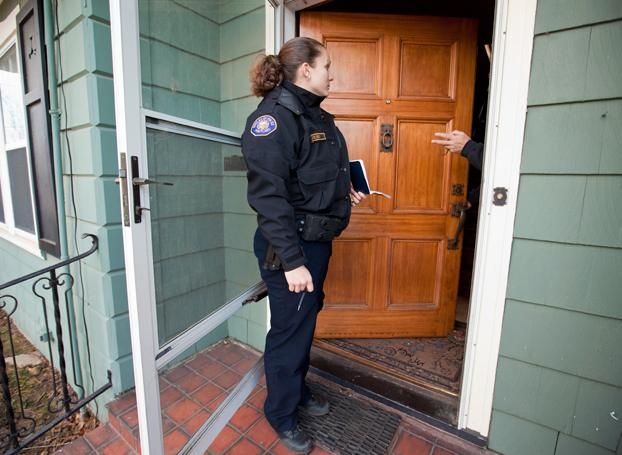
The Portland Police Bureau has a problem with excessive use of force, but the women who serve as officers aren’t to blame.
Across the board, female officers account for a far smaller share of the use of force by Portland police, and represent a tiny share of legal settlements for excessive force compared to male officers. They are also involved in a far smaller share of shootings, relative to their numbers in the bureau.
Female officers in the bureau say they use force when necessary but more often employ other tactics, including what one veteran officer called a “mommy voice,” to de-escalate situations that can lead to a need for force.
Yet the bureau isn’t taking full advantage of the lessons of its female officers. Police officials say only one of the 22 officers in the bureau’s Training Division is female.
“We would be as open as anybody for exploring the disparity in case there is something that can be learned from it,” says Police Bureau spokesman Sgt. Pete Simpson. “If there is something that can be gleaned from it, we want to do that.”
Police officials say they see no reason female officers cannot serve in the same capacity as sworn male officers in the bureau, and police brass continue to try to recruit more women.
“I’m proud of the work that has been done by the [bureau’s] personnel division in their recruiting of women and minorities to the Police Bureau,” Chief Mike Reese said in a statement to WW. “My expectation is that we continue to recruit diverse candidates to the Police Bureau in the years to come.”
Meanwhile, the bureau still has its all-male enclaves—including the Special Emergency Response Team, or SERT. And police officials claim they don’t track even the most basic statistics to help them understand how and why female officers handle situations requiring force differently than men.
“They know it,” says retired Lt. Michelle Lish, who retired from the force in 2006 after 25 years as a Portland police officer. “They might not maintain it, but they know it.”
Portland police have faced allegations of excessive use of force for decades, but the hammer fell in September 2012, when the U.S. Department of Justice reported that the bureau’s “pattern and practice” of excessive force against the mentally ill violated federal law.
The DOJ’s 14-month investigation found the bureau’s officers too often use a higher level of force than necessary; overuse electronic control weapons or Tasers; and use a disproportionate level of force when responding to minor offenses.
The problems go deeper than the cops on the street, the DOJ found, and include “deficient policy and training, as well as inadequate supervision.”
The Police Bureau and the DOJ have reached a settlement aimed at fixing problems cited in the investigation.
The bureau has a proud history that includes hiring the first female police officer in the U.S. and two female police chiefs, including the first female chief of a big-city department. The bureau has known for a long time its female officers use force differently than men. A 2009 report by the city auditor found that Portland’s female officers filed an average of 2.2 use-of-force reports that year; male officers filed an average of 3.2 reports.
WW interviewed a half-dozen female officers. They spoke frankly about the challenges they face in a career that’s legendary for being male-dominated, as well as about specific strengths they bring to police work.
Some agreed to speak on the record, for the first time, about differences in their approach compared to male officers.
“[Using less force] is just the nature of the beast of being a female,” Lish says. “Our nurturing nature makes us more inclined to try to reason, try to mitigate the circumstances, try to de-escalate things.”
To Lish, that “nurturing nature” doesn’t interfere with a female officer’s ability to use force when necessary. She recalled one arrest that briefly landed her in the hospital.
But female officers also bring different communication skills to bear upon sensitive situations. Several of the bureau’s female officers recalled playing the gender card in order to keep Tasers and Glocks in their holsters.
“I remember many times when I really sweet-talked a guy to get him in the back of my car,” says Assistant Chief Donna Henderson, currently the bureau’s highest-ranking female. “[One suspect] was 6-foot-6 and weighed 300 pounds, and there was no way I was going to get into a fight with him.”
She’s not alone.
“I’ve been able to use a mommy voice to get people to stop doing what they’re doing,” said Deanna Wesson-Mitchell, who recently moved from a position as the bureau’s recruitment coordinator to police policy director for Mayor Charlie Hales.
That female officers approach problems differently and use force less doesn’t surprise experts. “It’s a woman’s method for dealing with conflict,” says Roy Bedard, a Florida-based consultant and expert in police procedures. “Women tend to have more mental choices. Men almost default to violence.”
Geoffery P. Alpert, a professor of criminology at the University of South Carolina, adds, “Historically, women officers don’t use the same level or type of force, because they have different communication skills.”
The numbers bear this out. Proportionally, Portland’s female officers are involved in shootings far less often than male officers.
Police spokesman Sgt. Pete Simpson says the bureau doesn’t maintain a database or list of officer-involved shootings—a fact that surprises some experts.
“If you’re having a hard time getting numbers, there’s a problem there, period,” said Bedard, the police consultant. “They need to be more transparent.”
Failing to track such an important aspect of bureau operations isn’t new. The DOJ report called the bureau’s collection and review of force data inadequate. The bureau, the DOJ said, failed “to collect even basic acceptable force investigative data,” and these gaps were “too many to list.” The city’s settlement with the DOJ calls for the bureau to keep better data.
Copwatch, a police watchdog group, has built a database from newspaper accounts and police reports. The group’s database shows female officers were involved in only 5.7 percent of shootings since 1992—just seven of 123 officer-involved shootings.
“So it’s a dynamic of the skills of the female officer and the concerns of the suspects that don’t want to attack a female officer,” Alpert says. “That’s a pattern that [criminologists] have all found.”
Taxpayers have paid out far less in legal settlements for incidents involving female officers.
The city’s Risk Management Division provided WW with a database showing settlements or verdicts for the plaintiff in 90 police cases from 1992 to 2013 coded “use of force.” Since most large payouts received media attention, WW compared the database with news reports and added a handful of large payouts the city’s list didn’t include.
WW’s findings: Fewer than 1 percent of $11.4 million in city payouts since 1992 stemmed from excessive force by a female officer.
One notable case involved Officer Jennifer Thompson, who in 2007 used a Taser on Hung Minh Tran outside the Cheerful Tortoise at the corner of Southwest 6th Avenue and College Street. The city settled for $81,766 after an arbitrator found Thompson shot Tran in the back with a Taser while he was on his knees with his hands on his head.
Arbitrator Alan Bonebrake called Thompson’s actions “unnecessary, unreasonable and an excessive use of force.”
Henderson says the bureau has already made big gains in reducing the use of force. “We’ve really made some huge strides in the last couple of years,” she says, “with our [Crisis Intervention Team] program, [and] training people how to communicate.”
Several police officers interviewed by WW say they believe many people the cops deal with are reluctant to become aggressive or violent with a female officer. “Why officers use force can have complex reasons behind it,” says Simpson, the Police Bureau spokesman. “It could be that suspects are less likely to physically attack female officers. We don’t know that.”
Simpson says another possible explanation for the lower use-of-force statistics for women is that female officers may be given less dangerous assignments. He called patrol duty “the most dangerous job” in the bureau. When he checked, he found that just 14.4 percent of Portland’s patrol officers are women.
That’s close to the overall rate of women on the force, 15.1 percent, and down slightly from the bureau’s historic numbers: 16.7 percent in 2000, according to Copwatch, and 17 percent in 1972, according to an official Police Bureau history.
Until recently, the bureau had no women serving in its Traffic Division. In October, Capt. Kelli Sheffer was assigned to oversee the division after her promotion to captain by Reese in November 2012.
The bureau says no women now serve on the 10-officer K-9 team. Nor are there any women on the 26-officer SERT, which is essentially a SWAT team that responds to the most dangerous police calls, such as hostage situations or calls involving armed, dangerous or barricaded suspects.
The only former female member of SERT, Sgt. Liani Reyna, filed a 2001 complaint with the state Bureau of Labor and Industries alleging she was “forced to resign” after blowing the whistle on the team’s hazing practices, according to reports in The Oregonian.
Her complaint led to discipline against 20 officers, including herself, and the brief disbanding of SERT during the bureau’s investigation.
The Oregonian in 2002 reported BOLI dropped its investigation when Reyna initiated a $1 million lawsuit against the bureau in federal court. She lost a jury verdict in 2005 but continues to work at the bureau.
Police officials say women simply aren’t applying for these jobs. Simpson says only three women applied for the K-9 unit this year, and no women were among the 45 applicants for assignments in traffic or SERT.
Since Reese took over in 2010, bureau recruits have averaged 41 percent minority and female, as opposed to 30 percent from 2005 to 2010, according to Simpson. Reese recently promoted Capt. Sara Westbrook to commander of East Precinct, the largest in the city.
But among the recruits in 2011 and 2012, only 16 percent were women, or about the same as the bureau as a whole.
Part of the problem is the small pool of applicants from which the bureau can draw. Having a diverse police department is “easier said than done,” says Eriks Gabliks, director of the Oregon State Department of Public Safety Standards and Training, the state’s police academy. He says police work isn’t an easy sell for many young women, in Oregon or elsewhere.
“If we have 10 percent [women], that might be average or that might be high,” Gabliks says. “You really have to work with who’s in the pot, and are they qualified.”
Wesson-Mitchell says the bureau could make an administrative change to create promotion opportunities for female officers by returning to a “dual list” policy: using a single test for officers to become either detective or sergeant.
The gender difference between the two jobs is significant: 28.7 percent of detectives are women, compared to 11.8 percent of sergeants, according to the bureau.
Simpson, the police spokesman, says the bureau had such a policy from 1996 to 2001.
Currently, he adds, sergeants and detectives can both apply for lieutenant. “Most lieutenants and above came from the sergeant rank,” he says. “Sergeants are simply better prepared.”
Wesson-Mitchell, however, says detectives have shown plenty of ability to supervise and lead.
“When something happens out on the street, who do they call to come and manage it? Detectives,” she says. “They’re doing supervisory action.”
Mary-Beth Baptista, who recently retired as director of the city’s Independent Police Review Division, says the bureau’s biggest struggle with female officers is not hiring them but keeping them.
“I think they are making sincere efforts, I really do,” Baptista says. “My bigger concern is, once they have more diversity, how do they keep them? Has the bureau really thought about ways to ensure that these [women] feel comfortable there?
“It’s not whether you can find [women officers] to hire. It’s whether they stay and they succeed.”
This article was published by Willamette Week on December 10, 2013.
———————————————————————————
The “Gender Rap” article brought a strong reaction from the Portland Police Bureau, namely the following press release — which, ironically, itself misspelled the name of the writer it was accusing of “inaccuracies”: Willamette Week printed no correction.
Police Bureau Corrects Inaccuracies in Newspaper Article Published Today

Portland Police BadgeDecember 11, 2013 23:12
A recent article, (“Gender Rap,” Willamette Week, December 11, 2013) contained several inaccuracies. Unfortunately the writer, Thatcher Schmid, omitted information that fundamentally affects how the Police Bureau and its treatment of women is portrayed in the article.
The story stated: “Police spokesman Sgt. Pete Simpson says the bureau doesn’t maintain a database or list of officer-involved shootings – a fact that surprises some experts.”
This statement is inaccurate and untrue. The writer requested a list of officer-involved shootings going back two decades broken down by the gender of the officers involved. The Bureau absolutely maintains records of all officer-involved shootings; what the writer was told was the Bureau does not break the officers out by gender.
In addition, the writer states: “Simpson says another possible explanation for the lower use-of-force statistics for women is that female officers may be given less dangerous assignments.”
This statement was never made by Sgt. Simpson and completely fabricated. The writer asked the question: “Are female officers in positions that would put them in harm’s way as much as the men?” Sgt. Simpson responded that patrol duty is “the most dangerous job” in the Bureau, which the article accurately quotes.
Other information provided to the writer which was omitted from the article include:
* The Bureau’s Bomb Squad has one female member out of a total of 6.
* The Bureau’s Crisis Negotiation Team, which often works closely with SERT, has four female negotiators out of a total of 16.
* Both Assistant Chief Donna Henderson and Lieutenant Rachel Andrew promoted upward from the rank of Detective.Women in policing is a topic that deserves attention and thoughtful discussion. The Police Bureau remains committed to recruiting and training women as police officers, and will continue to be transparent and forthright around issues surrounding this topic. It is our hope that when journalists report on this subject, they do so with accuracy and the intent to tell the entire story factually.
###PPB###*************
Media Relations:
Sgt. Pete Simpson
Peter.Simpson@portlandoregon.gov
Desk: 503-823-0830
Pager: 503-790-1779
Portland Police Bureau
1111 SW 2nd Ave, Suite 1526
Portland, Oregon 97204 -

 Leaves Russell released its first full-length, “We Chose the Devil Red,” in March 2013. Unfortunately, the quartet dissolved shortly thereafter. I play violin, viola, mandocaster and sing backup on the album.
The band played the CD release party at the Doug Fir Lounge, and the material was favorably received by the Portland Mercury, The Portland Pick and longtime Portland rock DJ Inessa B, among others.
Here are my three of my favorite tracks on the CD:
-

 Emancipator’s “Dusk to Dawn” was released in January 2013, and received airplay and reviews from top U.S. media. Emancipator, a.k.a. Doug Appling, along with his Ensemble, has been touring the U.S., bringing his focused melodic downtempo to clubs around the country. Doug plays most of the instruments on all his recordings, and favors a pristine, organic tone.
I’m featured on violin and viola on the title track, “Dusk to Dawn,” and violin on “The Way.” Listen at these links:
http://locirecords.bandcamp.com/album/dusk-to-dawn
http://www.vibe.com/article/new-music-emancipator-dusk-dawn-full-album-stream
Doug also has his own label, Loci Records.
-

 East Forest released a full-length LP in Fall 2012. I play violin and viola on three songs. The album’s gotten airplay on OPB and in Europe. Go to eastforest.org for more info, or click on the link below. The project is keyboardist and vocalist Trevor Oswalt’s meditative-yet-funky inspiration.
http://music.eastforest.org/album/love-bomb-lp-5-or-gift-more